During World War II, few aircraft were as surprising—or as effective—as the De Havilland Mosquito. Built largely of wood in an era of aluminum and steel, it delivered speed, versatility, and performance that put it in a class of its own. It wasn’t just a bomber or a fighter—it was whatever the RAF needed it to be. Here are 10 things that make the Mosquito worth knowing if you’re serious about WWII aviation.
It was made almost entirely of wood
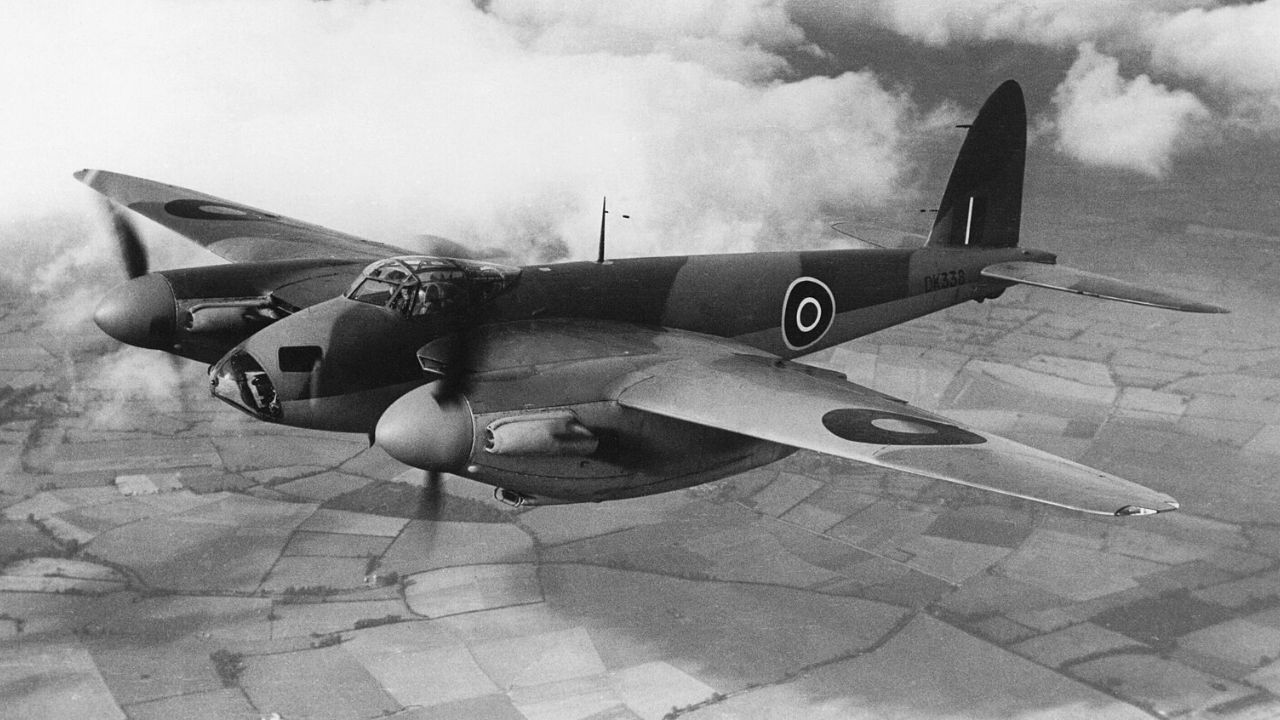
The Mosquito’s wooden structure wasn’t a gimmick—it was a practical workaround. At a time when strategic materials like aluminum were being rationed for frontline fighters, De Havilland leaned on furniture-grade plywood, spruce, and balsa. The fuselage was molded in two halves like a canoe, using a sandwich technique with balsa in the middle. This not only saved weight but also reduced radar visibility—an unintentional stealth feature decades ahead of its time.
It was faster than most fighters of its day

With twin Merlin engines pushing it to over 400 mph, the Mosquito was often faster than the enemy aircraft sent to intercept it. Its top speed was around 415 mph in some variants, even when loaded with bombs or cameras. That made it an ideal unarmed bomber—the logic being, if you’re fast enough, you don’t need guns. In practice, that strategy often worked. German pilots had a hard time catching it, especially during high-speed reconnaissance missions.
It was dirt cheap to build

Compared to heavy bombers like the Lancaster or B-17, the Mosquito cost very little. At roughly £5,000 to £6,000 per unit during the early years, it was significantly cheaper and used fewer strategic materials. Its wood construction also meant it could be built in furniture factories and other non-traditional plants. That dispersed manufacturing model helped it stay in production even under threat of bombing—smart, practical, and fast to turn around.
It could do almost everything

The Mosquito wasn’t just fast—it was flexible. It served as a bomber, photo reconnaissance aircraft, night fighter, pathfinder, intruder, and even a high-speed courier. More than 30 variants were produced during the war, each tailored to a different role. It could carry 4,000 lbs of bombs, mount radar and cannons for night operations, or fly long-range missions deep into enemy territory with a camera instead of guns. That kind of versatility was rare—and extremely valuable.
It played a big role in precision raids

The Mosquito wasn’t just about speed or payload—it was about accuracy. Because of its agility and low-flying capabilities, it was used in raids where precision mattered more than brute force. One of the best-known examples was Operation Jericho, where Mosquitoes breached the walls of a Gestapo prison in France. Their low-level bombing helped free dozens of resistance fighters. Missions like that gave the Mosquito a reputation as the scalpel to the heavy bomber’s sledgehammer.
It handled like a sports car in the sky

Pilots loved the Mosquito for its handling. It had light control forces, impressive roll rate, and smooth responsiveness at high speeds. In many ways, it felt more like a fighter than a twin-engine bomber. That made it perfect for low-altitude runs, evasion maneuvers, and high-G turns. Crews could feel confident flying it in dangerous territory, even when dodging flak or German interceptors. It didn’t just perform—it inspired trust in the cockpit.
It was deadly when outfitted as a fighter

Some Mosquito variants were outfitted with four 20mm Hispano cannons and four .303 machine guns—making them some of the most heavily armed planes in the RAF. These versions were used as night fighters and intruders, intercepting enemy bombers or sneaking behind enemy lines to attack airfields. The Mosquito’s firepower and speed gave it a real edge, especially in nighttime combat where radar and reflexes mattered more than brute force.
It played a key role in electronic warfare

The Mosquito wasn’t just a brawler—it was also an electronic warfare pioneer. Some were equipped with jamming equipment to interfere with German radar, making them useful as pathfinders or decoys during bombing runs. Others carried radar to help intercept enemy bombers at night. This combination of speed, altitude, and technology allowed the RAF to take on a more modern kind of warfare. For a plane made of wood, it had no trouble keeping up with the tech of the day.
Over 7,000 were built—and they lasted

Between 1940 and 1950, more than 7,700 Mosquitoes were produced. They served not only with the RAF but also with the air forces of Canada, Australia, New Zealand, and several other Allied nations. Some Mosquitoes remained in service into the 1950s, flying in roles ranging from aerial survey to training. A few even found postwar fame in civilian hands. For a plane originally considered a risky bet, its lifespan proved just how useful it really was.
Restored examples still fly today

Despite its age and wooden construction, a handful of Mosquitoes have been restored to flying condition. The restoration process is painstaking—wood warps and rots—but the results are worth it. Hearing the twin Merlins at full song is something special. These surviving aircraft now fly at airshows, where they continue to remind people what can happen when you get the engineering, the timing, and the mission just right—even if it’s built out of plywood.
Like Fast Lane Only’s content? Be sure to follow us.
Here’s more from us: