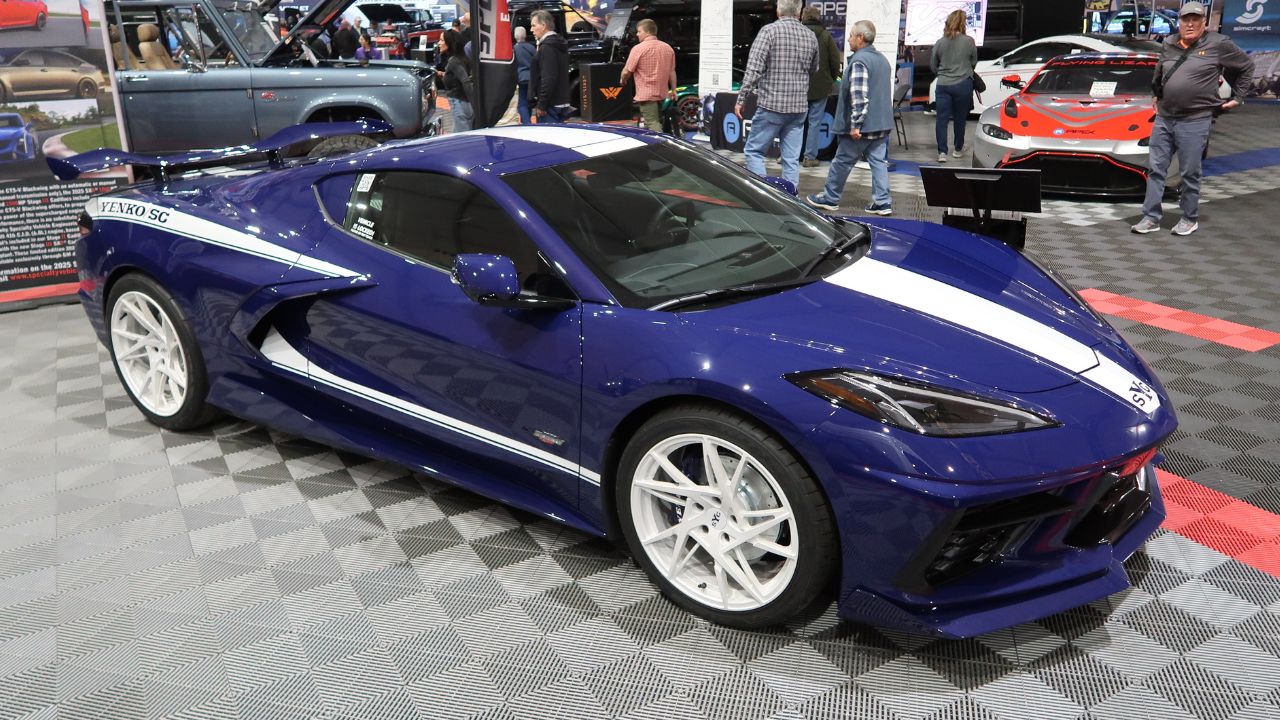
The Yenko Corvette E Ray hybrid takes an already headline-grabbing performance car and turns it into something that reads more like a laboratory experiment in excess. With a quoted output of 1,564 horsepower, it eclipses the 1,250-horsepower ZR1X and enters territory typically reserved for low-volume European hypercars. Rather than abandoning the factory hybrid concept, the build leverages electrification and all-wheel drive to create a Corvette that relies on both technology and power to challenge established hypercars.
That figure of 1,564 horsepower is not a theoretical dyno pull but a target delivered through a structured Stage III package from Specialty Vehicle Engineering, better known as SVE. The result is a car that keeps the everyday usability of the standard Corvette E Ray while adding the kind of acceleration and traction that would have sounded fanciful for a street-legal Chevrolet only a few years ago.
From factory E Ray to 1,564 horsepower statement
The starting point for this project is the production Chevrolet Corvette E Ray, a hybrid all-wheel-drive version of the mid-engine C8 platform that already blends a V8 with electric assistance. SVE treats that car as a foundation and then raises it far beyond the existing Corvette hierarchy, positioning the finished product above even the 1,250-horsepower ZR1X in the internal pecking order of tuned Corvettes. That comparison matters because it shows how far the tuner has gone to ensure the hybrid coupe is not just quick for an electrified Corvette, but a new benchmark for the brand.
To achieve that leap, SVE created the Stage III Yenko/SC package for the E Ray, which centers on a twin-turbocharged interpretation of the factory V8 and a significant recalibration of the hybrid system. The package is offered on both coupe and convertible versions of the Chevrolet Corvette, the Stage III Yenko specification is capped at 50 units, and pricing has not yet been disclosed, underscoring the project’s exclusivity compared with the regular production car. The limited production run and focus on the E Ray platform make this a statement piece rather than a volume tuner special.
The Custom twin turbo V8 and hybrid hardware
The heart of the transformation is a custom-built 6.2L LT2-based engine that retains an aluminum block while incorporating heavy-duty internals to handle four-digit power. SVE specifies a forged steel crankshaft, forged H beam rods, and forged 2618 aluminum pistons, the kind of hardware usually associated with endurance racing rather than a road-going Corvette. Twin turbochargers supply the compressed air that pushes the combustion side of the powertrain to extreme levels, while the factory hybrid front axle remains in place to provide instant electric torque and all-wheel-drive traction.
Fuel delivery receives the same kind of attention as the rotating assembly. Reports on the Stage III Yenko/SC highlight that fuel system upgrades are extensive, including enhancements to both high- and low-pressure components, auxiliary port injection, and flex-fuel capability that allows the engine to run on E85 for maximum output. In parallel, SVE retains the E Ray’s front-mounted electric motor and battery pack, integrating the hybrid controls with the turbocharged V8 so that electric assistance can fill any gaps in boost and sharpen response at lower speeds.
AWD, boost by gear, and daily drivability
Where many high-power builds struggle to put power to the ground, the Yenko Corvette E Ray hybrid leans on its AWD layout and electronic control strategy to manage traction. The original E Ray already sends electric power to the front wheels, and SVE builds on that by incorporating boost-by-gear control that tailors turbocharger output to each ratio. Reports describe the SVE Yenko Ray package as an AWD hybrid upgraded with boost-by-gear control, allowing the car to manage its 1,564 horsepower in a manner the chassis and tires can handle without constant stability system intervention.
The result is a car that aims to be more than a dyno sheet trophy. Coverage labeling the twin-turbo Yenko Ray as the ultimate hybrid Corvette distinguishes it from typical tuned models and presents it as a statement vehicle demonstrating the alignment of engineering and ambition. SVE supports that ambition with a warranty structure and street-focused calibration that preserve the E Ray’s ability to function as a daily driver, even as the powertrain deals with four-digit boost problems and the kind of acceleration that would have been associated with dedicated drag machines in previous generations.
Outmuscling hypercars and the Yenko legacy
Context matters when discussing a four-figure Corvette, and the most striking comparison comes from European hypercars that have long dominated performance conversations. Commentators introducing the build as a hybrid Corvette outmuscling the Bugatti Chiron frame the 1,564-horsepower figure as a direct challenge to established exotics. By exceeding the output of cars such as the Bugatti while starting from a mass-produced American sports car, SVE presents the project as an expression of American tuning culture that relies on engineering rather than rarity alone to command attention.
That positioning also ties back to the Yenko heritage, which stretches from classic muscle cars to modern C8 programs. Earlier coverage notes that SVE has given the hybrid model more power than a Bugatti rival and more output than the 1,250-horsepower in-house ZR1X, reinforcing that the Yenko badge is reserved for builds that exceed factory limits. Social and enthusiast channels that followed the development, including pages that highlighted how the spec sheet reads like a full race program for the Yenko Stage III Chevrolet Corvette Ray, have amplified that message and helped cement the 1,564 horsepower E Ray as a new reference point for what a hybrid Corvette can be.
More from Fast Lane Only