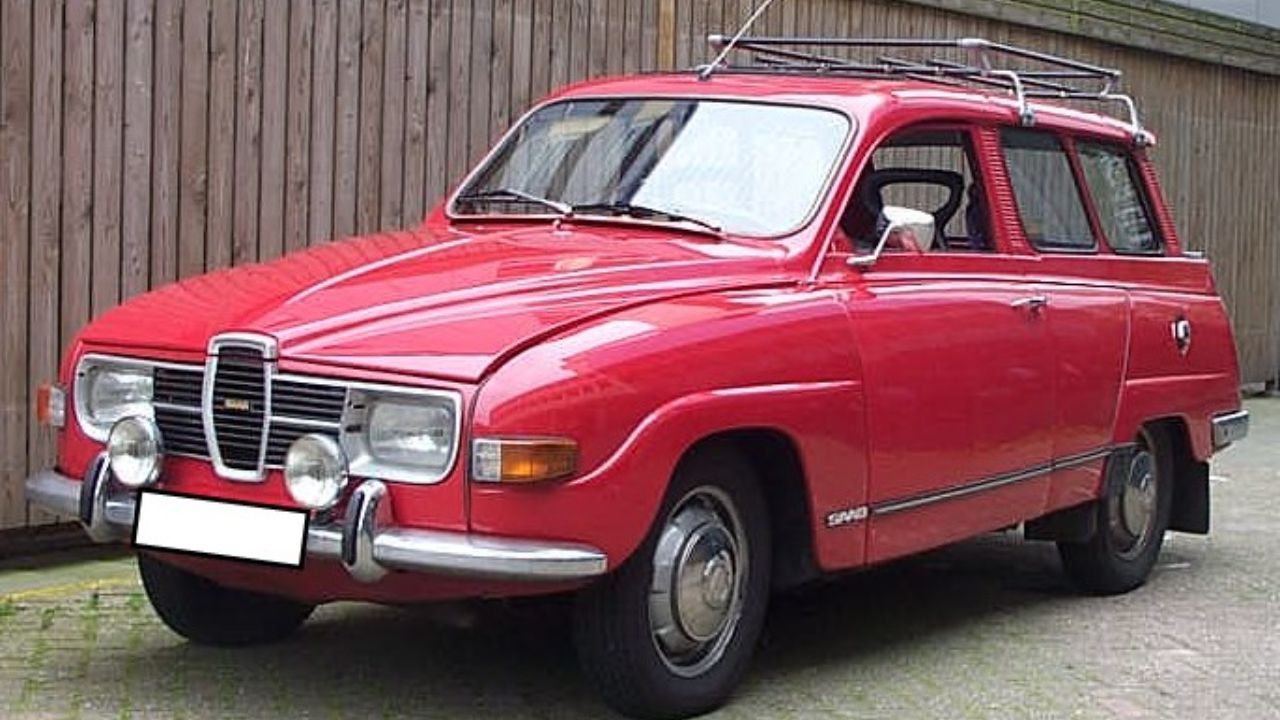
The 1965 Saab 95 is the kind of car that slips past most people, even dedicated enthusiasts, until one appears in traffic and instantly rewrites what a family wagon can look like. Short, upright and faintly aircraft like, it was never designed to chase style trends or brute performance numbers. Instead, it was built around a very specific mission: carry a family of seven in a compact footprint, in all weather, with the kind of mechanical thoughtfulness that defined Saab.
Seen from today’s SUV filled streets, that mission makes the 1965 Saab 95 feel almost radical. It recalls a period when a small Swedish manufacturer tried to solve everyday problems with engineering quirks, two stroke power and a layout that treated space efficiency as a design principle rather than a marketing slogan.
The oddball wagon that seated seven
The basic facts already set the Saab 95 apart. It was a seven seater, two door station wagon built by Saab from 1959 to 1978, an unusually long run for such a niche body style. Contemporary accounts of the 1959 1978 Saab describe a car that prioritized packaging and practicality over fashion. The Saab 95 used a short wheelbase and tall roof to create a surprisingly generous cabin, then layered on a layout that could carry people or cargo with equal ease.
Initially, Saab configured the wagon with an unusual rear seating arrangement that allowed it to claim space for seven occupants without stretching the car to American full size proportions. The two front seats were conventional, the middle bench handled three passengers, and a fold up third row in the cargo area faced backward. That last row is where the Saab 95’s personality really comes through. Children sat looking out the rear glass, feet near the tailgate, with a view of the road that felt more like a train carriage than a car.
This was not a gimmick. At a time when many European families still ran a single car, the ability to carry extra passengers in a compact wagon mattered. The Saab 95’s third row folded flat into the floor when not in use, turning the car into an impressively square cargo box. That dual identity, part people carrier and part load hauler, was central to why Saab built it at all.
From aircraft roots to family wagon
To understand why the 1965 Saab 95 looks and drives the way it does, it helps to trace the company’s path from aircraft to automobiles. Saab began as an aviation firm, and by the late 1950s its engineers were adapting aerodynamic and structural thinking from planes to road cars. Internal histories of the period describe how, as older models were about to be phased out and a successor was not yet ready, Saab created an interim car called the 93 F with a significant new front suspension layout. That detail, preserved in accounts of 93 F development, shows how Saab iterated quickly, using stopgap models to test ideas that would filter into later designs.
The Saab 95 grew directly out of that mindset. The front end shared much with Saab’s small sedans, but the rear half was completely rethought to maximize utility. Saab unveiled the 95 Station wagon as a way to extend its compact platform into family duty without abandoning the company’s preference for front wheel drive and tidy dimensions. Period descriptions of the Saab 95 Station emphasize how unusual it was to see a two door wagon promising seven seats in such a small footprint.
Even the way Saab communicated its history reflects that aircraft heritage. Company produced material on the brand’s origins, including long form presentations that trace how, by the mid 1930s, Saab’s founders were already thinking about conflict, neutrality and the need for self reliance, frame car building as an extension of that engineering independence. In one official chronicle of History of the, the narrative jumps from aircraft fuselages to front wheel drive family cars with a straight line of logic: controlled aerodynamics, safety in bad conditions and structural robustness all carried over.
Why 1965 matters for the Saab 95
By 1965, the Saab 95 had already been on the market for several years, but this point in the model’s life captures its character with particular clarity. The car still relied on Saab’s small three cylinder two stroke engine, a powerplant that defined the brand’s early cars. In valuation data for the 1965 Saab 95, the wagon is described as a 2dr Station Wagon with a 3 cyl 841cc engine rated at 44 horsepower. Those numbers look modest on paper, yet they speak to the Saab 95’s priorities: light weight, traction and usable torque rather than outright speed.
The same family of engines powered the Saab 96 sedan, a car that has gained a cult following in recent years. Enthusiast videos of a 1965 SAAB 96 often highlight how the two stroke three cylinder loves to rev, with a distinctive exhaust note and a driving style that rewards keeping the engine on the boil. The Saab 95 wagon shared that mechanical heart, which meant that under its practical bodywork lived a drivetrain capable of surprising energy.
The choice to keep the two stroke in a family wagon was deliberate. Saab’s engineers knew the engine well and valued its simplicity. The compact block freed up space for the front suspension and steering, while its light weight helped the car maintain good balance even when fully loaded. Owners learned to mix oil with fuel, accept a bit of smoke on cold mornings and enjoy the smoothness that came from a three cylinder firing order.
Engineering for more than errands
The Saab 95 was not just a grocery getter. As the 95 received the four speed gearbox before the 96, which still carried an older three speed unit, it became a favorite among drivers who wanted a more flexible transmission. Contemporary summaries of the Saab 95 and relationship point out that this gearbox advantage meant the wagon was also used for rallying. It is a striking image: a two door family wagon, complete with the potential for seven seats, sliding through gravel stages that most people associate with compact coupes.
This dual role reflects Saab’s broader approach to engineering. The brand was comfortable with overbuilding components and adding complexity if it improved safety or control. Later commentaries on Saab’s cars, including pieces that describe one model as perhaps the most overengineered car ever built, often mention details like the ignition key placed between the seats, the focus on crash structures and the insistence on front wheel drive for stability. In one widely shared video about a Swedish overengineered car, the narrator points to the way Saab owners still talk about their cars decades later because of those quirks.
The Saab 95 fits neatly into that tradition. Its front wheel drive layout provided traction on snow covered Scandinavian roads. The boxy body offered excellent visibility. The car’s structure, though compact, was carefully braced, a habit carried over from aircraft work. Even the wagon’s rear seat arrangement, as odd as it might look now, was the product of detailed thinking about how to carry children safely within a small shell rather than perching them on makeshift jump seats.
The strange genius of the rear seats
The third row of the Saab 95 has become something of an internet curiosity. Modern commentators who study vintage wagons often single out Saab’s solution as especially bold. In one close look at early 1970s wagons, an analyst examining a 1971 Saab layout pauses over the way the rear facing bench folds out of the floor and how passengers are positioned close to the tailgate. The piece, which invites readers to consider what the company was thinking with that arrangement, treats the wagon seat arrangement as both puzzling and strangely logical.
In period context, the design makes more sense. European roads and parking spaces were tight, and fuel was expensive. Stretching the wheelbase to add conventional rear doors and a larger cabin would have undermined the Saab 95’s mission. Instead, Saab squeezed every cubic centimeter of space out of the existing footprint. The result was a car that could serve as a family hauler on weekends, then transform into a cargo van for weekday work, all without growing unwieldy in city traffic.
The rear facing bench also gave the car a social character. Children in that third row often remember waving at drivers behind them, playing games based on license plates and feeling as if they occupied their own compartment. That experience, part practical and part emotional, is a big reason why surviving Saab 95s inspire such loyalty among former owners.
From obscurity to cult favorite
For decades, the Saab 95 remained a niche choice even among classic car fans. Its two door wagon profile and two stroke engine kept it in the shadows while more conventional sedans and sports cars took center stage at shows. Yet a slow reevaluation has been underway. Detailed histories of the Saab 95 in, Spanish language profiles and Persian summaries all treat the model as a distinct chapter in the brand’s story, not just a derivative of the sedans. Finnish enthusiasts maintain their own Saab 95 entry, a reminder that the car’s strongest following remains in northern Europe where it once served as a family workhorse.
Online communities have helped push the car back into the spotlight. Enthusiast sites that catalog the 1959 to 1978 run of the Saab 95 story share period photos, brochures and restoration tips. Social media accounts dedicated to Story Cars features, archival images, owner networks and even Threads discussions treat the wagon as a cult object, celebrated precisely because so few people have seen one in person.
The 1965 model year sits at the heart of that appeal. It captures the car before later mechanical updates changed its character, while still benefiting from early refinements. Collectors who seek out a 1965 Saab 95 often point to the purity of its two stroke drivetrain, the simplicity of its interior and the way its design still feels closely tied to the experimental spirit of late 1950s Saab engineering.
Why the Saab 95 feels relevant again
Modern buyers are surrounded by crossovers that promise to be all things at once, yet few of them feel as focused on a specific problem as the 1965 Saab 95. That car asked how to move seven people, or a surprising amount of cargo, through harsh weather in a compact, efficient package. Its answers involved front wheel drive, a high roof, a rear facing third row and a small but eager engine. None of those choices were made to chase fashion. They were made to solve real needs for families in Sweden and beyond.
More from Fast Lane Only