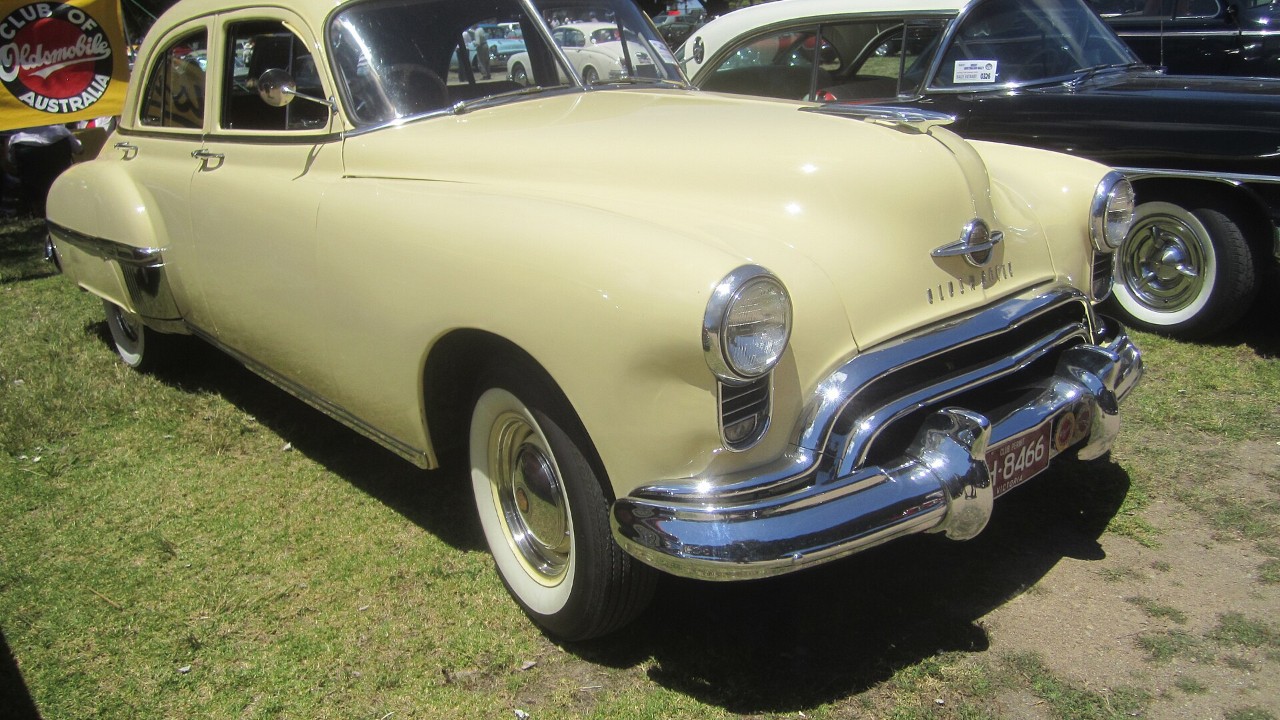
The 1949 Rocket 88 paired Oldsmobile’s lightest body with a new 135-horsepower overhead-valve V8, and stock car drivers noticed at once. Olds 88s won five of the first eight NASCAR Grand National races that year. For a decade that began with wartime rationing, that was a startling turn.
The 1940s were not a horsepower decade on paper. Many engines were flatheads, and civilian production stopped for most of the war. Yet the cars of those years became the raw material for hot rodders and, later, for the gassers that ran on drag strips from the late 1950s. Some came from the factory with more power than anything else on the road.
These are our picks, ten cars from the 1940s we think seemed almost too wild for the drag strip in their day. The verdict is our own opinion. The engines, ratings and production figures behind it come from factory data, marque histories and auction records.
1. 1949 Oldsmobile Rocket 88
Oldsmobile built the 88 by putting its new Rocket V8 into the smaller body from the Series 76. That V8 displaced 303 cubic inches and made 135 horsepower, with a 7.25:1 compression ratio. According to Old Cars Weekly, the 88 rode a wheelbase 5.5 inches shorter than the Ninety-Eight and weighed about 250 pounds less.
That simple recipe of a light body and a strong engine paid off right away. Olds 88s won five of the first eight Grand National races of 1949. Red Byron, an Oldsmobile driver, took the series championship. Hydra-Matic came standard, which made the speed easy to use. In other words, the lighter car carried the same Rocket V8 as Oldsmobile’s flagship.
Our take: we think the 1949 Rocket 88 has the strongest claim of any 1940s car to the start of American performance. Its formula, a big engine in a smaller body, is the same one muscle cars followed later. For a different angle on its launch, see why the Rocket 88 surprised buyers at its debut. If you want one, make sure the car still carries a Rocket V8.
2. 1941 Willys Americar coupe drag car
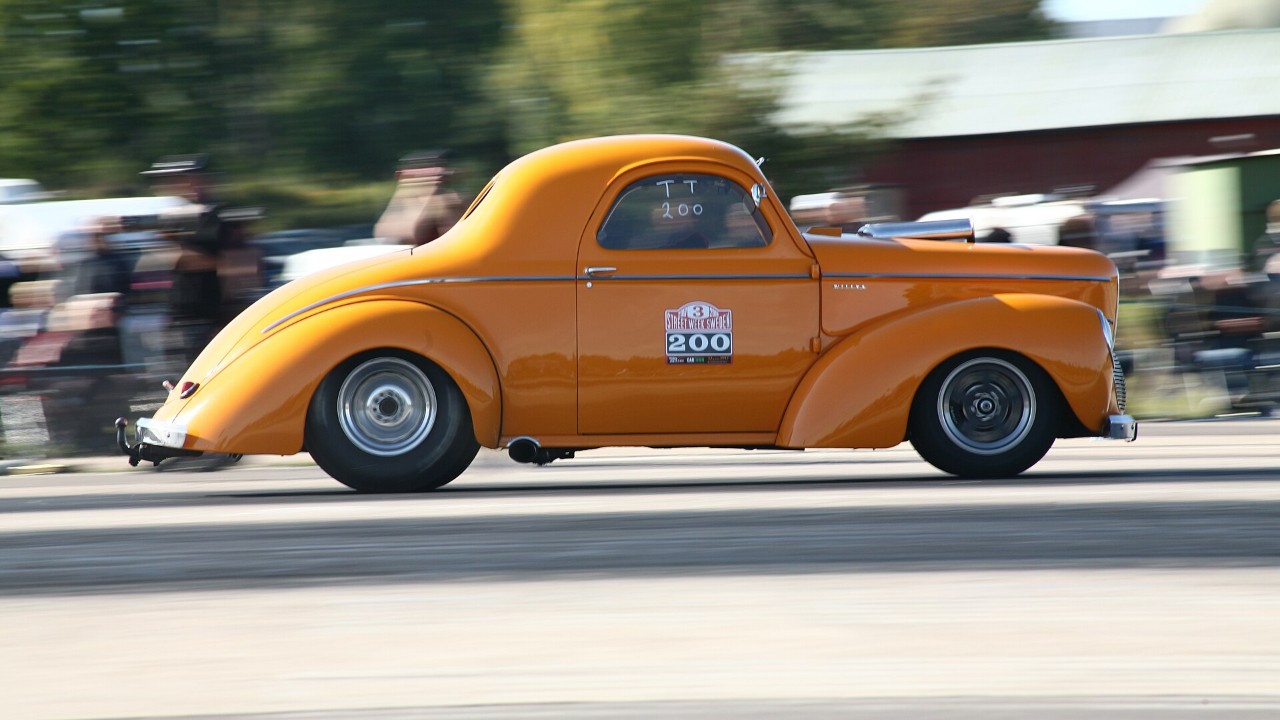
From the factory, the 1941 Willys Americar was anything but wild. Every one left Toledo with a 63-horsepower four-cylinder engine. As Old Cars Weekly notes, many drivers found that engine underpowered even on the highway.
However, the coupe was a featherweight with a short wheelbase, and both traits helped traction off the line. So drag racers stripped them and dropped in far bigger engines. By the late 1950s, the Willys coupe had become a favorite body for the gasser class, with its front end jacked up to shift weight to the rear tires. For example, the Stone-Woods-Cook team’s 1941 Willys ran in A/GS, and Doug Cook won the 1965 Nationals in that class. Similarly, Ollie Olsen’s 1940 Willys coupe, the Wil-A-Meaner, won the A/G title at the 1961 Nationals.
Our take: no 1940s car changed character more completely in the hands of racers. The stock Americar was an economy car. The drag version, in our view, was among the most extreme machines on any strip. NHRA eliminated the gas classes in 1972.
3. 1949 Mercury Eight Model 72 coupe
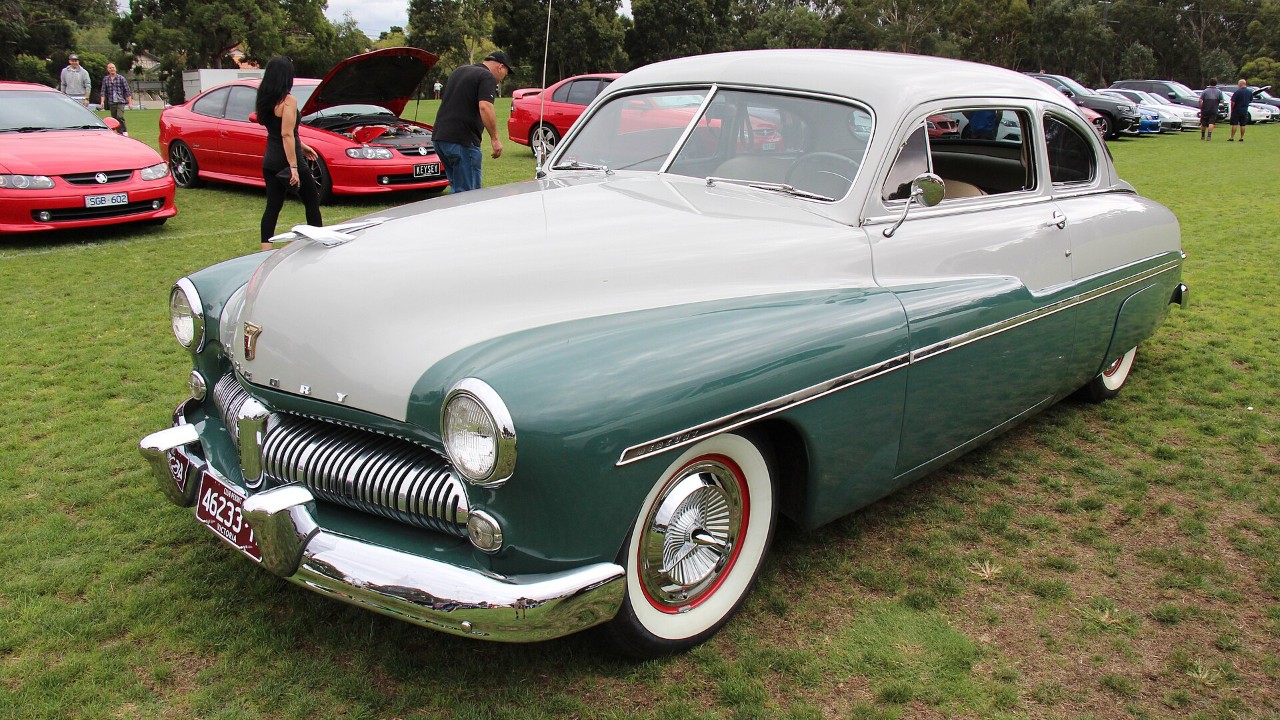
The 1949 Mercury was the brand’s first postwar design. It shared its body with Lincoln and dropped the old freestanding fenders and running boards. Under the hood, the flathead V8 grew to 255 cubic inches and 110 horsepower. The wheelbase, however, stayed at 118 inches. In our view, it was the first Mercury that looked fully modern.
The chassis changed too. Ford replaced the old transverse-leaf setup with independent front suspension, and overdrive became an option. Buyers responded. Mercury sales rose by more than 250,000 from 1948 to 1949, and the brand became the sixth-best-selling make in the country.
Our take: the Mercury’s bigger flathead made it a natural starting point for hot rodders. Then customizers found it too. In 1949, Sam Barris built the first “lead sled” from a Mercury Eight. We covered what came next in when the 1950 Mercury Eight became a custom car icon. In our view, the coupe is the purest version of the shape. If you want one, an unmodified example shows exactly what the customizers started with.
4. 1941 Buick Roadmaster convertible
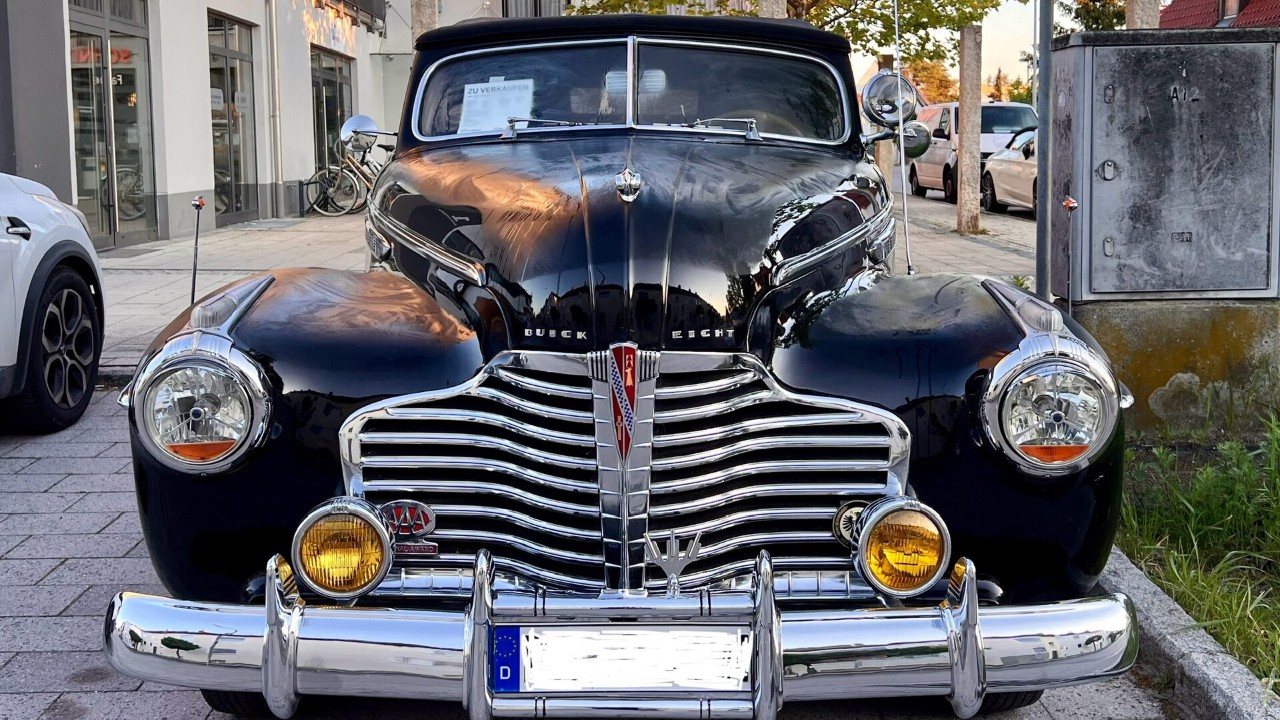
For 1941, Buick gave the Roadmaster’s straight-eight a feature it called Compound Carburetion. It used twin two-barrel carburetors. One worked all the time, while the second opened only under hard acceleration.
Buick also raised compression from 6.6:1 to 7.0:1. As a result, the engine made 165 horsepower, the most powerful engine available in an American car that year. In other words, a Buick straight-eight outgunned every rival on sale in the country. The two-door convertible was a new body style for 1941, and Buick sold 1,845 of them. Buick also offered a Brunn-designed convertible at $3,500, but it received no orders.
Our take: this is the car that held the American horsepower crown on the eve of war. We think that makes the Roadmaster convertible one of the most underrated performance cars of the decade. It looked like a luxury cruiser, but it had the strongest engine on the market. If you shop for one, confirm the compound carburetor setup is complete, since it is central to the car’s story.
5. 1946 Ford Super Deluxe coupe
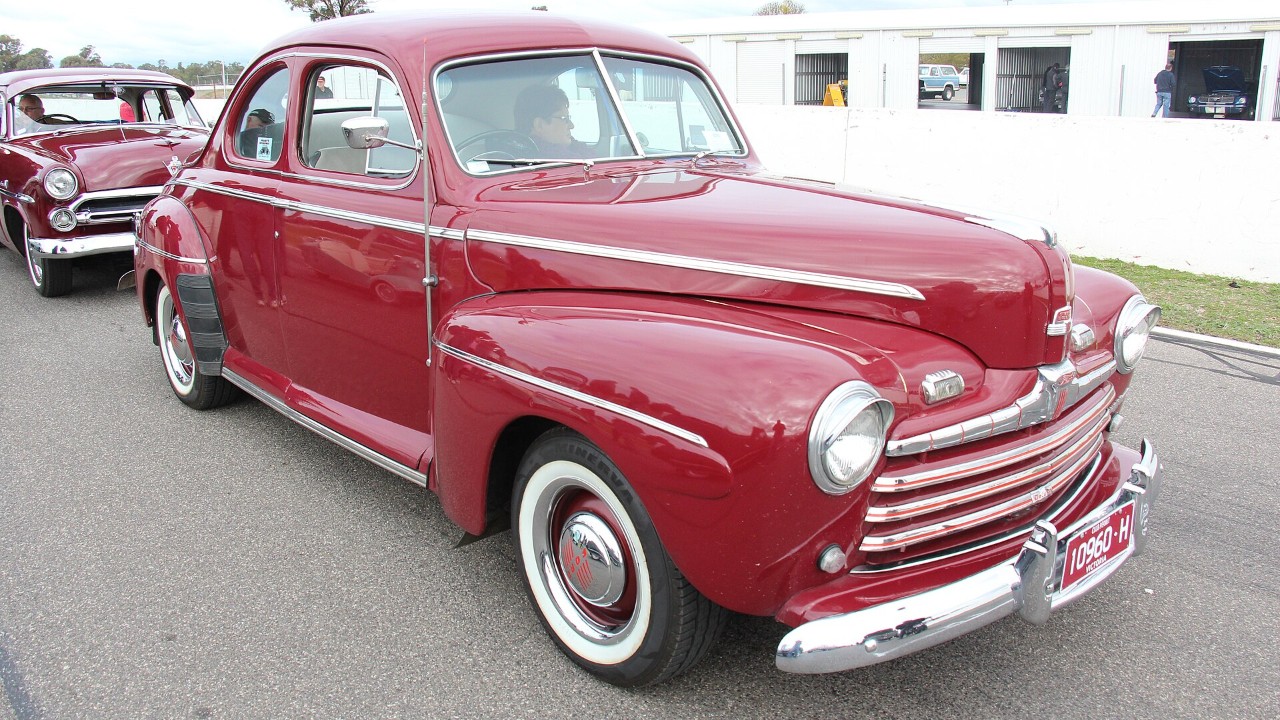
Civilian car production restarted slowly after the war ended in September 1945. For Ford, 1946 was the first model year of the postwar run. Mechanically, the 1946 car matched the 1942 model, but with one important change.
For the first time, Ford rated the 239-cubic-inch flathead V8 at 100 horsepower. Meanwhile, the styling got a heavier grille with horizontal bars and red accents. The Super Deluxe name had marked Ford’s top trim since 1941, when it brought more chrome and a wood-grain dashboard. That year, Ford also built the wood-paneled Sportsman convertible with an electric top. Later, a black 1946 Super De Luxe convertible became a movie star in Back to the Future.
Our take: a light coupe with a 100-horsepower V8 was a lot of car for the money in 1946. In our view, that is why the early postwar Ford became such a common starting point for hot rods. The flathead’s appeal has never faded, as we noted in why vintage flatheads are making a comeback.
6. 1949 Ford Custom Club Coupe
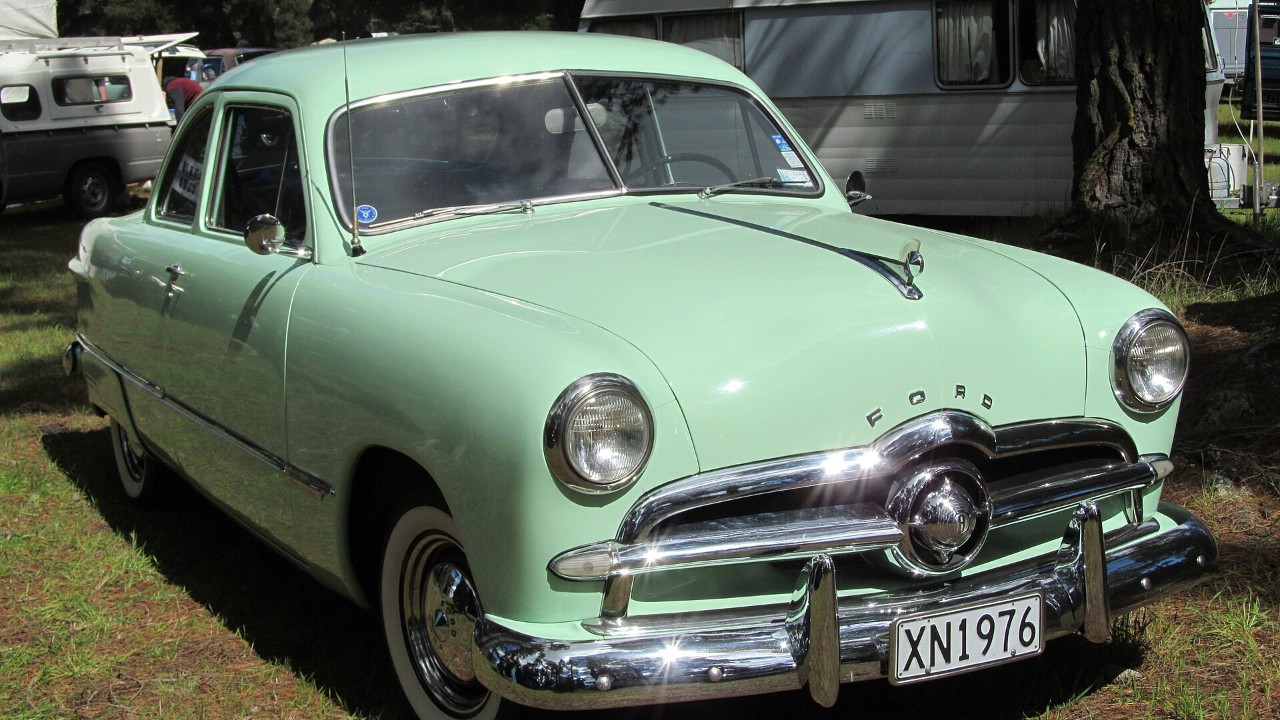
The 1949 Ford was the company’s first all-new car after World War II. Its “envelope” body had integral fenders and smooth slab sides, a sharp break from earlier Fords. In the middle of the grille sat a spinner that looked like an airplane propeller.
According to The Henry Ford, the club coupe in its collection uses a 239-cubic-inch L-head V8 rated at 100 horsepower at 3,600 rpm. It weighs 2,965 pounds, or 29.7 pounds per horsepower. The car cost $1,523 when the average yearly wage was about $3,000. It rode a 114-inch wheelbase and stretched 197 inches long.
Our take: the 1949 Ford was the modern, affordable V8 coupe that a generation of young drivers wanted. In our view, its modest weight and simple layout made it a natural for hot rodders. A Custom Club Coupe is the version to look for if you want the full 1949 look. Today, The Henry Ford displays its example in the Legacy Gallery on the Ford Rouge Factory Tour.
7. 1949 Oldsmobile Ninety-Eight
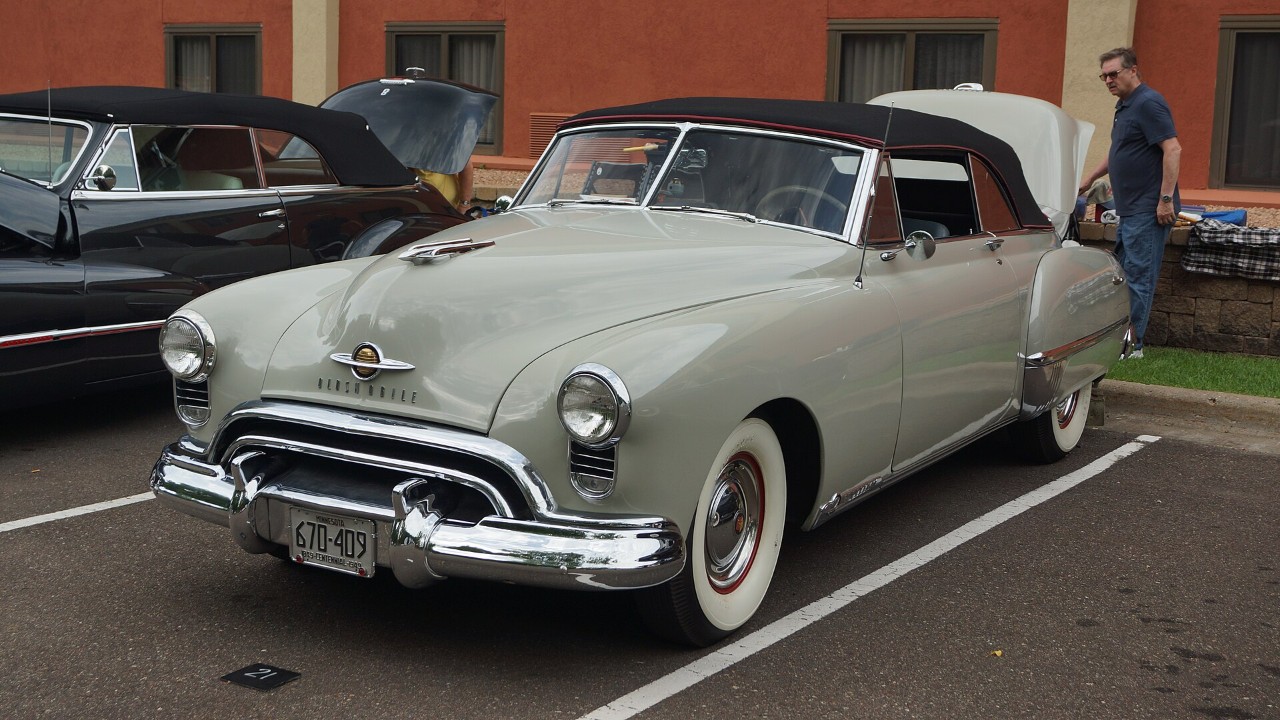
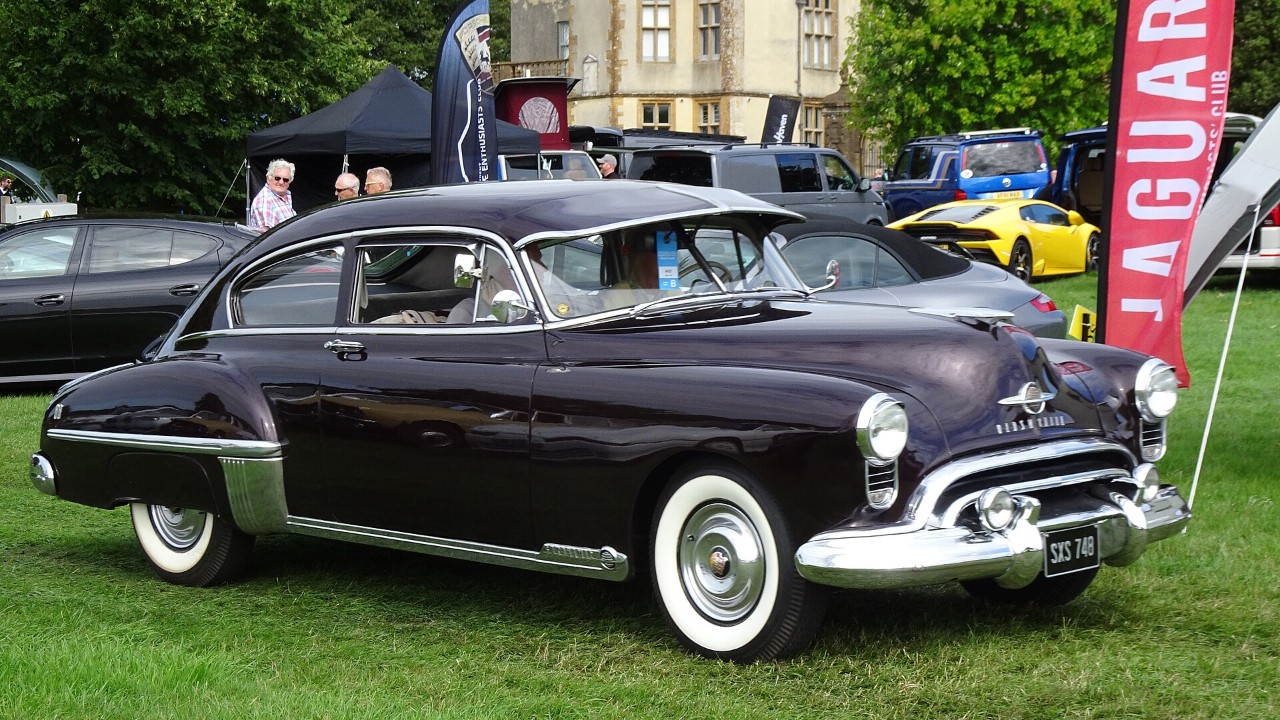
The Ninety-Eight was Oldsmobile’s bigger, more expensive car. For 1949, it got the new Rocket V8 too. Oldsmobile wrapped the launch in a marketing push it called “Futuramic.” The 98 was also the longer car, with a wheelbase 5.5 inches longer than the 88’s. Hydra-Matic came standard, just as it did on the 88.
The 98 also introduced a new body style. In February 1949, the Holiday hardtop arrived, exclusive to the Ninety-Eight that year. Oldsmobile sold 3,006 Holidays and 20,049 club coupes. Oldsmobile priced the Holiday the same as the convertible, which shows how special it thought the car was.
Our take: the 98 carried the same Rocket V8 as the 88 but with more weight. Even so, it gave luxury buyers a level of power that was rare in 1949. We think it is the classier way into the Rocket story. Because the 88 was lighter, it became the racer, while the 98 became the gentleman’s express. If you want the rarest version, look for a 1949 Holiday hardtop.
8. 1949 Lincoln Cosmopolitan convertible
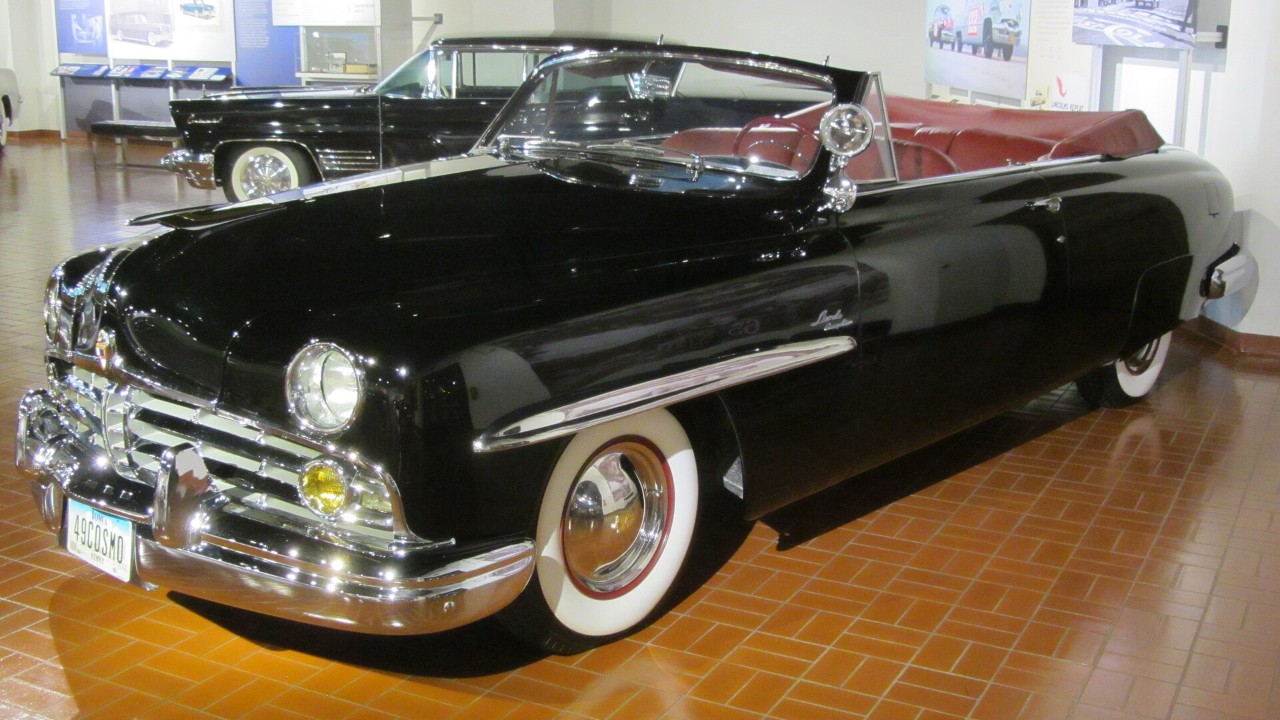
The 1949 Cosmopolitan was part of Lincoln’s first postwar line. It used a 337-cubic-inch flathead V8, the same engine Ford put in its heavy trucks. Few buyers expected to find a truck engine in a luxury car. The 1949 Cosmopolitan came as a two-door, a convertible and a four-door sedan.
The convertible listed at $3,948 when new. It also won powerful fans. Around 1950, the Truman White House leased ten Cosmopolitans, including one armored convertible. Later, in 1954, Eisenhower had a Cosmopolitan convertible fitted with a Plexiglas roof. Nicknamed the “Bubble-top,” it stayed in presidential service until 1965.
Our take: a truck engine in a luxury convertible sounds like an odd idea. In practice, we think it made the Cosmopolitan one of the most effortless big cars of its day. It was never a drag car, but its size and torque made it feel unstoppable. The presidential connection makes any surviving convertible worth a closer look. Henney Motor Company and Hess and Eisenhardt built those White House cars.
9. 1947 Cadillac Series 62 convertible
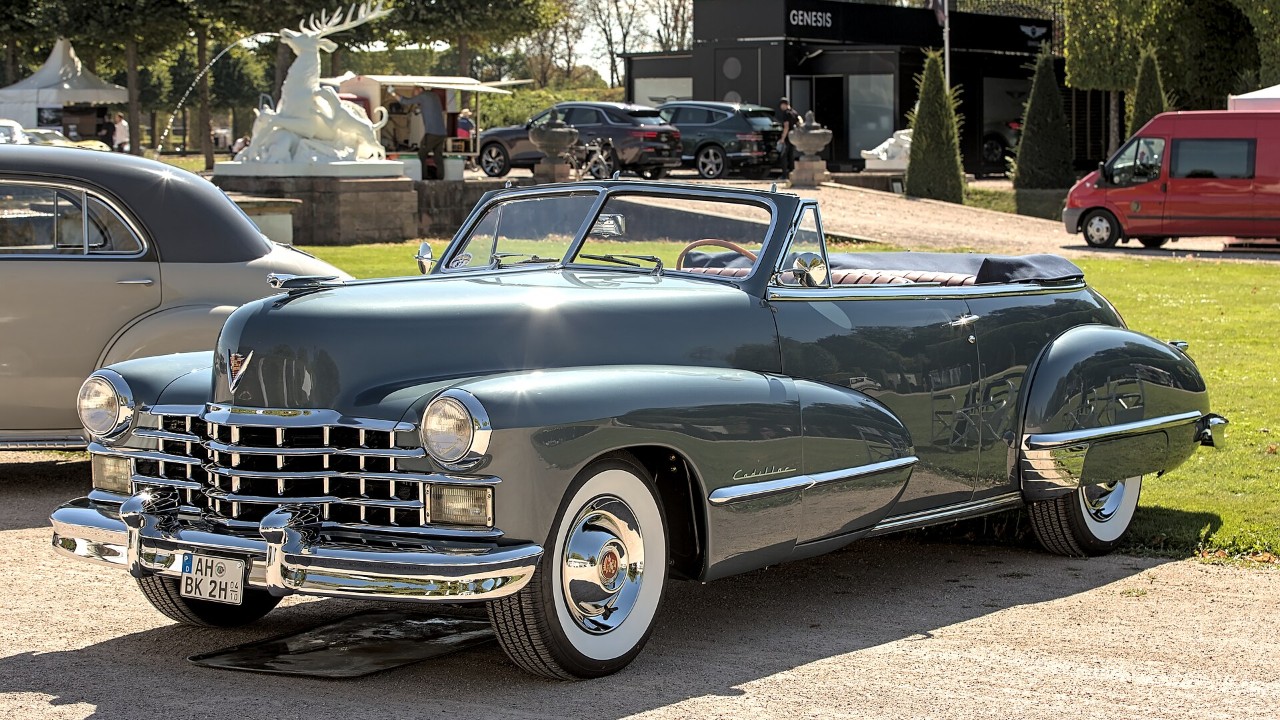
Cadillac used its 346-cubic-inch flathead V8 across the range from 1941 through 1948. Cadillac rated that engine at 150 horsepower when it was new for 1941. By comparison, the 1941 Buick Roadmaster on this list made 165 horsepower from its straight-eight. By 1947, the Series 62 convertible was the only convertible in Cadillac’s lineup.
That year, Cadillac added Hydro-Lectric window lifts to the Series 62 convertible. Altogether, Cadillac built 39,834 Series 62 cars across all body styles for 1947. The next steps came quickly. Tail fins arrived for 1948, and for 1949 Cadillac introduced an overhead-valve 331 V8 rated at 160 horsepower. Meanwhile, Hydra-Matic was fast becoming the norm, and it turned standard in 1950.
Our take: the 1947 convertible was the last flathead Cadillac of its kind before the fins and the new V8. In our view, it marks the end of one era and the doorstep of the next. If you want one, check that the Hydro-Lectric windows work, since they are part of the appeal.
10. 1941 Chevrolet AH Special Deluxe coupe
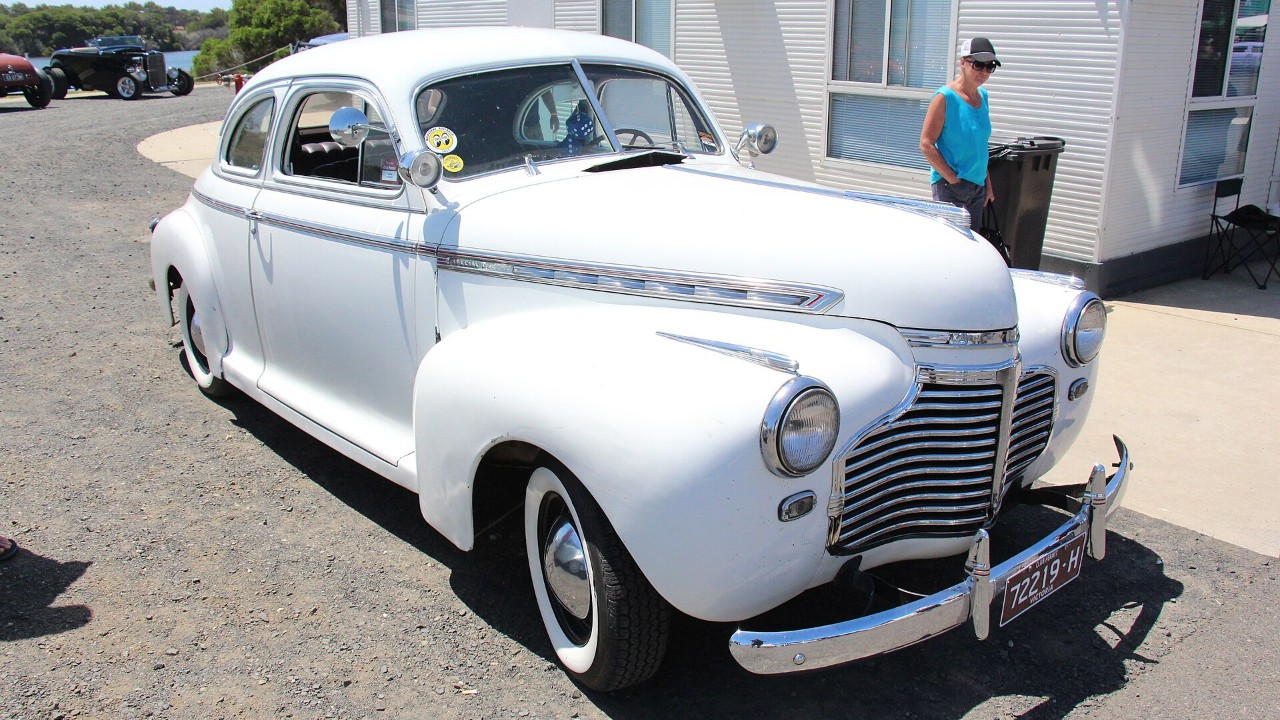
Chevrolet restyled its entire line for 1941. The headlamps moved into the fenders, and the wheelbase grew from 113 to 116 inches. Under the hood, the 216.5-cubic-inch Victory Six made 90 horsepower, up from 85 in 1940. Chevrolet also switched to front-hinged doors and tucked the running boards behind them.
The Special DeLuxe, coded AH, was the upscale series. According to the Antique Chevy Club of Queens, the five-passenger coupe cost $800 and came with a woodgrained dash and a standard clock. Chevrolet’s 1941 model-year production reached 1,020,000 cars. Even so, the war cut the calendar year short, and calendar-year output came to 930,293.
Our take: a six-cylinder Chevy is not a drag car, but in our view its overhead-valve six gave it more spirit than its rating suggests. We think the 1941 coupe is one of the best-looking Chevrolets of the decade. Every model also came with knee-action front suspension as standard. RM Sotheby’s sold a 1941 Special DeLuxe Club Coupe for $34,100.
More from Fast Lane Only