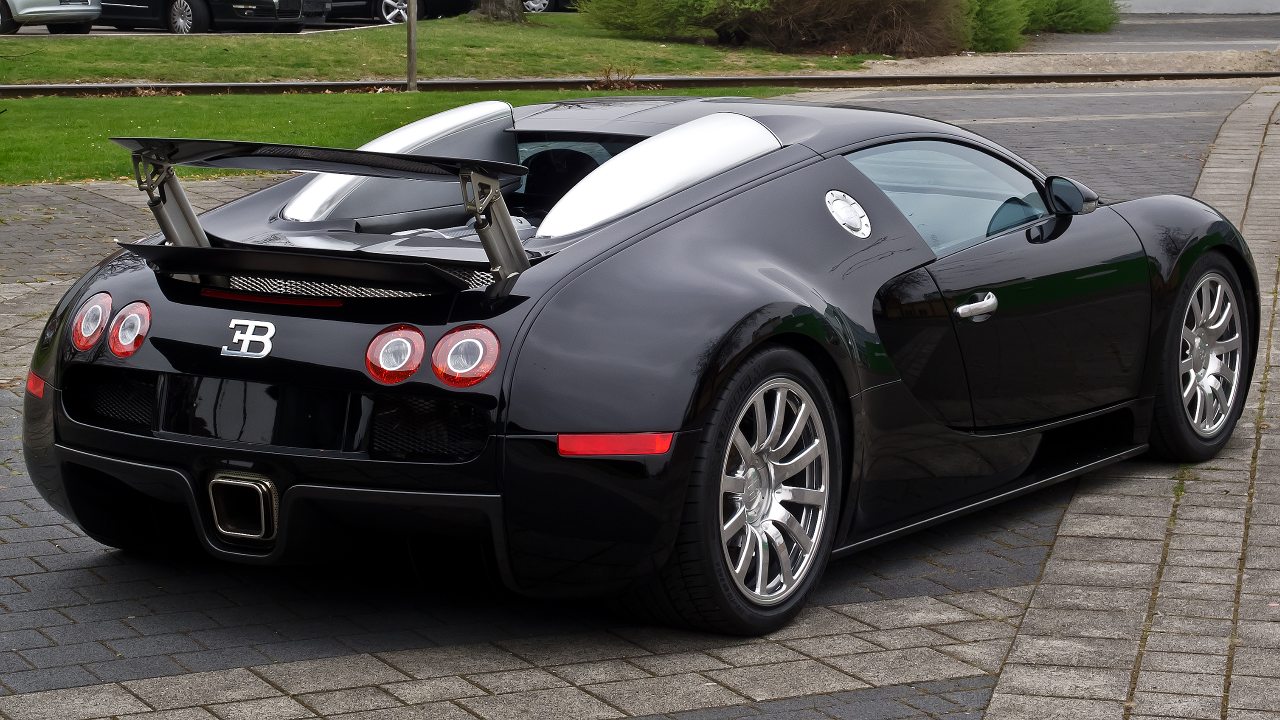
The 2005 Bugatti Veyron did more than nudge the speedometer a little higher. It shattered a psychological and engineering barrier by becoming the first series-production road car verified at over 250 mph, turning a theoretical benchmark into an everyday, if very expensive, reality. In the process, it redefined what a modern hypercar could be, pairing unprecedented speed with luxury, stability, and relative ease of use.
That achievement did not arrive in a vacuum. It was the result of a deliberate decision to build a car that would eclipse everything on the road, combining a 1,000‑horsepower‑class engine, advanced aerodynamics, and a transmission capable of handling forces that previously belonged on a race track, not a public highway.
From ambitious brief to 250 mph reality
When engineers set out to create the Bugatti Veyron, the target was not simply to be faster than rivals, but to cross a threshold that had long seemed out of reach for a road‑legal machine. The goal was a verified top speed beyond 250 mph, a figure that had hovered in enthusiast circles as a kind of mythical ceiling for production cars. Earlier supercars had flirted with extreme velocities, but the Veyron was conceived to make that number repeatable and officially recognized, not just a one‑off stunt.
That intent is reflected in how the car is described in detailed technical references, which identify the core model as the Bugatti Veyron 16.4 and emphasize its role as a production vehicle rather than a prototype or race special. The focus on a true series car, built in multiple copies and sold to customers, is what allowed its 250‑plus‑mph achievement to be framed as a production record rather than a laboratory experiment, a distinction that underpins later analysis of how it changed the market.
The 16.4 powertrain that made history
The heart of the Veyron’s speed record was its powertrain, and the designation 16.4 captures the essence of that engineering. The number refers to sixteen cylinders and four turbochargers, a configuration that delivered roughly 1,000 horsepower while still being packaged for a road car with full interior trim and comfort features. That output was not just a headline figure, it was the enabling factor that allowed the car to push through the immense aerodynamic drag that builds exponentially as speeds approach and then exceed 250 mph.
To translate that power into motion, the Bugatti Veyron 16.4 relied on a sophisticated Transmission listed in technical summaries as a 7‑speed unit, a reminder that the drivetrain had to handle torque levels far beyond typical performance cars. Reports on the model’s development describe how the combination of the 16.4 engine layout and the multi‑ratio Transmission was central to achieving both brutal acceleration and the sustained high‑speed stability needed for a verified run past the 250 mph mark, rather than a brief spike on the speedometer.
How the Veyron became the first 250+ mph production car
What turned the Veyron from a powerful grand tourer into a landmark in automotive history was the way its engineering was marshaled toward a single objective: breaking the 250 mph barrier in a production car. Analyses of its development describe how the project was framed around that specific milestone, with engineers working backward from the required speed to determine power, drag, cooling, and stability targets. The result was a machine that did not just edge past previous records, but reset expectations for what a road‑legal car could achieve.
Coverage of its performance highlights that the car was recognized as the first to push a verified top speed beyond 250, with references explicitly noting the figure 250 and describing how Breaking the 250 m threshold was treated as a defining achievement. One detailed retrospective even frames the story under the line How The Veyron Became The First 250+ MPH Production Car, underscoring that the 250 mph number was not incidental but central to the car’s identity and to the way its record was recorded and remembered.
Redefining speed and usability in the 2000s
Speed alone would not have made the Veyron so influential. What set it apart was the way it combined that 250‑plus‑mph capability with a level of refinement that, at the time, most automakers were not even attempting in their fastest models. Contemporary accounts of the early 2000s note that many brands were focused on more conventional performance targets, while the Veyron project aimed to deliver a car that could cruise comfortably and then, when conditions allowed, accelerate to speeds that had previously belonged to race circuits and closed‑course prototypes.
One detailed look at its legacy describes The Birth Of An Automotive Titan and explains How The Veyron 16.4 Redefined Speed by pairing extreme performance with everyday drivability. Those reports emphasize that, In the context of its era, the idea of a road car that could achieve more than 250 mph while still offering a fully finished cabin and user‑friendly controls was a radical departure from the stripped‑out, track‑biased supercars that had dominated the previous decade.
A 1,000‑hp benchmark that reshaped the hypercar class
The Veyron’s impact was not limited to its top speed figure. By entering production with a power output in the four‑digit range, it became widely recognized as the world’s first 1,000‑horsepower production car, a benchmark that reshaped expectations for the entire hypercar segment. Analyses of the model refer to The Bugatti Veyron 16.4 as the car that normalized four‑figure power in a road‑legal package, turning what had been a theoretical engineering exercise into something customers could actually buy and drive.
Later commentary on the car’s legacy notes that While such numbers might seem more familiar in today’s French hypercars, at the time they represented a step change in what a manufacturer was willing to certify for public roads. That shift in power expectations, combined with the verified 250‑plus‑mph top speed, is why the 2005 Bugatti Veyron is still cited as a turning point for modern performance cars, a machine that forced rivals to rethink both their engineering targets and their sense of what a production car could legitimately claim to do.
More from Fast Lane Only: