Ford’s 1966 Galaxie 500 arrived in showrooms wearing conservative full-size sheetmetal, but buyers who checked the right boxes could drive home with serious big-block power hidden under all that chrome. In an era when muscle cars were grabbing headlines with flashy stripes and mid-size bodies, this quiet full-size Ford could be ordered with engines that turned a family sedan into a surprise threat at the stoplight. That contrast between understated design and unexpected performance is what keeps the 1966 Galaxie 500 fascinating for enthusiasts today.
What happened
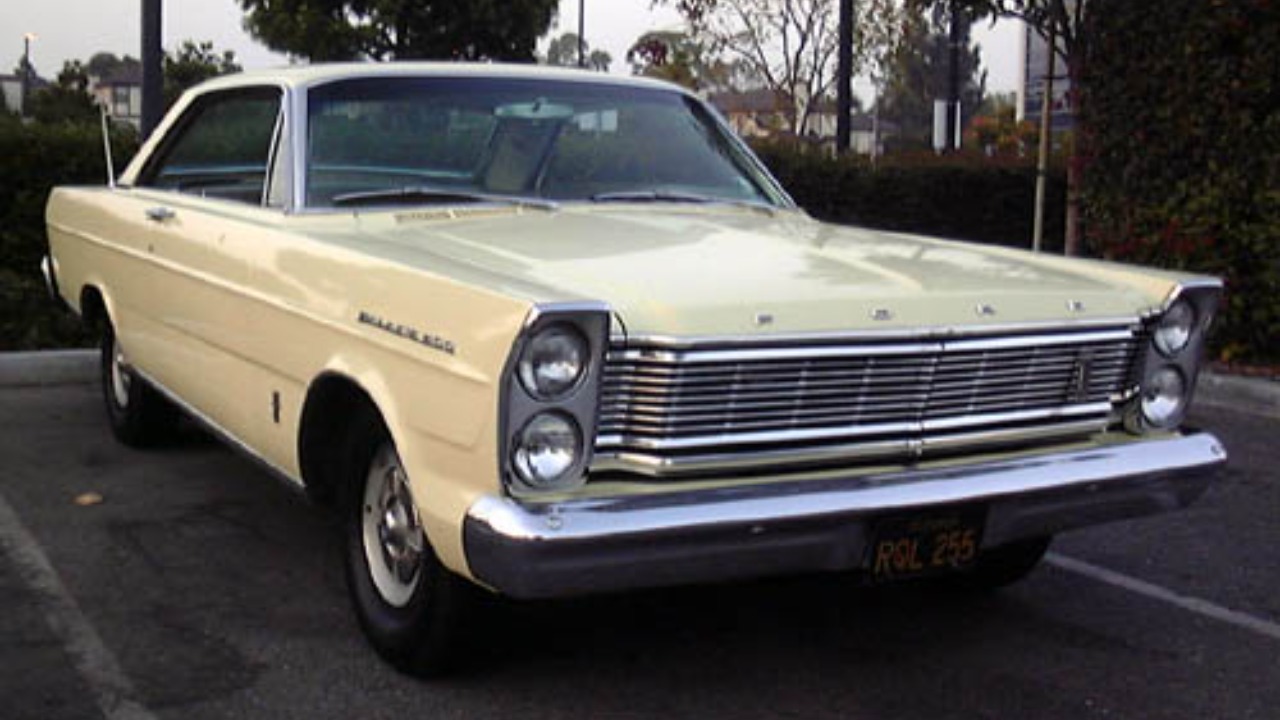
By the mid 1960s, Ford’s full-size line sat at the core of the company’s business. The Galaxie 500 occupied the volume sweet spot, positioned above the base Custom and below the plusher LTD. For 1966, the car rode on a perimeter frame with coil springs up front and leaf springs in the rear, carried over from the prior generation but dressed in new, more squared-off bodywork. Styling was clean and linear, with stacked headlights, a broad grille, and long slab sides that made the car look bigger than it already was. That conservative shape did little to hint at what could be ordered under the hood.
Ford’s powertrain catalog for the 1966 Galaxie 500 started modestly with a 240 cubic inch inline-six and small-block 289 V8, both aimed at buyers who cared more about price and economy than speed. The story changed quickly as the option list climbed. The 352 cubic inch FE-series V8 returned as the first big-block step, followed by the 390 in several states of tune. Above those sat the 428 cubic inch FE, which gave the Galaxie serious torque and highway passing power. At the top of the pyramid, Ford made the 427 cubic inch race-bred V8 available in limited numbers, turning a seemingly ordinary full-size car into a genuine performance weapon.
That 427 option came in two main versions: a single four-barrel carburetor rated around 410 horsepower and a dual-quad configuration advertised at 425 horsepower. Both were high-compression, solid-lifter engines that owed more to Ford’s NASCAR and drag racing programs than to typical family sedans. Buyers could pair these engines with a four-speed manual transmission and heavy-duty suspension hardware, effectively creating a street-legal counterpart to the Galaxie stock cars that were running on high-banked ovals.
Ford did not market the Galaxie 500 as a pure muscle car, at least not in the way it promoted the Mustang or the Fairlane GT. The big car remained a full-size model first, with bench seats, generous trunk space, and a wide range of trim levels that included sedans, hardtops, and convertibles. At the same time, the company quietly allowed performance-minded customers to combine luxury or family-friendly body styles with the most aggressive engines. That meant a buyer could order a 1966 Galaxie 500 two-door hardtop with a 427 and four-speed, or even a four-door sedan with a 428, and still present it to neighbors as a respectable family car.
The Galaxie’s big-block story did not unfold in isolation. Ford had been experimenting with high-performance full-size cars since the early 1960s, when 406 and 427-powered Galaxies dominated drag strips and speedway qualifying sheets. By 1964, those race-focused packages were already filtering into street cars, even as many ended up neglected once their competitive edge faded. One abandoned 1964 Galaxie 500, left in the woods for 43 years before being rediscovered, illustrates how some of these once potent cars slid into decay despite their performance pedigree, as shown by a detailed look at a neglected example.
By 1966, Ford had refined the formula. The Galaxie 500 could be had with power steering, power brakes, air conditioning, and upscale interiors, all while hiding a big-block that could embarrass smaller, lighter cars. This mix of comfort and speed made it attractive to buyers who wanted performance without giving up full-size space or a relatively conservative appearance.
Why it matters
The 1966 Galaxie 500’s performance options matter because they show how the muscle car era was never limited to mid-size coupes with stripes and spoilers. Full-size cars like the Galaxie blurred the line between family transportation and high-performance machinery. For many buyers, especially those with families or towing needs, a big car with a big engine made more sense than a smaller, more overtly sporting model. The Galaxie 500 delivered that combination without shouting about it.
In historical context, the car sits at a crossroads. On one side stood the traditional American full-size sedan, focused on comfort and presence. On the other was the rapidly growing muscle car movement, defined by cars like the Pontiac GTO and the Chevelle SS. The Galaxie 500 straddled both worlds. Its base versions appealed to conservative buyers, while the big-block variants gave Ford an answer for performance-minded customers who still wanted a substantial, quiet-riding car.
From a technical perspective, the big-block Galaxies served as rolling testbeds for Ford’s FE-series engines under real-world conditions. These cars put high-output powerplants into the hands of everyday drivers, not just racers and enthusiasts. That exposure built brand loyalty among customers who associated Ford with serious performance, even if they never set foot on a drag strip. It also helped justify continued investment in big-block development at a time when competition from rival manufacturers was intense.
The Galaxie 500’s understated nature also shaped its legacy. Many of the most powerful examples were not treated as collectible exotics when new. They were driven hard, used for towing, or simply traded in when fuel costs or changing tastes made them less practical. That pattern explains why some high-spec cars ended up in rough condition decades later. The 1964 Galaxie 500 left to rot in the woods is a stark case study in how performance heritage did not always protect these cars from neglect. For every surviving 1966 big-block Galaxie that now commands attention at auctions, there were others that quietly disappeared.
Collectors and historians now look back at the 1966 model year as a key chapter in Ford’s full-size performance story. The availability of the 427 in a mainstream model, even in small numbers, gives the car a direct link to Ford’s racing successes. At the same time, more common 390 and 428-powered Galaxies represent the broader trend of big-engined family cars that defined mid 1960s American motoring. Those cars were the workhorses of daily life, hauling families and luggage while still delivering the kind of straight-line speed that became a cultural touchstone of the era.
The Galaxie’s big-block heritage also influences how enthusiasts approach restoration and preservation. Because many of these cars were built in relatively ordinary trim levels, verifying original engine and option combinations has become a detailed detective exercise. Build sheets, data plates, and period documentation play a central role in determining whether a given 1966 Galaxie 500 left the factory with a 427, a 428, or a more modest powerplant. That complexity adds both challenge and intrigue for collectors who value authenticity.
There is also a broader cultural angle. The idea of a large, comfortable car that can surprise modern traffic with unexpected speed continues to resonate. Contemporary performance sedans and sleepers, from turbocharged family wagons to high-output pickup trucks, follow a template that cars like the 1966 Galaxie 500 helped establish. The appeal lies in the contrast between appearance and capability, a theme that runs through decades of enthusiast culture.
For Ford’s brand image, the Galaxie’s performance credentials reinforced the message that the company was serious about power across its lineup, not just in halo models. Customers who might have been drawn to a Mustang for its image but needed more space could find a compromise in a big-block Galaxie. That flexibility helped Ford compete across multiple segments at once, from family sedans to performance icons.
What to watch next
Interest in full-size performance cars from the 1960s has been climbing, and the 1966 Galaxie 500 sits near the center of that trend. As more collectors look beyond the usual muscle car favorites, attention is shifting toward big cars with genuine performance options. This shift has several implications for how the Galaxie 500 will be treated in the coming years.
First, documentation will become even more critical. As values rise, the difference between a genuine big-block car and a later engine swap will have a larger effect on price and historical standing. Enthusiasts and buyers will increasingly scrutinize VIN codes, casting numbers, and period paperwork to separate authentic factory builds from later recreations. That scrutiny will likely push owners of surviving cars to track down whatever records they can find, from original sales invoices to dealer order forms.
Second, the restoration philosophy around these cars is evolving. Some owners are pursuing full, factory-correct restorations that return the car to showroom specification, complete with period-correct finishes and options. Others are embracing restomod approaches that retain the original big-block character while updating suspension, brakes, and safety equipment for modern driving. The 1966 Galaxie 500’s generous engine bay and robust frame make it a popular candidate for both paths.
Third, there is growing interest in the stories behind individual cars. Because the Galaxie 500 served so many roles, from family cruiser to tow vehicle to street racer, each surviving example often carries a unique history. Some were ordered by enthusiasts who knew exactly which performance options to select. Others were bought by families who simply wanted the most powerful engine for highway travel, with little thought to quarter-mile times. Tracing those histories helps bring the broader narrative of 1960s America into sharper focus, connecting personal experiences to the larger arc of automotive culture.
On the preservation front, the contrast between well-kept survivors and long-abandoned cars will likely become more pronounced. The rediscovery of neglected Galaxies, like the 1964 example left in the woods for decades, highlights how many cars slipped through the cracks. As values rise, more of these forgotten cars will be pulled from barns, fields, and garages, sparking debates about whether to restore, preserve as-found, or use them as donors for other projects. Each choice reflects a different philosophy about how to honor the car’s history.
Looking ahead, the 1966 Galaxie 500’s place in Ford’s performance heritage is likely to gain more formal recognition. Enthusiast events and marque-specific gatherings increasingly highlight full-size performance models alongside better-known muscle cars. As knowledge spreads about the availability of engines like the 427 and 428 in a seemingly ordinary family car, the Galaxie’s sleeper reputation will only grow stronger.
There is also a generational element. Younger enthusiasts who grew up around imports and modern performance cars are discovering the appeal of big, comfortable American V8s. For some, the idea of a full-size Ford that can cruise quietly on the highway yet deliver strong acceleration when asked offers a different kind of thrill than a high-revving compact. That crossover interest may help sustain demand for Galaxies as the original buyer generation ages out of active ownership.
More From Fast Lane Only: