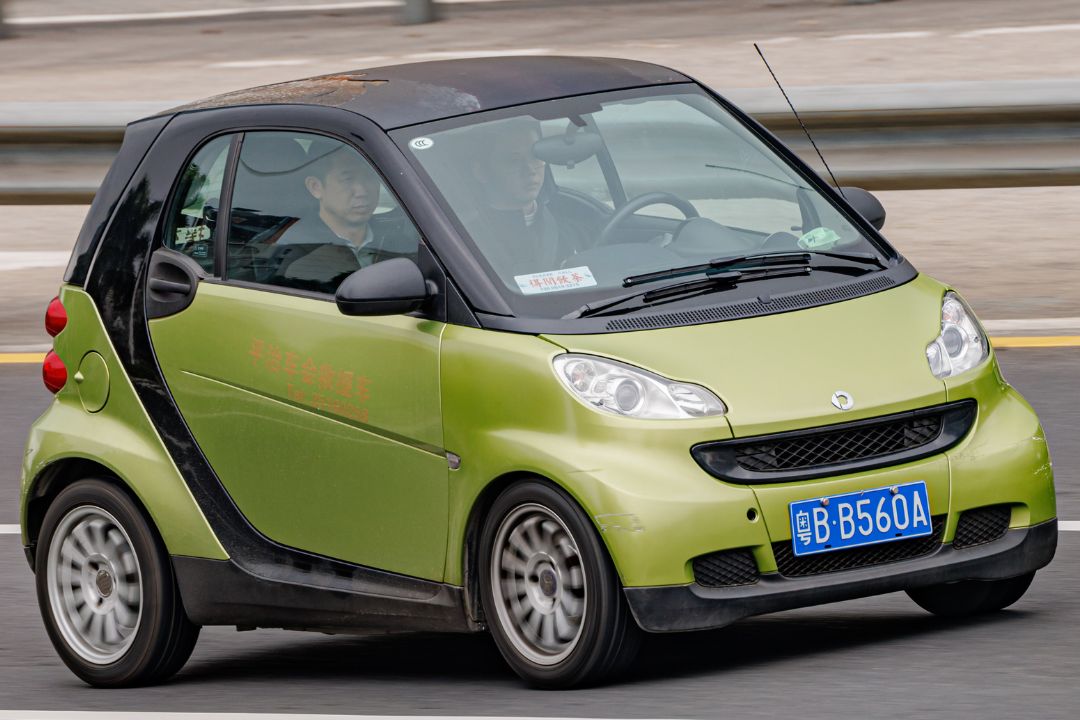
A Smart Fortwo is supposed to be many things. Small, cheap, easy to park, and probably more useful in a crowded city than it has any right to be.
It is not supposed to have a supercharged Suzuki Hayabusa engine.
But someone decided that was exactly what this little car needed.
What started life as a Smart car has been turned into a seriously strange machine, complete with a supercharged Hayabusa engine running on E85, a custom gear-driven gearbox, a sequential shifter, beadlock rear wheels, and a hydraulic handbrake. It still looks like a Smart. It just happens to be a Smart that has absolutely no business being this angry.
Why a Hayabusa Engine Changes Everything
The biggest change is sitting where you would expect to find the original Smart powertrain. Instead, there is a supercharged Suzuki Hayabusa engine running on E85. And this is not simply a motorcycle engine dropped into a car and left alone. The engine has upgraded rods, crankshaft, pistons, and camshafts, while a Holley Dominator ECU handles the engine management.
That turns the little Smart into something much more serious than its original design ever intended. The engine also sounds exactly like the sort of thing you would expect to find in a heavily modified race car rather than a tiny city car. When it is fired up and revved, the contrast is almost ridiculous. The Smart looks tiny. The engine certainly does not sound tiny.
The Transmission Is Just as Crazy
Putting a Hayabusa engine into a Smart was apparently not enough. The car also uses a custom gear-driven gearbox, making it the first Smart car, according to its builder, to use this type of setup. The clutch is also far removed from anything you would expect in a normal Smart. It uses an air-actuated lockup clutch integrated with a Snow Performance system and the car’s tune.
Inside, the transmission is controlled through a sequential shifter. First gear is forward, and after that, the driver works through five steps backward. It is the kind of setup that makes you realize how far this build has moved from anything resembling a normal Smart Fortwo.
Even the Wheels Had to Be Upgraded
The powertrain is not the only part that needed attention. The car has been converted to five-lug hubs and runs beadlock wheels at the rear. There is a very good reason for that. As the builder explains, the car likes to spin the rear tires on the wheels, so the beadlocks help keep everything together when the tires are being abused. That detail tells you quite a lot about what this Smart is actually built to do. This is not a cosmetic engine swap. The rest of the car has been modified around the demands of the new powertrain.
Inside, It Looks More Like a Race Car
The interior gives away another part of the story. There are aftermarket bucket seats, a custom steering wheel, three pedals, a hydraulic handbrake, and a push-button start. There is also a fire extinguisher, which feels like a fairly sensible addition once you know what is sitting behind the seats.
Even the sunroof has been wrapped in black, and small details like spare fuses kept in the dashboard round out the build. It still has some of the everyday features you would associate with a Smart, including working power windows, but everything around them has been turned toward performance.
The Smart Doesn’t Look This Mad Until It Moves
This is where the build really makes sense. Parked in the daylight, it is a bright chartreuse Smart with black graphics, beadlock wheels, and a rear wing. It is unusual, but it is still recognizable as the tiny car that was designed to squeeze into city parking spaces.
Then the engine starts. The car has been shown doing high-revving donuts and burnouts, and suddenly the whole idea becomes much easier to understand. The supercharged Hayabusa is not there because someone wanted to make a funny engine-swap project. It is there because someone wanted to turn one of the least threatening cars on the road into something completely ridiculous.
There are no confirmed horsepower figures, quarter-mile times, or top-speed numbers for this build, so there is no need to invent them. The hardware tells enough of the story: a strengthened Hayabusa engine, E85 fuel, a supercharger, a custom gear-driven gearbox, a sequential transmission, and beadlocks because the rear tires can spin on the wheels. That is not a normal Smart Fortwo. It is a very small car built around a very big idea: take something nobody expects to be fast, give it a motorcycle engine, and see just how far the idea can go.