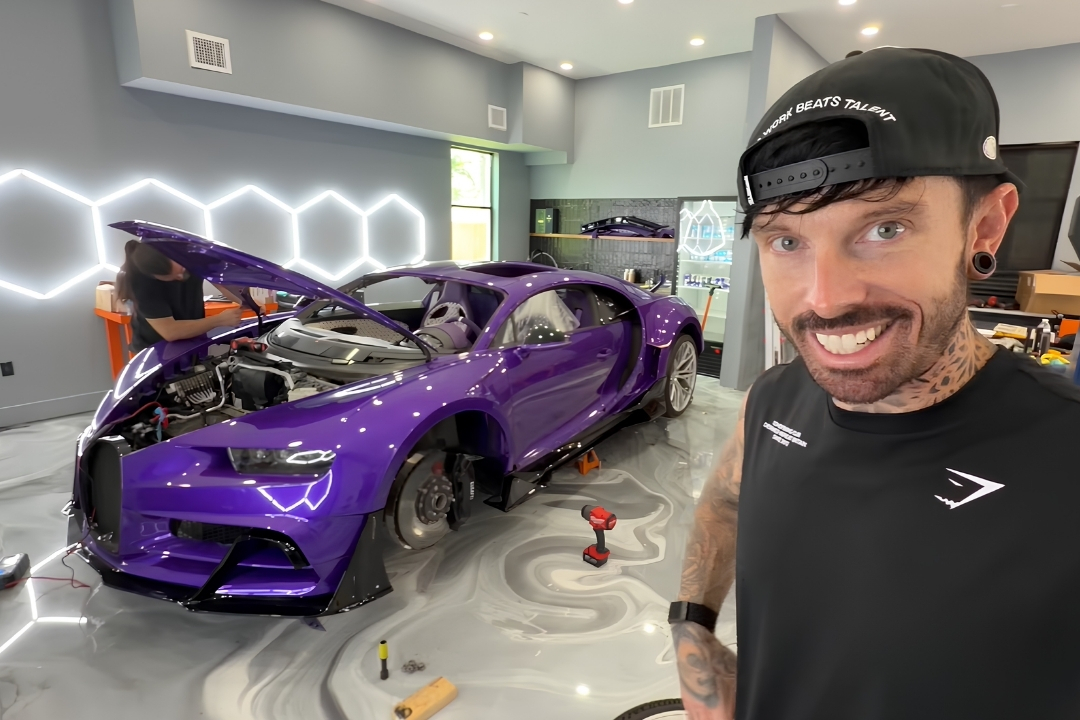
A Bugatti Chiron does not come apart easily, and it does not go back together easily either. When Alex’s Chiron ended up wrecked, the front end took the worst of it, with the crash forcing its carbon components backward hard enough to push the hood hinges out of alignment. Getting a car like that road-ready again usually means one thing: sourcing exact factory replacement parts, whatever the cost.
Except Bugatti wouldn’t sell Mat Armstrong’s team the hinges at all. For a car built with one of the highest price tags in the industry and a reputation for doing everything the correct, factory way, that left the team with a genuinely strange problem: how do you rebuild one of the most exclusive cars on earth when the manufacturer won’t sell you the piece you need to finish it?
The answer turned out to involve a machine shop vice, a lot of patient bending, and a latch mechanism borrowed from a Volkswagen Touareg.
When the correct part isn’t an option
Mat was upfront about how much easier this could have been. Replacing bent hinges outright is the standard fix for even minor hood damage, since straightening a mangled hinge by hand eats up hours that a new part would eliminate in minutes. But with Bugatti unwilling to supply them, that option was off the table entirely, leaving fabricator Bob to work the damaged hinges in a vice, bending, twisting, and cutting relief slots to coax them back toward their original geometry.
It was slow, iterative work. The team repeatedly test-fitted the bonnet, checked clearance against the front fenders, adjusted, and tried again, at one point elongating the mounting bolt holes just to pull the panel a few more millimeters into place. Eventually the hinges were tacked, welded, and cleaned up enough that the bonnet sat close enough to right that the team could move on.
The Volkswagen solution
The latch was a separate problem, and this is where the Touareg came in. Rather than trying to rebuild the Chiron’s original latch mechanism, the team fitted a lighter aftermarket unit sourced from a Volkswagen, using it to hold the front of the bonnet in position while the rest of the panel alignment was worked out around it.
It’s a strange detail to sit with. Bugatti sits under the same corporate umbrella as Volkswagen, so the parts-bin logic isn’t as far-fetched as it first sounds, but there’s still something almost absurd about one of the most expensive production cars ever built relying on a component borrowed from a mainstream SUV. It speaks less to any shortcut in ambition and more to the reality of rebuilding a hypercar with no factory support: sometimes the practical fix wins, badge be damned.
A reaction that made the effort worth it
All of that hand-fitted, improvised work led to a genuinely emotional moment when Alex finally saw the finished body kit in person, freshly painted black with silver accents that replaced the car’s original bronze trim. His reaction was immediate and unguarded, remarking on how much wider the car looked and how much better the paint read compared to the wrap it previously wore.
Then came the detail that gave the whole rebuild its meaning: Alex had kept the original Bugatti horseshoe badge, the exact piece struck during his crash, scuff marks and all. Rather than replacing it with a pristine new emblem, he asked to have that damaged badge reinstalled on the front grille, calling it a memory of the first thing he’d ever crashed into. Mat and Alex worked together to align and bolt it into place by hand, turning what could have been a purely cosmetic finishing touch into something considerably more personal.
What’s left before 200 mph
With the body panels aligned and the badge back where it started, the build’s remaining obstacle isn’t mechanical at all. It’s a windshield. Mat’s team spent time on the phone with a specialist glass manufacturer typically known for marine and boat windscreens, describing curved glass work with a quoted lead time of ten to twelve weeks once measurements and a template are provided.
Until that arrives, the Chiron can’t be finished, which is part of why the team left Miami to continue other projects back in the UK rather than wait around a stalled build. But the ambition attached to this car hasn’t shrunk to match the delay. Mat has said the Chiron needs to prove it can hit 200 mph once it’s finished, both to demonstrate the widebody kit holds together at speed and to put to rest any doubt that a car this thoroughly taken apart can still perform like the original.
That’s the real tension running through this whole rebuild. A car engineered for one of the highest top speeds in the world, missing a windshield, held together in places by hand-bent hinges and a Volkswagen latch, with its only truly irreplaceable part being a scuffed badge its owner refused to throw away.
More from Fast Lane Only
- Unboxing the WWII Jeep in a Crate
- 15 rare Chevys collectors are quietly buying
- 10 underrated V8s still worth hunting down
- Police notice this before you even roll window down
*Research for this article included AI assistance, with all final content reviewed by human editors.