Most cars capable of turning heads earn that reaction through speed, price, or rarity. A Bugatti does it by being absurdly fast. A vintage Ferrari does it by being irreplaceable. A five-foot electric Porsche replica with no doors, no seatbelts, and a top speed of 45 miles per hour should not, on paper, belong in that conversation at all.
And yet when Manny Khoshbin unboxed his miniature Porsche 911 Turbo from Lorazoomers, the reaction it generated, from the people around him and eventually from a commercial tow truck driver, suggests it earns attention through an entirely different mechanism. Not speed. Not price. Just the unmistakable shape of something everyone already recognizes, shrunk down to a scale nobody expects to see it at.
That contradiction, a car built for far less speed than the real thing still commanding double takes, is the whole story here.
A shape people know before they know what it is
The replica is built around the unmistakable silhouette of the classic Porsche Turbo, roughly five to six feet long and finished in automotive-quality paint rather than the cheap gloss typical of novelty vehicles. Manny said as much himself while inspecting the finish, noting that the paint genuinely looked like it belonged on a real car rather than a scaled-down toy, and even joked about sending it out for a protective wrap the way an owner would with an actual collector car.
That level of detail is exactly why the car reads as recognizable at a glance rather than as a curiosity. A shape people have seen on real roads for decades doesn’t stop registering just because it’s a third the size. If anything, the mismatch between the familiar silhouette and the unfamiliar scale is what makes people stop and look twice.
A car serious enough to need a flatbed
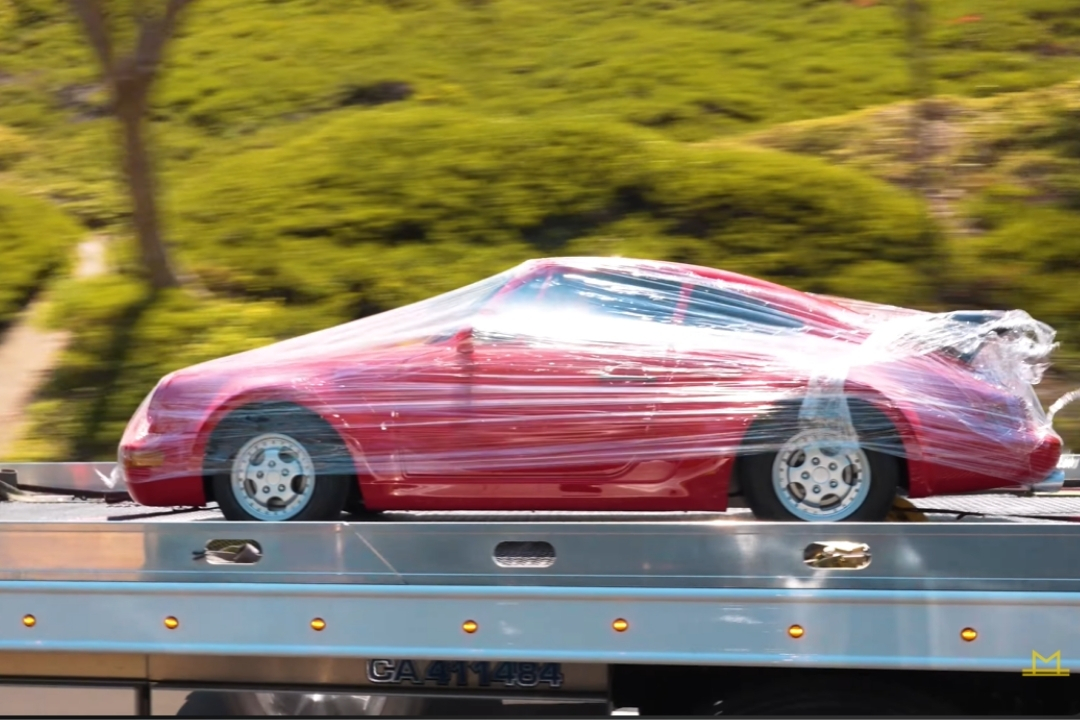
Nothing sells the illusion faster than watching professionals treat the mini Porsche like a real one. At nearly 300 pounds, the replica proved too heavy for Manny and his videographer to lift by hand, and its scaled-down wheelbase meant a standard tow truck couldn’t hook onto it the way it would a full-size vehicle. The solution was a flatbed, the same equipment used to transport actual cars.
The driver’s own reaction gave away how convincing the illusion was before he even saw the car up close. Manny said the driver arrived expecting an actual Porsche to roll out of the garage, only to be met with a five-foot replica that still needed the same specialized equipment a real one would. That is not a small detail. It means the car had already generated the kind of anticipation a genuine collector vehicle would, purely from a phone call describing it.
No doors, no belts, and nobody seemed to mind
Part of what makes the mini Porsche’s road presence so unlikely is what it’s missing. There are no doors, meaning the driver climbs in over the top like stepping into a go-kart. There are no seatbelts. The interior is built more like a stripped-down drift car than anything resembling a passenger vehicle, with bucket seating and a digital display handling drive modes and hazards.
None of that diminished the reaction once it was moving. Once Manny got it onto a paved surface and pushed it into its higher-performance drive mode, the car pulled off high-speed runs, slaloms, and donuts around the courtyard, all at a top speed of just 45 miles per hour in the tested configuration. That number would barely register on a highway on-ramp, yet the runs still produced the kind of unfiltered excitement usually reserved for cars capable of triple that number.
Presence without performance
What the mini Porsche proves, intentionally or not, is that visual recognition and genuine performance are two completely separate currencies. A car can turn heads without going fast, without costing what a real supercar costs, and without offering anything close to the driving experience of the vehicle it’s modeled after. It only has to look unmistakably like something people already know matters.
That’s a harder trick to pull off than it sounds. Plenty of novelty vehicles exist and get ignored. This one got a flatbed tow truck, a driver’s genuine confusion, and an owner already planning to order the faster version. A shape everyone recognizes, built at a scale nobody expects, turned out to be enough on its own.
More from Fast Lane Only
- Unboxing the WWII Jeep in a Crate
- 15 rare Chevys collectors are quietly buying
- 10 underrated V8s still worth hunting down
- Police notice this before you even roll window down
*Research for this article included AI assistance, with all final content reviewed by human editors.