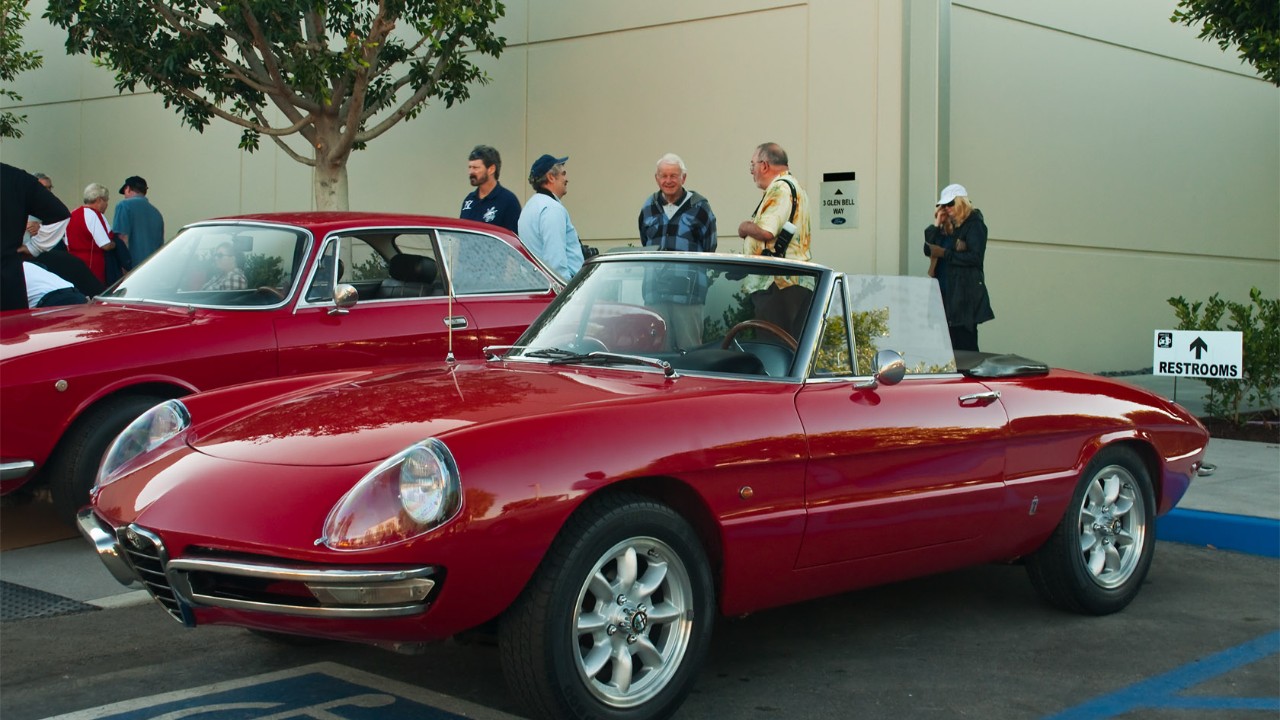
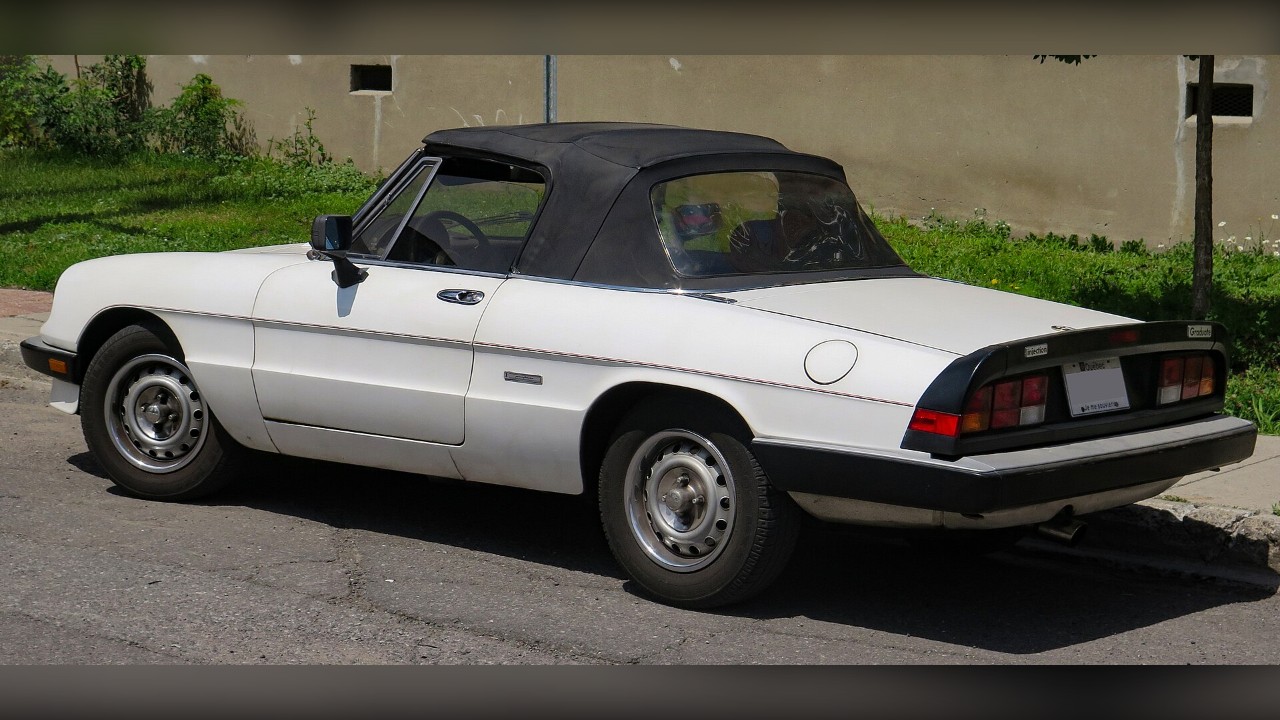
Dustin Hoffman’s red Alfa Romeo in The Graduate did more than carry Benjamin Braddock through the story. Nearly two decades after the 1967 film, Alfa Romeo named a model after it. The Alfa Romeo Spider Graduate went on sale in the United States in 1985 and stayed in the lineup until 1990.
For a movie role, that is a long run. Better still, the tribute landed on the same basic Spider design that had starred in the film.
The story starts with a small Italian roadster and a young man who did not even know what it was called. It ends with a budget-friendly Spider sold to Americans who remembered the film.
The Spider in The Graduate
Benjamin’s car is a gift from his parents for finishing college. According to the Revs Institute’s look at the film car, it was a bright-red 1966 Alfa Romeo Duetto Spider. In one early scene, Mrs. Robinson asks Ben to drive her home. When she asks what kind of car it is, he answers, “I don’t know.”
Audiences remembered it anyway. In the film’s final stretch, Hoffman drives the Spider against the clock, as Alfa Romeo’s own heritage history puts it. As a result, the little roadster became part of the film’s famous finish.
The car also mattered to Alfa’s U.S. business. The Lane Motor Museum says the film “put Alfa ‘on the map’ in the USA.” That kind of exposure is hard to buy.
Why it was called the Duetto
The Spider was still a new model when the film came out. Alfa Romeo launched the Spider at the 1966 Geneva Motor Show, according to the Alfa Romeo heritage history published by Stellantis. It was also the last project that Battista “Pinin” Farina led in person.
The Duetto name came from a public competition. However, a confectionery company claimed the name, so Alfa dropped it about a year after launch, the heritage history says. Officially, the car became the Spider 1600, the Revs Institute notes.
Under the hood sat a 1,570 cc twin-cam four. Alfa’s heritage history quotes 109 horsepower in the text and 110 hp in its spec table. Its listed top speed is 185 km/h, or about 115 mph. Meanwhile, the Revs Institute puts first-series production at about 6,000 cars before the 1750 Spider Veloce replaced it.
How the Alfa Romeo Spider Graduate came about
The Spider kept evolving long after the film. In 1969, Alfa cut the rounded tail short into a squared-off Kamm tail, the heritage history says. Later, in 1971, a 2.0-liter engine arrived.
By the 1980s, the car had reached its third series. The Lane Motor Museum calls it the “Ducktail” Series III and dates it to 1983–90. Its spec sheet lists a fuel-injected, 1,962 cc twin-cam four and a five-speed manual.
Then, in 1985, Alfa added the Graduate. The name was a nod to Benjamin’s car, and the Lane Motor Museum says it was “marketed to relate to the car Dustin Hoffman drove.” Barn Finds adds that it was offered only in North America.
What the Graduate gave up
The Graduate was the entry-level Spider. It cost $14,000 when new, according to the Lane Motor Museum, which says the three trims were “mechanically identical.” So buyers got the same engine and running gear as pricier versions.
The savings came from equipment instead. The Graduate “made do with steel wheels and trim rings” in place of optional alloys, the museum notes, and it had manual-wind windows. Conceptcarz adds a vinyl top and vinyl seats to that list.
In short, it was the plain version of a pretty car. That suited the name, since Benjamin’s Spider was a starter car for a young man, too.
The end of the run
The Graduate lasted six model years. Its last example left the assembly line in 1990, Barn Finds reports. That same year, Alfa introduced the final version of the Spider, according to the heritage history.
The Spider itself carried on a little longer. Production finally stopped in 1994, the heritage history says, nearly three decades after the Geneva debut. The Lane Motor Museum’s spec sheet counts 37,208 Series III cars out of 124,104 Spiders built in all.
Prices for the Graduate can still look modest. For example, one red 1985 Graduate with 42,000 miles carried an asking price of $14,500 when Barn Finds featured it. That is only $500 more than the $14,000 the Lane Motor Museum lists as the car’s price when new.
More from Fast Lane Only