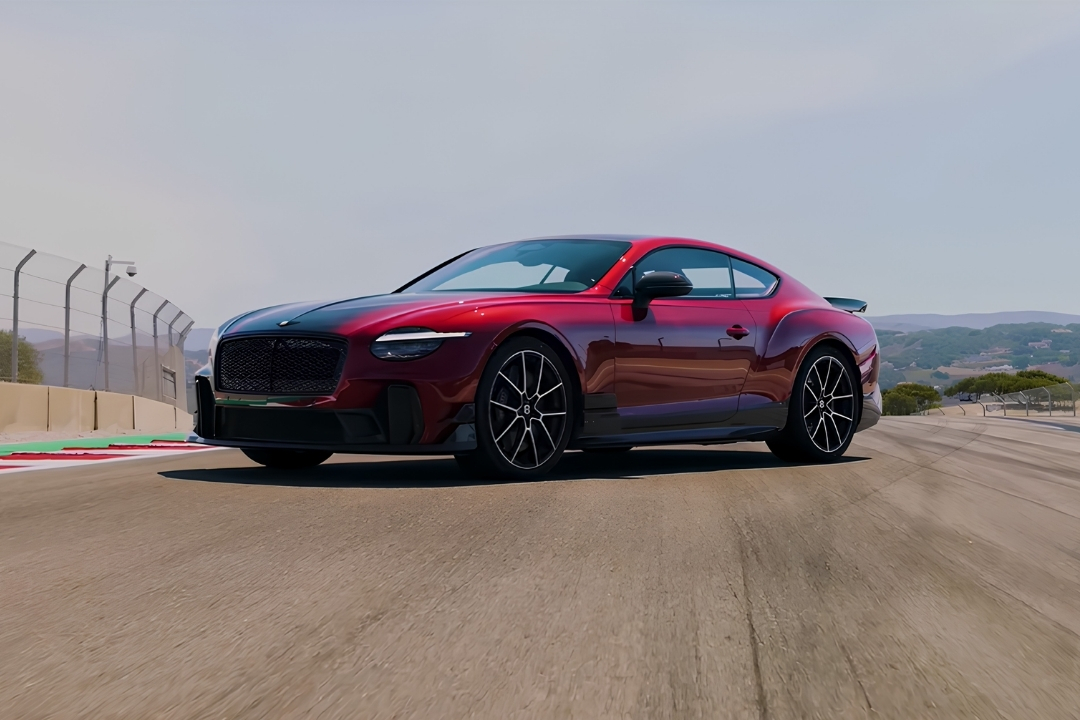
Some performance upgrades come with an obvious trade-off. Strip the weight, strip the comfort. Sharpen the handling, lose the luxury. That’s the formula enough manufacturers have followed that it’s become an expectation: a track-focused version of a comfortable car usually means living with a harder ride, a stripped cabin, and fewer ways to make the interior feel like your own.
Bentley’s new Continental GT Supersports set out to test that assumption directly. The brand removed 500 kilograms from the standard Continental GT, the equivalent of taking an entire grand piano out of the car, while also adding 300 kilograms of downforce, a larger front splitter than any Bentley road car has worn, and a non-hybrid twin-turbo V8 producing 657 brake horsepower. That’s the kind of spec sheet built for a track, not a boutique.
And yet climb inside, and the car still offers 22 main hide colors, 11 secondary hide colors, and 9 accent hide colors, available in single, duo, or tri-tone combinations. Nothing about the ordering process got simpler just because the chassis got sharper.
A grand piano’s worth of weight, gone
The headline number is the 500 kilogram reduction, described by CAR magazine’s presenter as making this the lightest production Continental Bentley has ever built. That’s not a marginal diet. It’s roughly the mass of an actual grand piano lifted out of the car, achieved partly through extensive carbon fiber use across the roof, dive planes, side sills, blades, rear diffuser, and fixed rear wing.
Those same carbon components do double duty, contributing to 300 kilograms of additional downforce over the standard Continental GT. Between the weight savings and the downforce gain, the Supersports is a fundamentally different physical proposition than the car it’s based on, even before accounting for the engine.
Power without the hybrid assist
Unlike much of Bentley’s recent lineup, the Supersports skips electrification entirely. It runs a twin-turbocharged 4.0-liter V8 alone, producing 657 bhp and 590 lb-ft of torque, enough for a 3.7-second run to 62 mph and a top speed of 192 mph. All of that power goes exclusively to the rear wheels, a notable departure for a car built on a platform that typically sends drive to all four.
The presenter noted that without a hybrid system’s instant torque fill, the car doesn’t deliver quite the same punch off the line as some electrified rivals. But once moving, he found it settled into a different kind of character entirely, one built around agility rather than outright straight-line violence.
A cabin that stayed a Bentley
This is where the Supersports separates itself from the usual playbook. Rear seats are gone, replaced by more aggressively bolstered front bucket seats, and the whole car has clearly been reworked around lap times rather than lounge comfort. But the presenter was explicit that the cabin still felt like a proper Bentley, full of leather and customization options rather than stripped-out carbon and exposed structure.
That’s an unusual combination to pull off. Most manufacturers treat weight reduction and interior luxury as a zero-sum trade. Bentley kept the full spread of hide color options intact, letting buyers spec a genuinely track-capable Continental in whatever combination of 22 main, 11 secondary, and 9 accent colors they’d choose for the standard car.
On track at Laguna Seca
Testing took place at WeatherTech Raceway Laguna Seca, a circuit known for its mix of high and low speed corners and its famous Corkscrew, a steep downhill left-right combination that has humbled far more track-focused machinery than a Bentley. The presenter came away impressed by how the car handled it, noting cleaner steering feedback, sharper turn-in, and a chassis balance that let the rear end step out predictably rather than feel clinical.
He was careful to frame those improvements honestly. The Supersports isn’t going to challenge a 911 GT3 as an outright track weapon, and at close to two tons, comparisons to genuinely lightweight sports cars don’t hold up. But relative to every other Continental he’d driven on a circuit, it represented a real step forward, responsive to inputs in a way the standard car simply isn’t.
Sharper without asking for less
What makes the Supersports notable isn’t that Bentley made a faster Continental. It’s that they did it without demanding the usual concessions. The comfort stayed close to intact. The interior customization stayed exactly as extensive as before. The only things that changed were the parts that needed to change to make the car quicker: the weight, the aerodynamics, the drivetrain, the suspension.
Bentley has reportedly hinted there’s room to go further still, with lighter suspension components or a more extreme powertrain possible down the line. For now, the Supersports reads less like a stripped-down special edition and more like proof that a genuinely track-capable Bentley doesn’t have to stop feeling like a Bentley to get there.
More from Fast Lane Only
- Unboxing the WWII Jeep in a Crate
- 15 rare Chevys collectors are quietly buying
- 10 underrated V8s still worth hunting down
- Police notice this before you even roll window down
*Research for this article included AI assistance, with all final content reviewed by human editors.