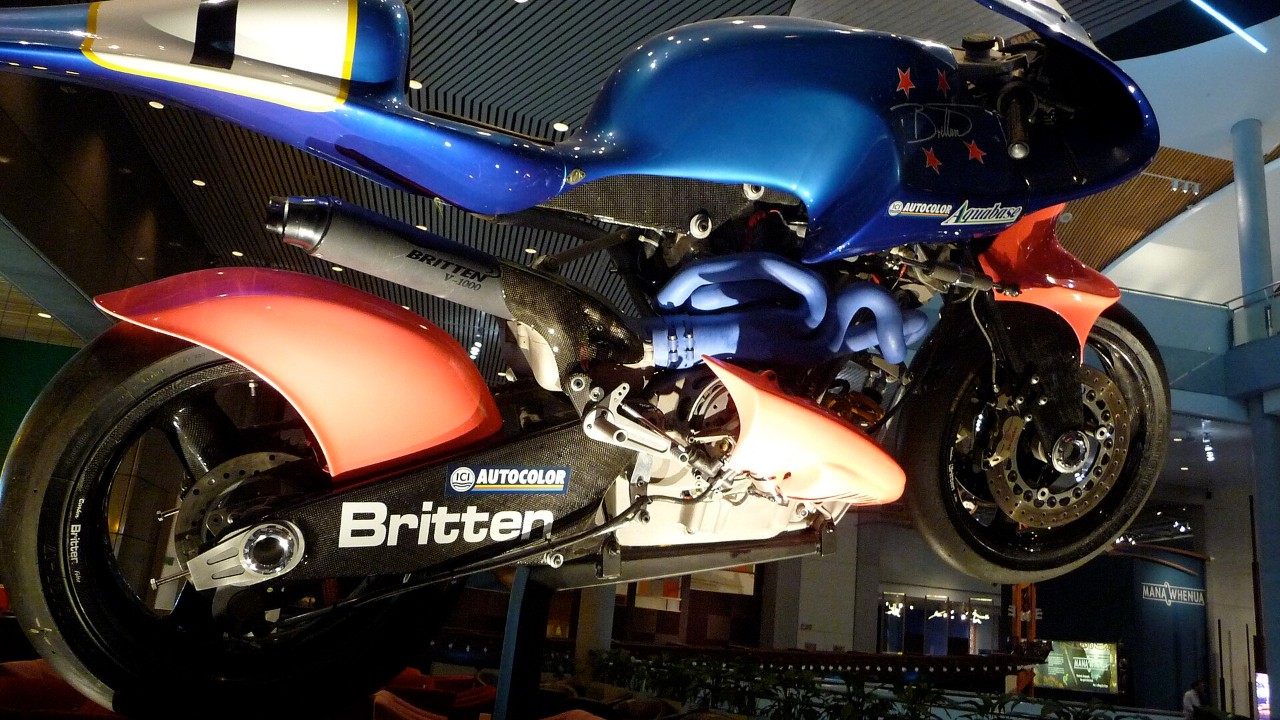
Only 10 examples of the Britten V1000 were ever made, and every one came out of a small operation in Christchurch, New Zealand. John Britten designed the bike, and a crew of friends, mechanics and volunteers helped him build it by hand. Then that home-grown race bike went up against factory machines and set world speed records.
It’s one of the great “how did they do that?” stories in motorcycling. Britten worked from rented premises and a home garage, not a factory. Even so, his team made almost everything themselves, from the engine to the bodywork.
The bikes still exist, and one sits in New Zealand’s national museum. Here’s how the V1000 came together, what made it so different and where you can see one today.
Who built the Britten V1000
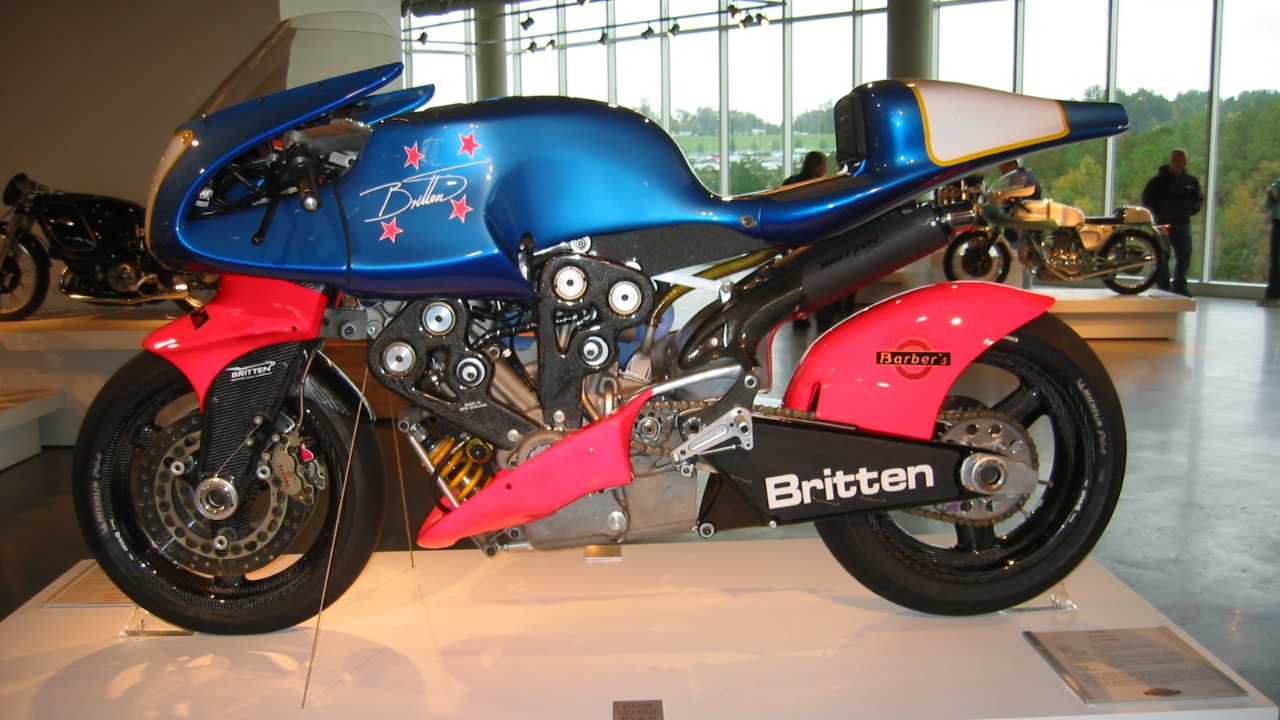
John Britten was a Christchurch engineer. According to the Britten Motorcycle Company’s own history, he and “his team of hardworking volunteers” built just 10 of the pink and blue bikes between 1991 and 1998. The same history describes friends, craftsmen and mechanics pitching in.
Even the workspaces were modest. The company history says the workshop was in cheap rented premises in Addington, while the bodywork was done in Britten’s garage in Riccarton. Goodwood’s account puts it more simply, crediting Britten and “a merry band of mates” in Christchurch.
That small-shop spirit sets the V1000 apart from most superbikes. For contrast, see how the 1969 Honda CB750 became the first superbike with a giant factory behind it. Even Harley tried its hand, as our story on the superbike Harley-Davidson built in secret shows.
An engine built from scratch
First, there’s the heart of the bike, a 60-degree V-twin. Motorcycle Classics describes it as a 999cc, water-cooled, quad-cam engine with four valves per cylinder. It also quotes a claimed 166 horsepower at 11,800 rpm.
According to the Britten company history, the team built the engine from scratch, apart from one or two parts. The cylinder heads and ports were the most inventive pieces. In fact, Hans Weekers worked out the port lengths using clay models.
Some of the methods sound wonderfully homespun. For example, the history says the sand-cast aluminum crankcase was heat-treated in Kirsteen Britten’s pottery kiln. Meanwhile, an on-board computer sampled engine data every few hundredths of a second.
Carbon fiber, a hidden radiator and a different front end
On the Britten V1000, most of the chassis and bodywork was carbon fiber. In fact, the company history says that even the wheels were carbon fiber. However, the first bike’s body used four layers of carbon cloth plus some Kevlar, while later bikes used two.
The radiator moved, too, because space up front mattered. Motorcycle Classics notes that a small radiator sat under the seat, which cut frontal area compared with a radiator in front of the engine. As a result, the bike could wear a slim, wind-cheating nose.
Up front, Britten skipped the usual telescopic fork. Motorcycle Classics describes a girder-style front end, a reworking of the Hossack wishbone design. It also notes that the fuel injection could be adjusted by laptop, which the magazine calls a first for motorcycles.
Racing against the factories
The V1000 earned its fame on track. According to Motorcycle Classics, the Britten won the BEARS World Championship race at Daytona Bike Week in 1995. In the same week, it finished second and third in the Battle of the Twins race.
Still, the early years were harder. The company history says that at Daytona in 1991, one bike retired with a broken clutch, while the other was caught by a factory Ducati near the end. Over the years, riders included Andrew Stroud, Gary Goodfellow and Loren Poole.
Then came the records. Te Papa says the Britten set four world speed records for motorcycles of 1000cc and under. The company history adds that Britten No. 2 took them in 1993, including 302.705 km/h in the flying mile. That’s about 188 mph.
John Britten’s death and the last bikes
Britten didn’t live to see the full run finished. The company history gives his death as September 5, 1995, from cancer. According to Te Papa, he was 45. As Motorcycle Classics notes, that came just a few months after the Daytona win.
His team kept going, however. Motorcycle Classics says the remaining bikes were completed after his death, and production ran until 1998. It also notes that Britten had wanted exactly 10 bikes.
Where to see a Britten V1000 now
All 10 bikes still exist, the company history says. Of those, three are in New Zealand, and the rest are in Europe, the United States and South Africa. In the U.S., the Barber museum in Alabama owns No. 7, according to Motorcycle Classics.
That Barber bike has a quirk. In its feature on the bike, Goodwood says Barber bought it new from Britten in 1994 and it has never been raced.
In New Zealand, Te Papa, the country’s national museum, displays a Britten V1000 in front of its Tangata o le Moana exhibition. It’s a fitting home for a bike that a small Christchurch crew built by hand in 1991 and the years after.
More from Fast Lane Only