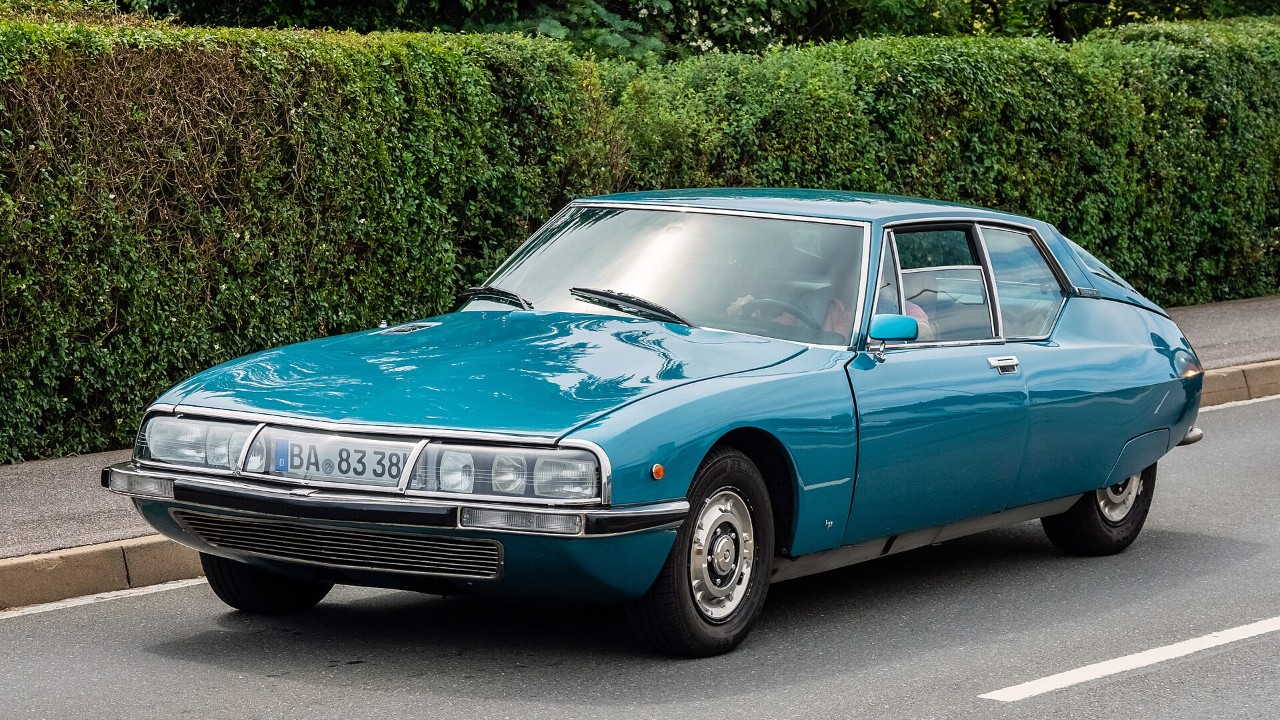
The Citroën SM V6 began life as a Maserati V8 with two cylinders taken away. Citroën had just bought control of the Italian sports car maker in 1968, and its new flagship coupe needed an engine. Maserati’s engineers delivered one in weeks.
As a result, the SM became a French luxury coupe with Italian power. It rode on Citroën’s hydropneumatic suspension, and in Europe its inner headlights turned with the front wheels. Underneath, though, the story of how its engine came together is just as unusual.
This is how a shortened V8 became the heart of the SM, what it produced and where it went after the car died.
Why Citroën bought Maserati
Citroën purchased a controlling interest in Maserati in January 1968, according to Jalopnik’s history of the SM. By contrast, Motor1 France dates the majority stake to March 1968. Both agree on the year.
Citroën already had the chassis ideas. However, it lacked an engine to match them. So it turned to Maserati’s technical director, Giulio Alfieri. Jalopnik says he had a design ready in a matter of weeks.
How Maserati cut a V8 into the Citroën SM V6
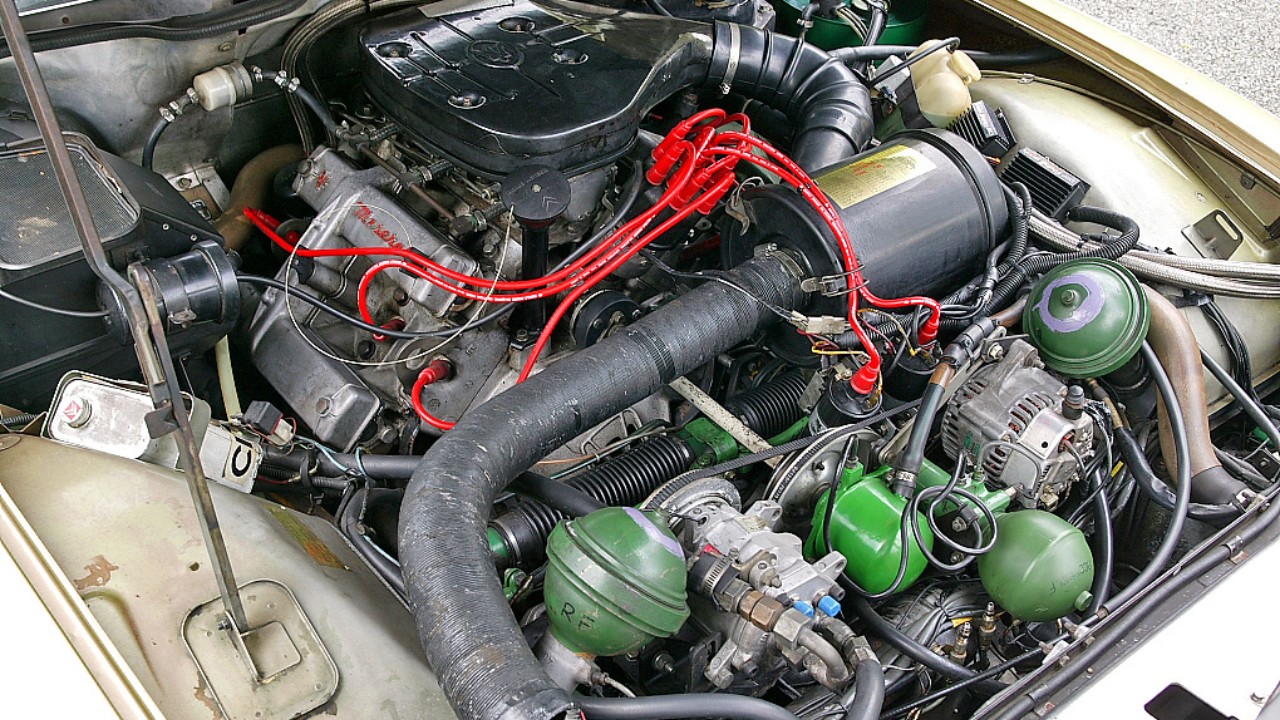
Alfieri did not start from a blank sheet. Instead, Jalopnik explains, Maserati created the V6 by “trimming two cylinders off of their existing V8 engine.” Motor1 France adds that the starting point was a 3.0-litre V8, itself derived from the 4.2-litre engine in the Maserati Indy.
Still, cutting cylinders was only part of the job. The engineers also shortened the stroke by 5 mm (0.2 in.), Jalopnik says. That kept the engine under 2.8 liters, a threshold beyond which French tax laws became too onerous. Meanwhile, the angle between the cylinder banks stayed at 90 degrees, a clear sign of the engine’s V8 roots.
Motor1 France gives the finished engine the code C114. It displaced 2,670 cc and used twin overhead camshafts on each bank. Even so, it kept two valves per cylinder. The engine weighed only 140 kg, Motor1 says, and Jalopnik gives the same figure as 309 pounds.
The numbers behind the SM’s Maserati V6
The 2.7-litre V6 made 170 hp at 5,500 rpm, according to Motor1 France. Jalopnik quotes the same output as 170 net horsepower (127 kW). It also says the early engine breathed through a trio of two-throat Weber carburetors.
In turn, that was enough for real speed. Jalopnik reports the SM could approach 140 mph (225 km/h). Meanwhile, Motor1 France lists the car’s curb weight at only 1,450 kg.
The engine kept changing. In 1972, Motor1 says, the 2.7-litre engine gained Bosch D-Jetronic electronic fuel injection. Then, from 1973, Citroën also offered a 3.0-litre version of the V6 in the SM, which kept carburetors.
A luxury coupe unlike anything else
The SM made its debut at the Geneva auto show in 1970, Jalopnik says. European cars carried six Cibié halogen headlights, and the inner pair steered with the front wheels to light up curves. By comparison, U.S. cars made do with four sealed-beam lamps. The hydropneumatic suspension had not changed much in principle from the original DS, yet the same writer calls it a wonder.
The steering was new, too. Jalopnik describes a speed-variable system that reduced assist at higher speeds. It also had a self-centering action. In fact, if a driver cranked the wheel around with the engine running, it would return to the center by itself.
Naturally, the car did not come cheap. For example, prices in France started at around 52,000 francs, according to Jalopnik. In the United States, the SM started at a sizable $11,800.
Sales that rose and then collapsed
At first, demand was strong. Close to 5,000 SMs sold in 1971 and more than 4,000 the following year, Jalopnik reports. However, the figures fell fast after that.
Sales tumbled from 2,619 in 1973 to only 294 for 1974, the same history says. Citroën had left the U.S. market after 1973. Only 115 SMs from 1975 found buyers before production ended, which brought the total to 12,920.
Citroën itself was in trouble by then. By the end of 1974 it was bankrupt, Jalopnik says, and it sold off Maserati in May 1975. Finally, a government-imposed merger with rival Peugeot followed, completed in 1976.
Where the SM’s Maserati V6 went next
In the end, the engine outlived the car it was built for. Jalopnik notes that the V6 and its transmission survived in the Maserati Merak. Motor1 France says Maserati showed the Merak, a mid-engined coupe, at the 1972 Paris Motor Show.
In that car the Maserati V6 had a long second career. Motor1 says the Merak could reach 240 km/h, and it stayed on sale until 1983, eight years after Citroën withdrew the SM from the market in 1975.
More from Fast Lane Only