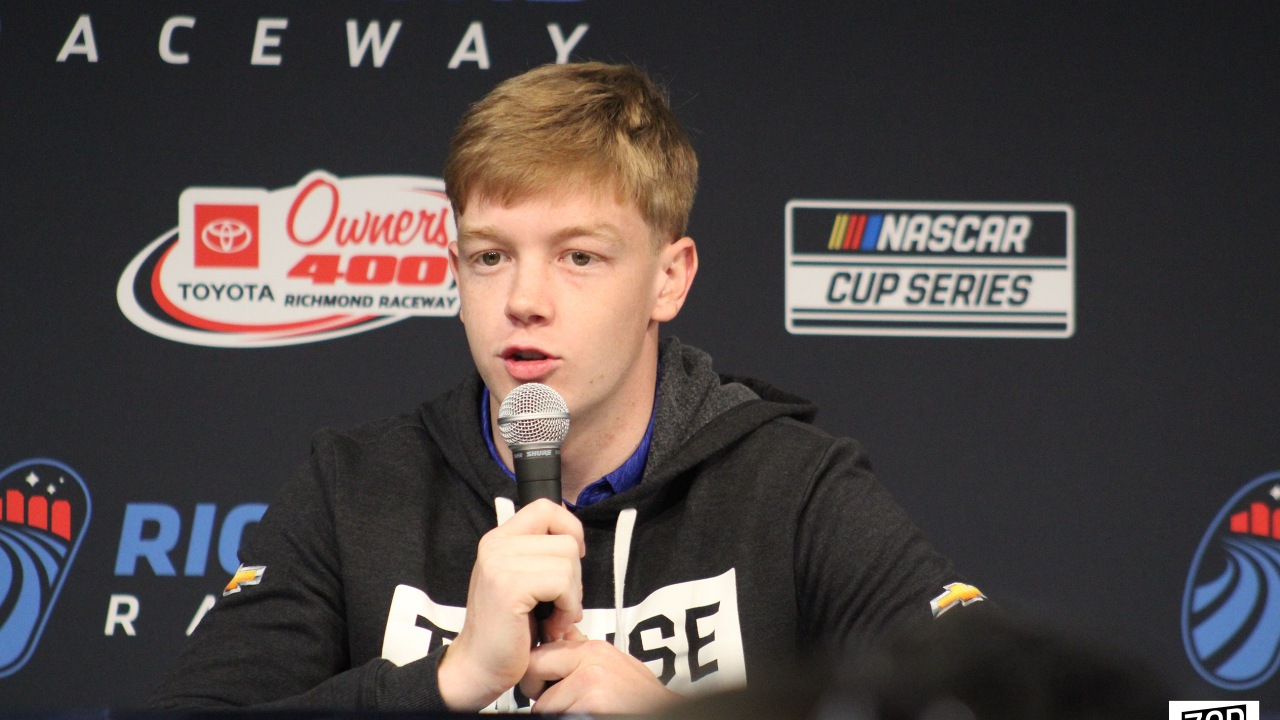
Connor Zilisch is stepping into the NASCAR Cup Series with the kind of clarity that usually comes only after a full career, not before it. The teenager has aligned himself with Trackhouse Racing and speaks openly about building a long-term future in stock cars, yet he has also acknowledged that a credible Formula One opportunity, particularly through Cadillac, is something he would at least hear out. That balance between commitment and curiosity is already shaping how teams, manufacturers, and fans talk about his trajectory.
From karting prodigy to Cup Series regular
Connor Zilisch’s path to the top tier of American stock car racing began long before his name appeared on a NASCAR entry list. Born on July 22, 2006, and raised in Charlotte, North Carolina, he started racing at the age of 5 and built a reputation as a prodigy who adapted quickly to every step up in machinery and competition. His own biographical account traces a steady climb through youth categories and into professional-level equipment, with each move reinforcing the sense that he was being groomed for a major-league seat rather than dabbling in a hobby.
That early foundation has now delivered him to a full-time place in the NASCAR Cup Series with Trackhouse Racing, a team that has positioned itself as a modern, aggressive player in the garage. Zilisch’s progression into a full-season schedule reflects not only his pace but also the confidence of an organization willing to invest in a 19-year-old as a central pillar of its future. His personal site notes that he is beginning this phase of his career as a full-time driver in 2026, and outside analysis has already framed him as a potential disruptor in the Cup field, a young competitor whose speed and composure suggest he belongs in the top tier of stock car racing in America.
A fast-track disruptor in the making
Within the Cup Series paddock, Zilisch is already being discussed less as a prospect and more as an immediate factor. Evaluations of his potential emphasize that he “just turned 19” yet appears to possess the blend of raw speed, racecraft, and maturity that veteran teams covet. That combination, paired with a full-time opportunity at Trackhouse Racing, has led some observers to describe him as a fast-track disruptor, a driver who could compress the usual learning curve and challenge established names sooner than expected.
The structure around him reinforces that perception. Trackhouse Racing has committed to giving Zilisch a complete season of Cup Series experience, with the grind of 38 race weekends offering a laboratory for rapid development. Reporting on his move highlights that this is not a part-time audition but a full immersion in the demands of NASCAR’s premier division, from short tracks to superspeedways and road courses. For a driver whose background includes success across multiple disciplines, that breadth of challenge is less a risk than an opportunity to showcase the adaptability that has defined his rise.
Why NASCAR is the priority
Publicly, Zilisch has been careful to underline that his focus is on NASCAR, not on chasing every open door in global motorsport. He has described himself as committed to the Cup Series and to making the most of his chance with Trackhouse Racing, framing the 38-weekend grind as the core of his professional life rather than a stepping stone. In interviews he has stressed that his energy is directed toward learning the nuances of stock cars, building chemistry with his team, and proving that he can contend over the length of a full season.
That stance is not mere rhetoric. Reports on his outlook emphasize that he views NASCAR as the arena where he can build a lasting legacy, and that his current contract and competitive goals are aligned with that vision. The language he uses, speaking of being “committed to NASCAR” and embracing the demands of a full Cup schedule, signals to sponsors and team leadership that he is not treating the series as a temporary stopover. For a young driver, that clarity matters, because it reassures stakeholders that their investment is aimed at long-term success rather than a brief cameo before a switch to another discipline.
The Cadillac F1 question
Even as he reinforces his NASCAR-first mindset, Zilisch has not entirely closed the door on Formula One, particularly in the context of Cadillac’s interest in the championship. He has acknowledged that if a serious F1 program backed by Cadillac materialized and sought his involvement, it would not be something he would automatically reject. In one discussion of that scenario, he characterized it as “not something I wouldn’t say no to,” a carefully phrased admission that, while he is not actively pursuing F1, he recognizes the magnitude of such an offer.
The nuance in his comments is important. Zilisch has framed any potential F1 move as conditional, dependent on timing, the competitiveness of the project, and how it would intersect with his NASCAR obligations. Reports describing the hypothetical Cadillac F1 link make clear that there is a catch: he is not lobbying for a seat or plotting an exit from stock cars, but rather acknowledging that a manufacturer-led opportunity at the highest level of single-seater racing would at least merit a conversation. In effect, he is leaving a narrow window open without letting it distract from his current responsibilities.
Balancing ambition with realism
The way Zilisch talks about his future reflects a broader trend among modern drivers who must navigate overlapping pathways between series. He has said he is “committed to NASCAR” yet has also admitted he “would definitely consider” or “wouldn’t say no” to a credible Formula One shot, language that threads the needle between ambition and loyalty. That balance allows him to project seriousness about his Cup Series role while still signaling to global manufacturers that he is open to elite opportunities if they align with his career and contractual realities.
For now, the practical implications are straightforward. Zilisch is a full-time NASCAR Cup Series driver with Trackhouse Racing, anchored in a 38-weekend calendar that leaves little room for parallel commitments. His background, from early karting in Charlotte to his rapid ascent into top-level stock cars, suggests that he thrives when fully immersed in a single challenge rather than splitting focus. If a Cadillac-backed F1 program eventually reaches the point of offering him a seat, he has left himself the flexibility to evaluate it. Until then, his words and his schedule both point in the same direction: the center of his professional universe is the NASCAR Cup Series, with Formula One existing as a distant, conditional possibility rather than an active pursuit.
More from Fast Lane Only