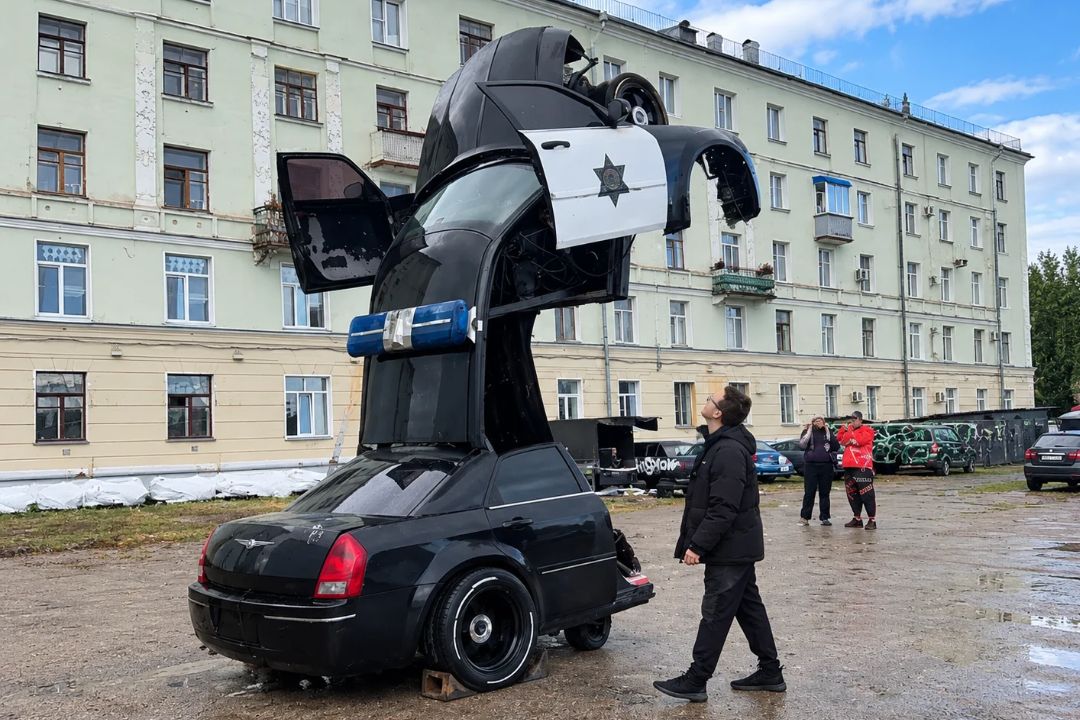
Most car builds try to hide their modifications. This one does the exact opposite, taking a Chrysler 300 dressed up as a police cruiser and turning it into a machine that stands up on command, exposes a painted robot face underneath, and somehow still drives away like nothing happened. It sounds like a concept sketch that never survived contact with reality. It isn’t.
The car in question wears a full black-and-white police wrap, complete with a star badge on the doors and an emergency light bar on the roof, the kind of livery that would look at home on patrol anywhere in the country. Underneath that familiar shell sits something considerably stranger: a hydraulic transformation system capable of lifting the entire front end and cab section vertically, folding the sedan into a standing, robot-like configuration reminiscent of the Transformers franchise, without any CGI involved.
What makes the build genuinely impressive isn’t just that it transforms. It’s that the finished robot form is still, in some sense, a functioning car. Once it locks back down into sedan shape, it starts up, clears its wheel chocks, and drives off under its own power, which is a considerably higher bar than most novelty builds ever attempt to clear.
A cop car built to stand up
The transformation itself centers on the front half of the vehicle, which pivots upward on a set of hydraulic or pneumatic actuators until the car is standing on end. Raising the body reveals what’s normally hidden beneath it: a custom-painted robot face and additional artwork worked directly into the exposed frame, suggesting this section was designed from the outset to be seen rather than just engineered for the mechanism to work.
The reveal only works because of how much had to be relocated elsewhere in the car to make room for it. A transformation like this isn’t something you bolt onto a stock chassis. Getting the front end to lift cleanly almost certainly required rethinking where the vehicle’s core mechanical components could live, which turns out to be exactly the case here.
Driving from the back seat, because the front is busy folding
Rather than a traditional dashboard and steering column up front, the car’s actual driving controls, a custom steering wheel, foot pedals, and a visible tangle of wiring and linkages, are mounted in the rear passenger compartment instead. It’s a detail that only makes sense once you understand why: with the front cab designed to swing upward as part of the transformation, there’s simply no room left up there for a driver.
That relocation extends to the engine as well. Rather than sitting under the hood where a Chrysler 300 would normally carry it, the internal combustion engine, identifiable by its red-painted valve covers, has been moved to the rear frame near the trunk area. Between the engine and the driving controls both shifting toward the back of the car, the entire mechanical layout has essentially been reversed from a standard sedan, all in service of freeing up the front end to fold upward on command.
Watching it fold back into a normal car
The most convincing part of the whole demonstration isn’t the robot pose itself. It’s watching the car return to being a car. With an operator working the controls from beside the rear door, the raised upper body slowly lowers back down until it locks into standard sedan form, at which point the disguise is essentially complete again. Exhaust fumes signal the engine catching, the wheel chocks come away, and the Chrysler pulls forward and drives off down the lot under its own power, no trailer, no push start, nothing to suggest the car had just spent the last several seconds standing on end.
That final drive-off is really the detail that separates this from a static art piece. Plenty of builds can look impressive parked. Far fewer can transform on command and then immediately prove they’re still a functional, driveable vehicle once the show is over.
A build with more questions than answers
For all its visual clarity, the video leaves several obvious questions unaddressed. Nobody names the builder or the shop responsible for the conversion, and there’s no indication of engine displacement, horsepower, or how long the whole project took to design and fabricate. The location isn’t stated outright either, though background details, including Soviet-era apartment architecture and other custom or military-style vehicles visible nearby, suggest this wasn’t filmed in a typical American parking lot.
None of that undercuts what’s actually shown. A police-liveried Chrysler 300 that stands upright into a robot silhouette, exposes hand-painted artwork underneath, and then folds itself back down into a car capable of driving away is a strange enough sight on its own merits, regardless of who built it or where. Sometimes the build speaks clearly enough that the missing paperwork barely matters.
More from Fast Lane Only
- Unboxing the WWII Jeep in a Crate
- 15 rare Chevys collectors are quietly buying
- 10 underrated V8s still worth hunting down
- Police notice this before you even roll window down
*Research for this article included AI assistance, with all final content reviewed by human editors.