Honda never built a Type R version of the CR-V. That’s not an oversight worth complaining about, since a boxy family SUV was never really the platform screaming for a hot hatch treatment. But that gap is exactly what pulled content creator Grace into her most ambitious build yet: buying a rough 2006 CR-V out of Scotland for £350 (about $470), roughly what you’d pay for a decent used iPhone, and setting out to build the performance version Honda never bothered making.
The CR-V made an unlikely amount of sense as a starting point once you look past the badge. Under that unassuming shell sits a factory K20 engine, the same family of motor found in genuine Type R Civics, albeit in a detuned economy state. A surprising number of CR-V parts also show up in all-wheel-drive Honda builds elsewhere, giving the car more performance-parts compatibility than its reputation as a school-run SUV would suggest. Add in the fact that it came with a flip-up picnic table built into the trunk, and Grace had more than enough reasons to commit to the project, whatever the eventual cost turned out to be.
Making room for a turbo meant relocating everything
Work started with the basics: stripping the hood, trim, badges, and factory intake components at Built JDM, the shop run by mechanic Sha, who took Grace through her first real hands-on mechanical experience. One of the earliest and more involved jobs was relocating the battery from the engine bay to the boot entirely, a change needed simply to free up space for the intercooler piping that would eventually feed the turbo setup. It meant mounting a new battery tray in the trunk and running a live wire the full length of the car, the kind of job that sounds simple in description and turned into Grace’s first time ever drilling through metal.
Before any of the turbo work could really begin, though, the car needed a proper look underneath, which meant a trip to a dry ice blasting specialist for a full undercarriage clean. Ice blasting strips away grime and corrosion without the abrasive damage of sandblasting or the moisture problems that come with a pressure wash, making it a useful diagnostic step before serious fabrication work starts. For a car that had spent its life in Scotland, that diagnostic step turned out to be considerably more alarming than expected.
The rust was worse than anyone was ready for
The message Grace received while away on holiday didn’t sugarcoat anything: the car was in far worse shape than anticipated, bad enough that the shop suggested she might want to reconsider the whole plan. The video that followed showed exactly why, with visible corrosion working through the wheel arches, sills, subframes, and lower control arms, the kind of rust that goes well beyond cosmetic and starts raising real questions about structural integrity.
Faced with a car that, by her own admission, barely justified the effort of fixing it, Grace decided to press ahead anyway, partly out of stubbornness and partly because she’d already proven with a previous rusted-out EP3 Civic that a full restoration from a rough starting point was possible. The rust repair work itself was pushed to a later phase of the build, but its discovery reframed the entire project. This was no longer just an engine swap wrapped in fresh paint. It was a full restoration wearing a turbo kit.
Where the budget actually went
By the time Grace had the turbo system, intake, intercooler, fuel components, sensors, and everything else needed to get the car running, the tally sat at roughly £3,600 (about $4,865), on top of the original £350 ($470) purchase price. Individual line items told the story just as clearly as the total: the paint alone cost £350 (about $470), matching the price of the car itself, the side exhaust setup ran another £350 (about $470), the upgraded 1000cc fuel injectors came in around £500 (about $675), and a stand-alone ECU added £700 (about $945) on its own. Fitting the front-mount intercooler also meant permanently removing the front crash bar, since there simply wasn’t room for both.
The paint process doubled as Grace’s first attempt at ever using a spray gun, something she practiced first on the CR-V’s iconic built-in picnic table before touching the actual bodywork, turning it into what she jokingly claims might be the only Championship White CR-V table in existence. The full respray happened over three days in the middle of a 38-degree heatwave inside the workshop, sanding and painting a car with zero prior experience while learning technique in real time.
Getting it to actually start took ten hours and a factory wiring defect
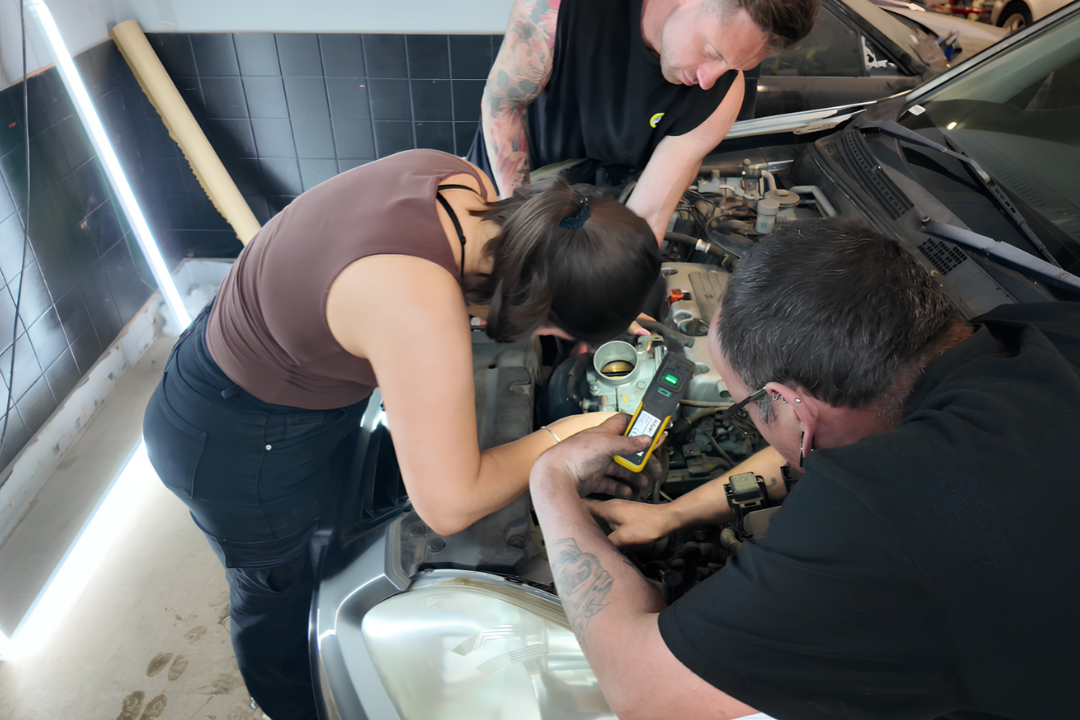
Getting the engine running turned into the build’s most drawn-out fight. A new wiring harness was needed since the CR-V’s original throttle-by-wire system wouldn’t communicate with the standalone ECU, and the first problem to surface was a fuel pump that refused to prime, eventually traced back to incorrect ECU pinouts. Once fuel was sorted, the car still wouldn’t fire, and attention shifted to the crank sensor as the likely culprit for a total lack of spark, despite the engine having run perfectly fine before the teardown began.
After roughly ten hours of troubleshooting stretched across two separate sessions, the actual fault turned out to have nothing to do with the crank sensor at all. Sha’s contact identified the real issue: the universal K-swap wiring harness came from a faulty manufacturing batch where three white signal wires had been miswired at the source, cutting signal to the spark coils entirely. Swapping the affected wires and installing a K24 sensor solved the problem immediately, confirming that hours of diagnostic work had been chasing a red herring caused by a defective part straight out of the box. The engine caught, idled, and held, closing out phase one on a note that felt earned rather than lucky.
Wheels arrived not long after, a set Grace had wanted since spotting them at SEMA three years earlier, finished in white with red center caps that echo the Type R badge she’s chasing without technically being allowed to use it. With tires fitted and the drivetrain running, phase one wrapped with a car that, by Grace’s own accounting, had cost around £4,000 (about $5,400) all in, more than ten times its purchase price, but still running, driving around the lot, and somehow still fitting that same picnic table in the trunk.
What’s left is substantial. The rust underneath still needs proper repair, the exhaust system hasn’t been finalized, and the car hasn’t turned a wheel on public roads yet. But for a project that started as a joke about a school-run SUV with a table in the boot, a running, turbocharged, freshly painted CR-V represents a genuinely serious first phase, even if Honda never intended for any of it to happen.
More from Fast Lane Only
- Unboxing the WWII Jeep in a Crate
- 15 rare Chevys collectors are quietly buying
- 10 underrated V8s still worth hunting down
- Police notice this before you even roll window down
*Research for this article included AI assistance, with all final content reviewed by human editors.