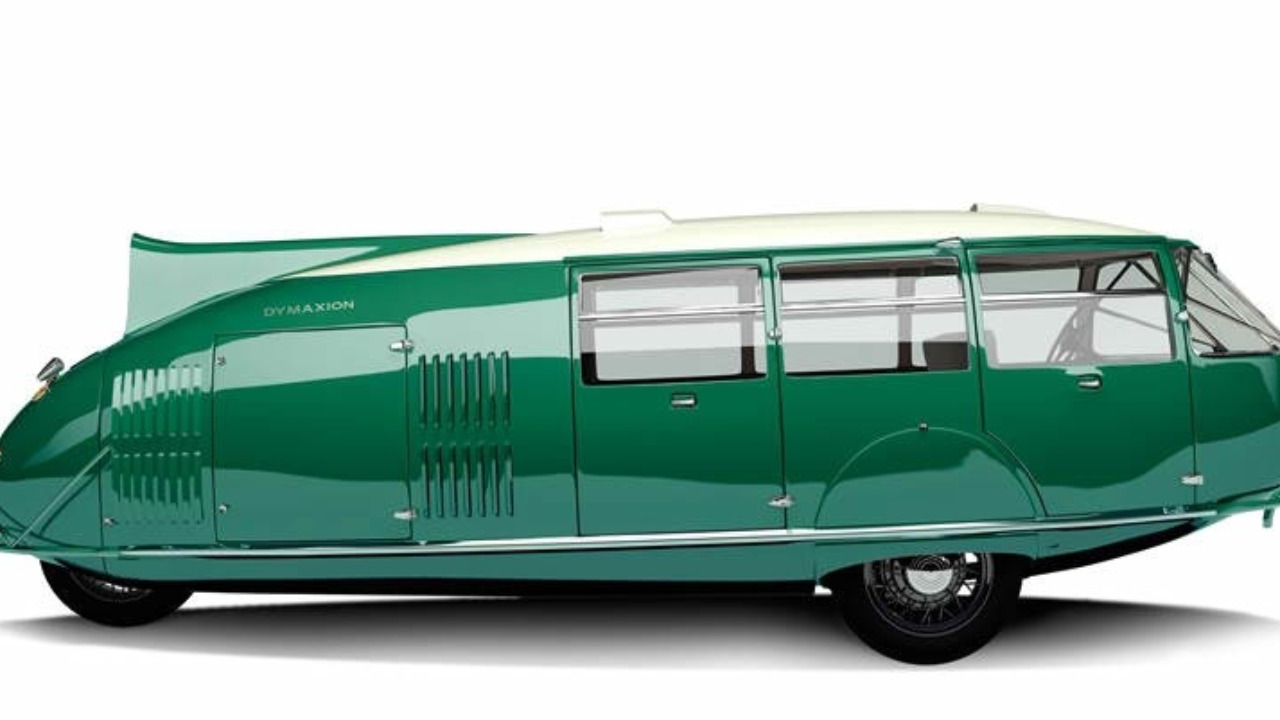
Buckminster Fuller’s Dymaxion car steered with its back wheel. The 1933 machine rode on three wheels, two at the front and one at the tail. That lone rear wheel aimed the car, while the front pair did the pulling.
Fuller was an inventor and designer, not a carmaker. Even so, he and a small crew in Connecticut built three of these long, teardrop-shaped cars. None of them reached production.
The steering is the part people remember. Here is how it worked, who built it, and why it turned out to be so hard to drive.
Why Fuller wanted the Dymaxion car steered from the rear
Fuller started from a simple theory. He held that “a moving object should be steered from the rear, irrespective of the medium,” according to a Speedreaders review of the book on the car by Jonathan Glancey and Norman Foster. After all, a boat has its rudder at the stern, and an airplane has its rudder at the tail.
The name was his, too. The Lane Motor Museum says “Dymaxion” came from the phrase “dynamic maximum tension.” It also calls the car Fuller’s best-known automotive project.
Then came the money and the shop. Lane says the socialite Anna Biddle funded the work in 1933, and Fuller rented a workshop in Bridgeport, Connecticut, that March. Hagerty adds that the building was a factory once used by the steam car maker Locomobile.
Fuller also had serious help. Hagerty says he brought in the yacht engineer Starling Burgess and the artist Isamu Noguchi to turn his concept into a car.
How the single rear wheel did the steering
The chassis explains the trick. Lane describes three separate frames. The rear frame carried the single back wheel, while the middle frame held the engine and tied into the front wheels. Finally, a front frame supported the body.
Power went forward, not back. Hagerty says Ford’s then-new flathead V8 sat just ahead of the rear wheel and sent its power to the front wheels. As a result, the Dymaxion was a front-wheel-drive car. Lane lists that V8 at 221 cubic inches and 85 hp, with a three-speed manual.
That layout left the tail wheel free to swivel. The Speedreaders review says cables running six meters from nose to tail worked the pivoted rear wheel. It also gives a steering ratio of 30 to one, with no caster angle. In other words, the driver turned a wheel up front, and cables swung the wheel behind the passengers.
The payoff came in tight spaces. Motor Authority reports that the reverse-tricycle layout let the car make a U-turn within its own 20-foot length. Meanwhile, the car’s publicity leaned on a similar stunt, the review notes: turning nose-first around a person standing still.
What the Dymaxion car was like to drive
The same layout made the car a handful. Motor Authority says its single-wheel rear steering “proved tricky to grasp.” Hagerty goes further, because it blames “jittery handling” on the rear-steering chassis.
Critics doubted the basic shape of the thing as well. Metropolis magazine notes that critics thought the two-front, one-rear wheel arrangement was “inherently unstable.” The review on Speedreaders agrees that the car was hard to drive at any speed.
Fuller’s speed claims didn’t help his case. Lane gives a claimed top speed of 120 mph but says the real figure was probably about 80 mph. By comparison, Hagerty says the goal was sustained travel near 100 mph at 28 mpg. CT Explored reports that the car reached 70 mph at its debut at Seaside Park.
The first car’s story ended badly. Lane says it went to Gulf Refining’s Al Williams and crashed in October 1933, though an investigation cleared the Dymaxion of fault, according to CT Explored.
Three cars from a Bridgeport shop
The team worked fast. Speedreaders says Fuller’s 27-strong crew finished the first car in July 1933, and Hagerty dates it to July 12. Next, car No. 2 followed in January 1934 at a cost of $7,688, Lane says.
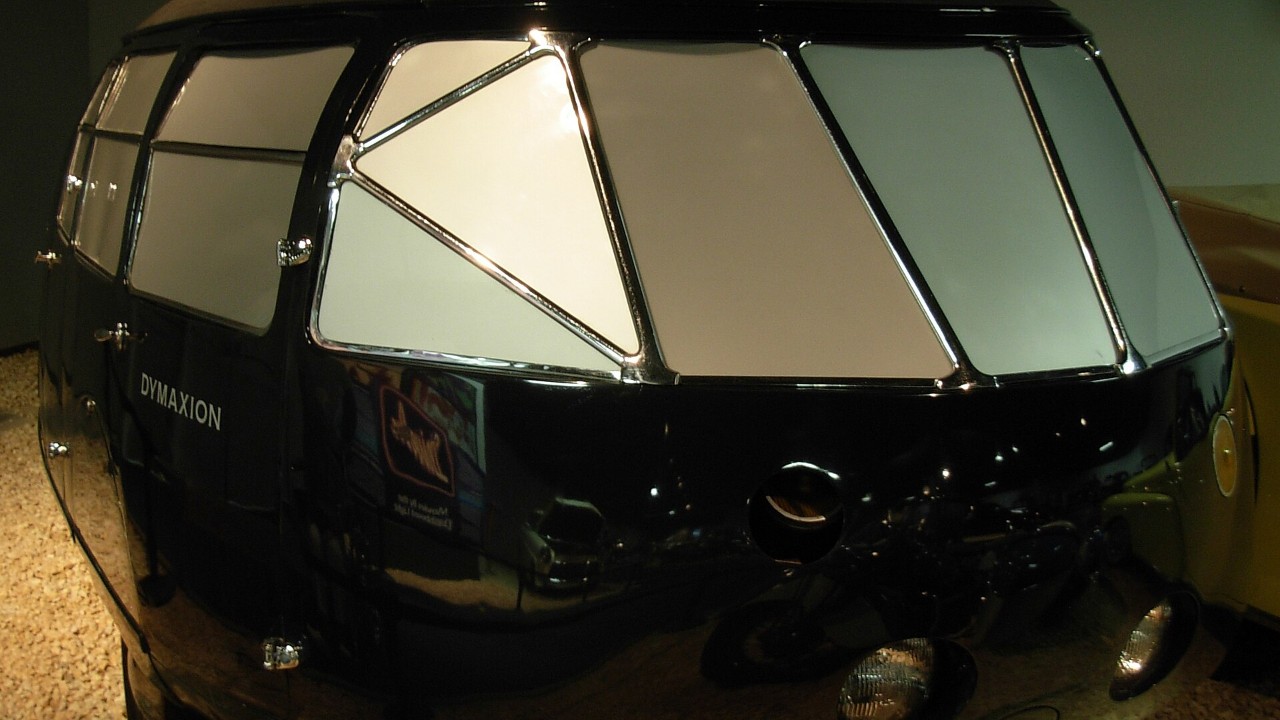
Inside, there was plenty of room. Motor Authority says the Dymaxion could seat 11 passengers, while CT Explored puts the figure at 12 plus luggage. Its structure used aircraft-grade steel wrapped in an ash frame covered in aluminum, CT Explored adds.
Car No. 3 went to a private client. Lane says Evangeline Stokowska commissioned it, and it appeared at the 1934 World’s Fair before it was most likely scrapped in the 1950s. Orders then dried up. Lane says the funding ran out by 1935, whereas CT Explored dates the closing of Bridgeport’s Dymaxion Corporation to 1936.
Fuller did protect the idea. A chronology of the project lists a patent application on October 18, 1933, and U.S. patent 2,101,057 granted on December 7, 1937. That same record shows him rethinking the steering later. In a 1943 redesign, the front wheels steered at cruising speed, and rear steering helped only in tight turns.
Where to see one today
A fourth Dymaxion exists now, too. Motor Authority says architect Norman Foster commissioned the British firm Crosthwaite and Gardiner to build car No. 4, based on the surviving original. Lane, for its part, lists a 1933 Dymaxion replica in its collection.
Foster also paid for an interior restoration of that original, Motor Authority reports, and the work brought the car back to “as new” condition. Only car No. 2 survives from Fuller’s three, and Lane says it lives at the National Automobile Museum in Reno, Nevada.
More from Fast Lane Only