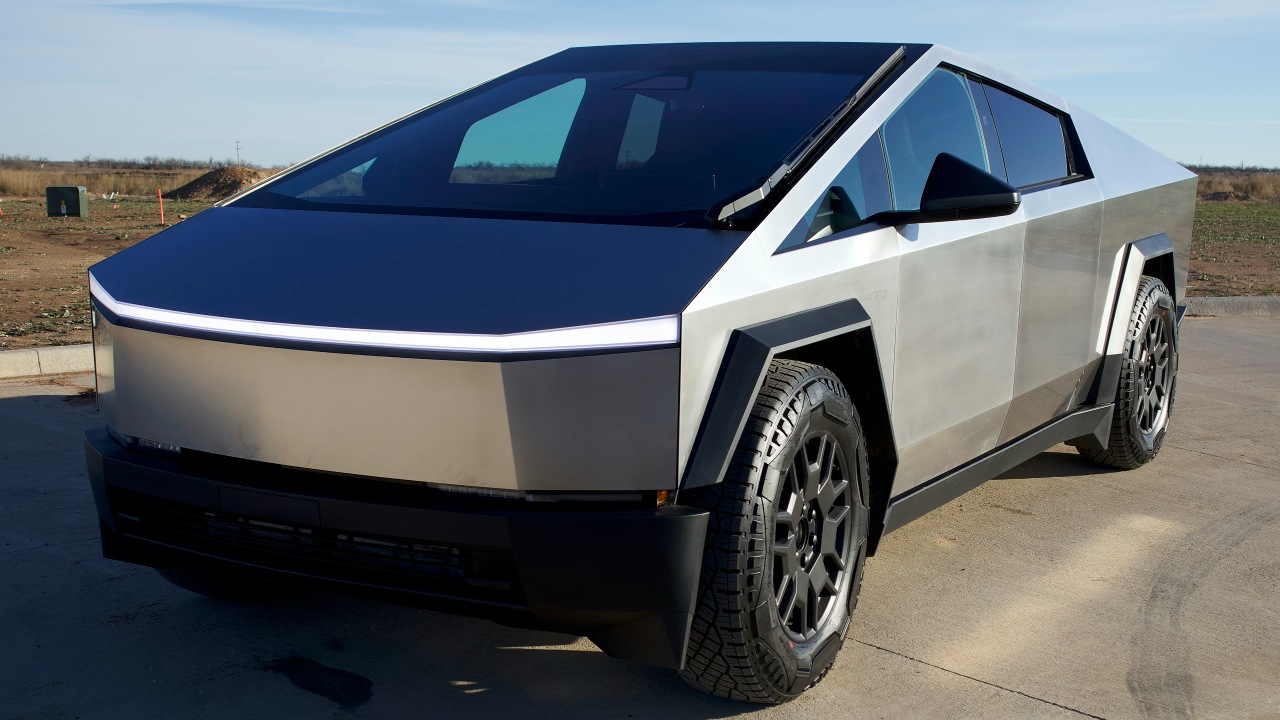
Tesla’s Cybertruck has finally secured the kind of safety accolade that automakers chase for years, yet the pickup’s most coveted new badge is effectively useless across a large part of the global market. Even as the angular electric truck earns a top rating from a leading U.S. crash testing body, its sharp stainless-steel shell, weight and visibility issues leave it blocked from key European roads.
I see a widening gap between what counts as “safe” in American crash labs and what regulators in Europe demand for crowded city streets. The Cybertruck’s story shows how a vehicle can excel at protecting the people inside while failing the test that matters most to European authorities: how it behaves when it hits everyone else.
America’s safest pickup, on paper
On its home turf, the Cybertruck is now one of the most decorated pickups on sale. After a fresh round of crash testing, the truck earned an IIHS Top Safety Pick+ rating, with reporting describing it as the safest pickup in the U.S. market and highlighting that it outperformed rivals like the Ford F-150 in several key evaluations. The recognition reflects strong performance in frontal and side impacts, roof strength and head restraint tests, and it confirms that the Cybertruck’s rigid structure and crumple zones work effectively for occupants when things go wrong.
Independent crash analysis of the 2025 model backs up that narrative, noting that the truck scored well across the IIHS crash-test battery and met the higher bar that the institute now sets for pickups. Those results helped the Cybertruck secure a coveted Top Safety Pick+ designation and reinforced Tesla’s claim that the polarizing design is not just a styling exercise but a safety-focused architecture. In the U.S. regulatory context, where occupant protection and advanced driver assistance weigh heavily, the Cybertruck now sits at the top of the pickup safety hierarchy.
Why Europe sees a safety problem, not a safety leader
European regulators are looking at the same stainless-steel wedge and reaching the opposite conclusion. Several reports describe how the Cybertruck’s sharp-edged, stiff body panels collide with European rules on “external projections,” which limit hard, protruding surfaces that can slice or concentrate impact forces in a crash. One detailed breakdown frames this as the “Sharp Edges” problem, explaining that the truck’s design violates the External Projections Law that governs how vehicle fronts and sides must deform to protect people outside the cabin.
Pedestrian safety sits at the center of that clash. Analyses of the Cybertruck’s European prospects point to its rigid stainless-steel exterior as fundamentally incompatible with pedestrian impact protection standards, which assume that a car’s front end will absorb energy and deflect a person rather than hit them with a near-solid plate. Commentators describe the truck as an “unyielding exterior” that cannot meet requirements for softer, energy-absorbing zones around the hood and bumper. In that framework, the same stiffness that helps the Cybertruck ace U.S. crash tests for occupants becomes a liability when regulators model what happens to a pedestrian or cyclist in a collision.
Germany’s hard stop and the U.S. Army’s unusual role
Germany has become the most visible flashpoint in this regulatory standoff. National authorities have refused to allow the Cybertruck on German roads, citing “Significant Passive Safety Concerns” tied to its body structure and impact behavior. Coverage of the decision notes that the truck’s sharp stainless-steel panels and overall crash profile raised enough red flags that regulators would not even grant limited approvals, effectively shutting the door on private imports and local registrations.
The U.S. Army’s presence in Europe has unexpectedly amplified that message. In guidance to personnel, the Army confirmed that the Tesla Cybertruck cannot be imported into Europe under existing rules and cannot obtain an exemption through NATO agreements. Internal communications cited several specifications of the Cybertruck, particularly the sharp-edged, stiff stainless-steel body, as violating EU safety requirements, and the vehicle was blocked from the USAREUR-AF system that tracks approved cars. Separate reporting on Germany’s stance echoes those concerns and describes the truck as a risk to pedestrians and other road users, reinforcing that this is not a narrow bureaucratic quirk but a broad safety judgment.
From “banned in Europe” to a long list of fixes

Specialist analyses of EU law go further, arguing that the Cybertruck is effectively “banned in Europe” under current regulations. One deep dive into the EU framework explains that the combination of sharp edges, rigid bodywork and external projections issues makes the truck a non-starter for type approval. The piece emphasizes that owners cannot simply modify a few parts or seek a one-off exemption, because the core structure conflicts with the rules that govern how vehicles must behave in collisions with vulnerable road users.
Other European-focused breakdowns sketch out what it would take to change that verdict, and the list is long. A review of the Cybertruck’s “European conundrum” outlines required design modifications that would likely include softening or reshaping the front end, addressing visibility concerns from the high beltline and thick pillars, and reworking the stainless-steel skin to introduce more controlled deformation. Analysts also flag the truck’s mass and size as compounding factors, noting that its weight and height increase the risk to smaller vehicles and pedestrians even before the sharp edges are considered. Taken together, those changes would amount to a substantial redesign rather than a light regional tweak.
The UK, licensing limits and a heavier burden on drivers
In the United Kingdom, the Cybertruck runs into a different but related barrier: licensing and weight rules that assume most private drivers are in lighter vehicles. Owners discussing the issue point out that the Cybertruck’s kerb weight and gross vehicle weight exceed the 3,500 kg limit of a standard UK Category B license, which means many drivers would need a higher license category just to operate it legally. That alone makes the truck a poor fit for a market where everyday pickups and SUVs are expected to fall under that threshold.
UK-focused commentary also notes that the Cybertruck fails to meet local requirements for pedestrian protection and restrictions on vehicles with sharp external projections, echoing the broader European concerns about its angular stainless-steel body. Reporting on European safety regulations more generally adds that the three-tonne Cybertruck is not allowed on UK roads, with its angular design and pedestrian protection shortfalls cited as key reasons. In practice, that leaves British buyers facing both regulatory bans and licensing hurdles, a combination that turns the truck from a niche curiosity into a legal impossibility.
A widening transatlantic safety divide
The Cybertruck’s split fate highlights how far U.S. and European safety philosophies have drifted apart. In the U.S., the truck’s IIHS Top Safety Pick+ badge and strong crash-test scores are treated as proof that the design works, even if it looks unconventional. The focus is on how well the vehicle protects its occupants in controlled crash scenarios and how its structure and restraint systems manage energy in those tests. For American buyers, the message is simple: this is a very safe pickup to be inside.
European regulators, by contrast, are judging the same vehicle primarily on how it behaves toward everyone outside the cabin. Analyses of EU and UK rules stress pedestrian impact protection, external projections limits and overall compatibility with dense urban environments where large vehicles share space with walkers and cyclists. Reports on the Cybertruck’s European roadblock argue that the truck’s unyielding exterior, sharp edges and visibility issues all run counter to that philosophy, and that no amount of occupant-focused crash performance can offset those structural concerns. Until Tesla is willing to build a fundamentally different version of the Cybertruck for Europe, the truck’s top safety badge will remain a U.S. story that stops at the border.