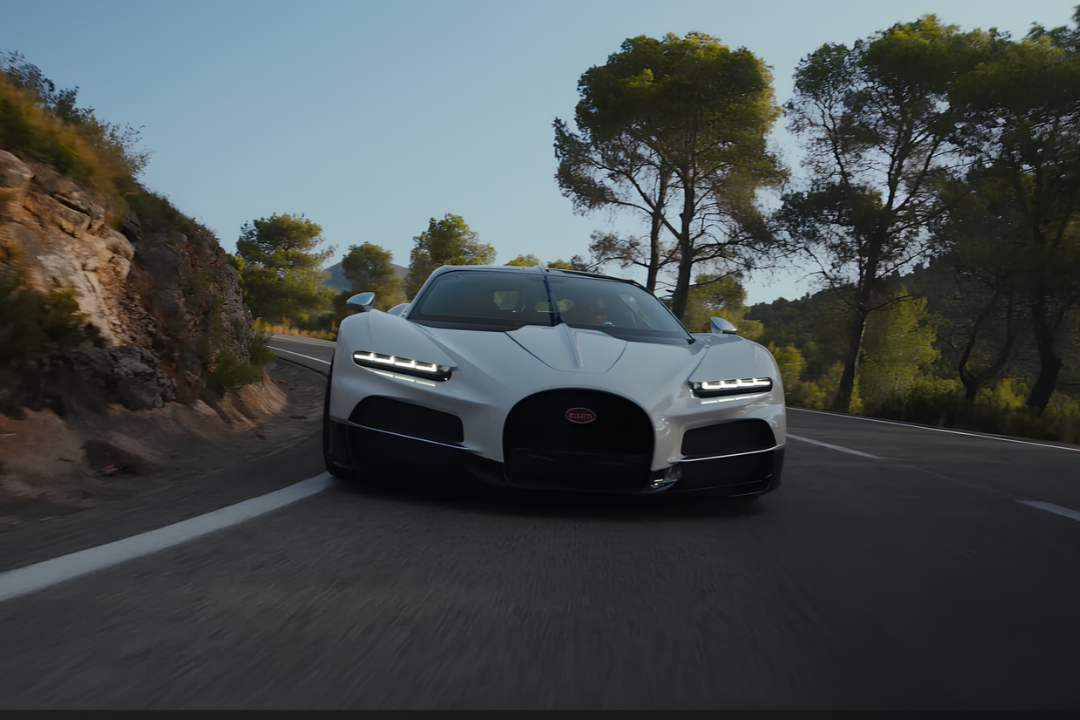
The Bugatti Tourbillon has a problem most performance cars would probably love to have: its engine is already loud enough.
In an era where a growing number of automakers quietly pipe amplified or synthesized engine notes through the cabin speakers to make their cars sound more dramatic than they actually are, Bugatti went the other direction entirely.
Bugatti’s engineers spent years working on the car’s intake, exhaust, and cabin acoustics, but there was one thing they deliberately refused to do. They didn’t pump artificial engine noise through the speakers, even though that would have been the easier, cheaper path to a satisfying soundtrack.
Instead, every bit of engine sound the driver hears in the cabin comes from the actual mechanical parts of the car. No amplification. No layered-in samples. Just the V16, the intake, and the exhaust doing what they were built to do.
Bugatti Wanted the V16 to Sound Raw
Bugatti didn’t want the Tourbillon to sound overly polished, and that decision came from looking backward before looking forward. According to the company’s acoustic team, older Bugattis were never known for having an especially clean engine note. There was always something raw and slightly dirty about the sound, a quality that could easily have been engineered away in the name of refinement. Instead, the engineers made a deliberate choice to preserve that character in the new V16 rather than smooth it into something more generic.
Holding onto that rawness while building a modern hypercar wasn’t a matter of simply leaving things alone. It took real engineering effort. The team ran thousands of hours of simulations on the exhaust and air intake systems, testing different configurations to figure out how to keep that distinctive edge without it becoming unrefined or, worse, illegal. The challenge wasn’t simply making the car loud. Loud is easy. The real difficulty was making the Tourbillon sound exciting and unmistakably Bugatti without allowing outside noise levels to become a problem, because a car this expensive and this exclusive still has to pass the same regulatory hurdles as anything else on the road.
That balance, character on one side, compliance on the other, became especially important when it was time to certify the car. The Tourbillon had to meet the requirements of UN/ECE R51.03, which regulates vehicle pass-by noise, the standard that governs how loud a car is allowed to be to someone standing outside as it drives past. Bugatti’s target was simple on paper: the car could not exceed 72 decibels during the required testing.
The Sound Had to Stay Under 72 Decibels
That number isn’t determined by simply driving past a microphone once and calling it done. The test uses a 20-meter measurement area with two microphones positioned in the middle, and the car has to complete different runs through it, including constant-speed passes and accelerated ones, before the results from all of those runs are combined into a single final figure. It’s less a single pass-fail moment and more an aggregated score built from repeated, carefully controlled attempts.
And the engine isn’t the only thing making noise that counts against that number. The tires contribute significantly to the total, generating their own noise footprint as they roll across pavement at speed. So does the body of the car itself, including aerodynamic noise generated by the vehicle’s active rear wing, a component that produces real downforce and, as a byproduct, real noise of its own. That meant Bugatti’s engineers weren’t just tuning an engine note. They were managing an entire acoustic profile made up of several independent, sometimes competing noise sources, all of which had to add up to something under 72 decibels.
Even when the car itself was ready, Bugatti couldn’t simply run the test whenever it wanted. The environmental conditions had to be right, and getting them right turned out to be its own ongoing battle. Temperature matters because it can significantly change tire noise, meaning a test run on a cold morning and one on a warm afternoon could produce noticeably different results even with everything else held constant. Wind speed also has strict limits built into the regulation. A sudden gust that exceeds the allowed parameters can invalidate an entire run, no matter how well the car itself performed during that pass. That meant plenty of testing could end with the team having to start over from scratch, sometimes for reasons that had nothing to do with the car at all. The acoustic development had already taken around two and a half years, approaching three years by the time this final testing phase was underway.
The Driver Still Gets to Hear the V16
Bugatti didn’t want to isolate the driver from the engine just to make the Tourbillon more comfortable, even though isolating cabin noise is usually treated as a win in most modern car development. The test driver explained that being able to hear the engine is important because it creates a direct connection between what the driver does with the throttle and what the engine is doing in response, a feedback loop that matters as much for confidence behind the wheel as it does for enjoyment.
With the windows closed, the Tourbillon is still designed to remain comfortable enough for normal city and highway driving, including when the car is operating in EV mode, where the goal shifts toward quiet, low-drama cruising rather than theater. But lower the windows and the difference becomes obvious almost immediately. The intake and exhaust become much more prominent, giving the driver the raw mechanical sound Bugatti wanted from the beginning, unfiltered and immediate in a way that closed-cabin comfort simply can’t replicate. And behind all of it is the Tourbillon’s naturally aspirated V16, doing the actual work that everything else in this story was built around capturing accurately.
The Speakers Are Staying Out of It
That may be the most interesting part of Bugatti’s approach, and it’s a philosophy that runs against the grain of where a lot of the industry has drifted. The company isn’t trying to convince the driver that they’re hearing a powerful engine through some clever audio trick. They’re trying to make sure the driver can actually hear the one that’s there, unedited and unenhanced.
Bugatti’s acoustic team put it plainly: everything heard inside the car comes from the engine and air intake. There is no artificial sound coming through the speakers. It’s a simple statement, but it carries weight given how common the alternative has become across the performance car market.
After years of simulations, acoustic testing, failed runs, and environmental headaches, the company says the major work is now complete. The result is a hybrid hypercar that can stay quiet when it needs to, blending into everyday driving in EV mode without demanding attention, but still lets the driver hear all 16 cylinders when the situation calls for it, unmuffled and unmanufactured. And Bugatti clearly thinks the real thing is better than anything a speaker could recreate.
More from Fast Lane Only
- Unboxing the WWII Jeep in a Crate
- 15 rare Chevys collectors are quietly buying
- 10 underrated V8s still worth hunting down
- Police notice this before you even roll window down
*Research for this article included AI assistance, with all final content reviewed by human editors.