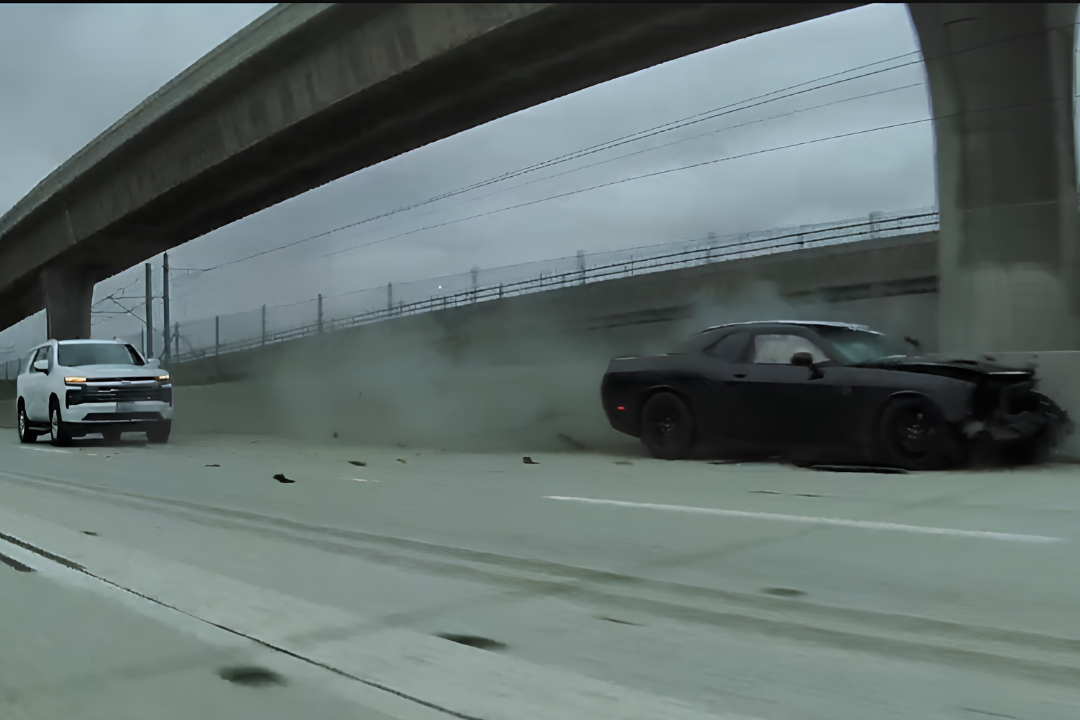
Some drivers correct a lane drift with a light tap of the wheel. This guy corrected his with a full-send into a concrete barrier. All it took was one honk.
Jim was cruising to work near SpaceX headquarters in Hawthorne, California, letting his Tesla’s Full Self-Driving handle the boring parts of the commute, when a black Dodge Challenger started wandering into his lane. Window down, no signal, just drifting like the lane markings were more of a suggestion. It’s the kind of thing that happens on freeways constantly, a driver zoning out for two seconds, drifting a few feet over, usually correcting before anyone even notices. Jim noticed. Jim hit the horn.
What happened next wasn’t a little wheel wobble. The Challenger driver yanked the wheel so hard he shot clean across the carpool lane and drove straight into a Jersey barrier. Not a fender bender. Not a scare. A full, wall-meets-car event, triggered entirely by the sound of a horn. Whatever was going through that driver’s head in the half-second between hearing the honk and hitting the wall, it clearly wasn’t “gently steer back into my lane.”
The Tesla was already a step ahead
When Jim reviewed his own dashcam footage later that day, he noticed something he’d completely missed while it was happening: FSD had already slowed the car down by 20 mph and slid it toward the right side of the lane, and it had done all of that before he’d even touched the horn. The car had clocked the drifting Challenger as a developing problem and started quietly buying distance on its own, no drama, no dashboard alert, nothing that would have grabbed a driver’s attention in the moment.
So by the time Jim leaned on the horn and the Challenger driver had his meltdown, Jim’s Tesla was already out of the blast radius, sitting further right and going slower than it had been thirty seconds earlier. He told the channel he’s convinced his own car would’ve been part of that wreck if FSD hadn’t already made room without being asked. That’s a meaningfully different story than the usual “self-driving car saves the day” clip, where a system yanks the wheel at the last possible second to dodge disaster. This wasn’t a last-second heroics moment. It was a quiet, early adjustment that had already done its job before the actual danger even peaked, which arguably makes it more impressive, not less.
One honk should not do this to a car
Drifting into someone’s lane happens. People get distracted, drift, hear a horn, snap back into their lane, life goes on, nobody even remembers it by lunch. That’s the normal version of this story, and it plays out on highways thousands of times a day without anyone thinking twice about it. This was not the normal version.
Instead of a small correction, the Challenger driver reacted like the horn was an ejector seat button, cranking the wheel hard enough to launch across an entire carpool lane before slamming into the barrier at speed. There’s a wide gap between “startled” and “total loss of vehicle control,” and this driver managed to close that gap in under a second. Jim’s own theory is that the open passenger window might have amplified the horn’s impact, catching the driver more off guard than it would have with the windows up. That’s speculation on Jim’s part, not a confirmed cause, but it’s as good a guess as any for why a routine warning honk turned into a full-speed collision with a concrete wall.
Jim still played it straight
No safe shoulder meant Jim couldn’t just pull over and check on the guy in the moment, so he kept driving past the wreck, which is the only realistic option when there’s nowhere to stop on an active freeway. But he didn’t just shrug it off and move on with his commute either. He called California Highway Patrol, reported the collision, and specifically flagged that the Challenger’s occupants might need assistance, giving them the location and details while the crash was still fresh.
That’s not a dramatic gesture, but it’s a meaningful one. A lot of dashcam footage that circulates online comes from drivers who caused chaos and then vanished, or who filmed a wreck purely for content and never thought to report it. Jim did the boring, responsible thing: he made a phone call. It doesn’t make for exciting footage on its own, but it’s worth noting when the alternative, driving off without a second thought, is so much more common.
What this actually says about FSD
Strip away the fireworks and the real headline buried in this clip is quieter than “Challenger driver loses his mind.” It’s that the system reacted to a hazard before the human did, without any prompting, without any alert, without the driver even being aware it was happening until he sat down later and watched his own footage back. No dramatic last-second wheel-yank, no cinematic near-miss where the software saves the day in slow motion. Just a car quietly creating space and shedding speed 20 mph and a lane-width earlier than its driver even noticed anything was wrong.
That’s a much less flashy story than “car saves driver from certain doom in the final second,” but it’s arguably a more useful one, since most close calls on the highway don’t come with a countdown clock or a moment of obvious peril. Most of them look exactly like this: a slow drift, a small adjustment nobody clocks in real time, and a crisis that quietly gets defused before it ever becomes a crisis at all.
More from Fast Lane Only
- Unboxing the WWII Jeep in a Crate
- 15 rare Chevys collectors are quietly buying
- 10 underrated V8s still worth hunting down
- Police notice this before you even roll window down
*Research for this article included AI assistance, with all final content reviewed by human editors.