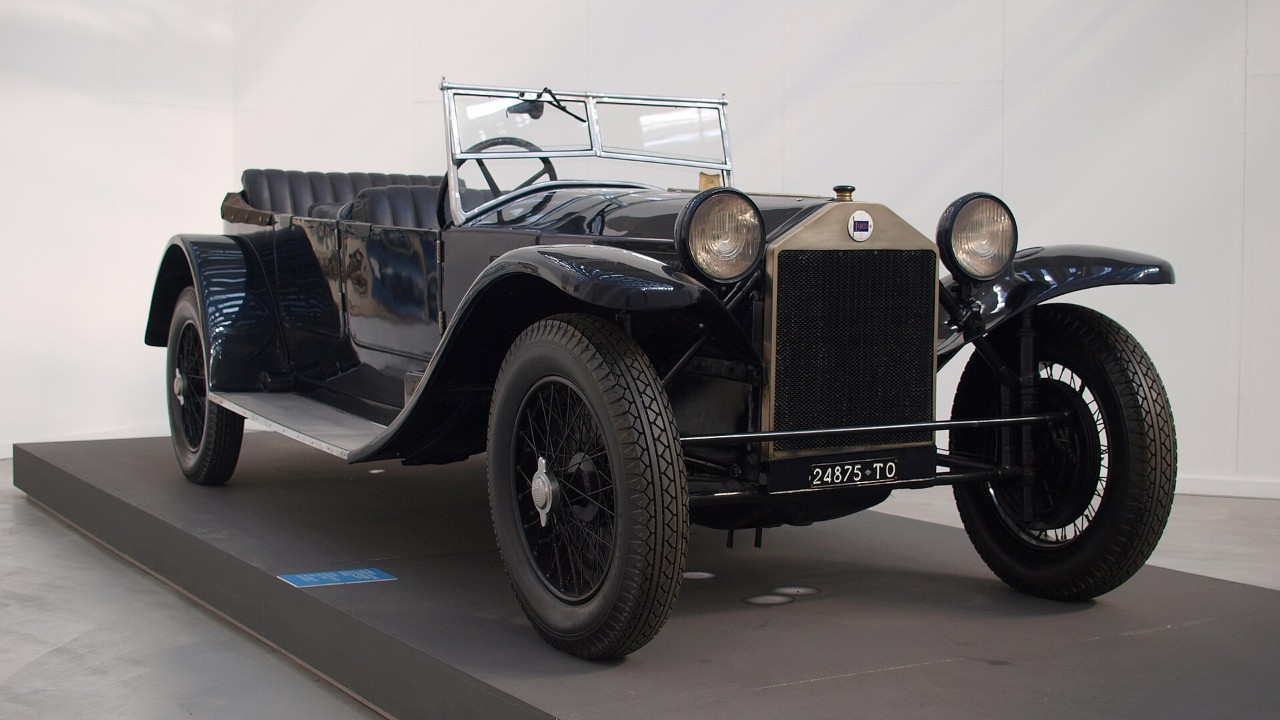
Most cars of the early 1920s bolted a body onto a separate steel frame. The Lancia Lambda did something different. Its body carried the load itself, and the engine and front suspension hung directly from that structure. Vincenzo Lancia showed the car at the 1922 Paris motor show, and it stayed in production for nine years.
That idea sounds ordinary today, because nearly every modern car is built the same way. In 1922, however, it was a bold bet for a small Italian company from Turin. The Lambda also brought a compact V4 engine and an unusual front suspension that Lancia kept using for decades.
So here is how the car worked, what it was like to drive, and how many left the factory before the last one rolled out in 1931.
Why the Lancia Lambda had no separate frame
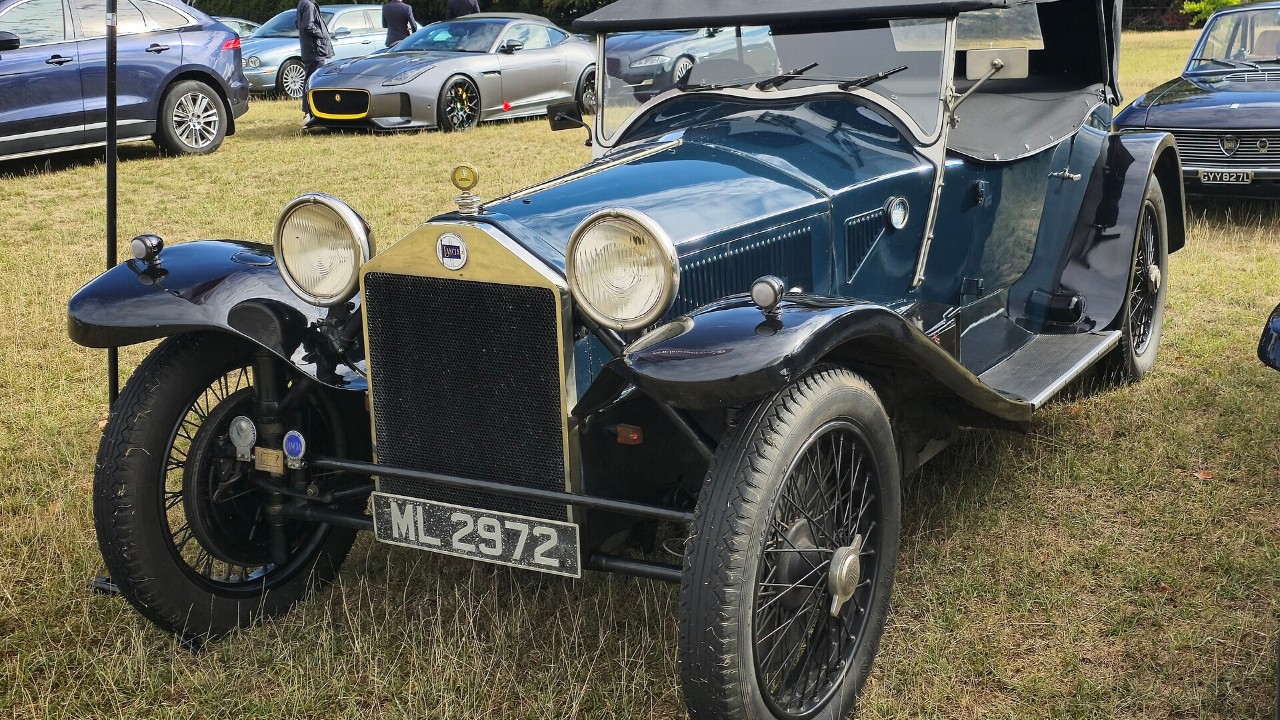
Vincenzo Lancia filed a patent in 1918 for a car body without a separate chassis. That was four years before the Lambda reached production, according to Classic & Sports Car. The patent drawings already showed a central tunnel for the propeller shaft.
In practice, the transmission tunnel and the rear axle tunnel formed a backbone that stiffened the whole shell, as Autozine explains. Because there was no frame underneath, Lancia could mount the body lower. As a result, the center of gravity dropped, and roadholding improved.
Where did the idea come from? Pinin Farina later recounted that Lancia drew inspiration from the strong hulls of the ships he sailed on to America. Either way, the result was a car that felt solid without carrying a heavy ladder frame. Lancia’s own 1910 catalogue had already argued the point: “Weight is not strength.”
The structure had one drawback. Because the body was the chassis, coachbuilders had little room to create their own designs. For that reason, factory bodies set the look of the long-wheelbase cars until later in the model’s life.
The sliding-pillar front end
The front suspension was just as unusual. Lancia’s lead engineer, Battista Falchetto, presented 14 design options for an independent front end before one was chosen. Autozine notes that Lancia wanted independent front suspension after a Kappa, the Lambda’s predecessor, broke its front axle in a race.
The chosen layout used sliding pillars. Each front wheel moved up and down on a vertical pillar inside a tube, with a coil spring and valving that controlled the flow of oil. In other words, the damper and spring lived together inside one neat unit. Lancia used the design for about 40 years.
Brakes were drums on all four wheels. At the time, the industry still argued over whether front brakes made a car unstable. Still, Falchetto’s tests showed no built-in stability problem, so the Lambda kept them.
A narrow V4 under a short hood
Lancia’s engineers Primitivo Rocco and Augusto Cantarini designed the engine in-house. It was a V4 with an aluminum block, iron head and overhead camshaft. Its two banks of cylinders sat just 13 degrees apart, so the engine was very short. That, in turn, allowed a shorter front end.
Early cars used 2,119 cc and made 48 bhp at 3,250 rpm, according to Classic & Sports Car. The Seventh Series of June 1926 grew to 2,375 cc and 58 bhp. Finally, the Eighth Series of 1928 used 2,568 cc and made 65 bhp at 3,500 rpm.
The narrow V4 idea outlived the Lambda by a long way. Lancia kept a V4 layout until the Fulvia ended production in 1976. Fans of later Lancias can see that line in our look at how the 1967 Lancia Fulvia HF dominated rallies.
Nine series in nine years
Lancia did not leave the car alone. Over nine years it built nine series, each with changes to the engine, body or controls. The first five series were open Torpedo tourers. For those cars, buyers could order a detachable hardtop made of fabric and wood, called the Ballon Smontabile.
Early cars had a three-speed gearbox. From the Fifth Series on, the Lambda gained a four-speed. Meanwhile, the Sixth Series of 1925 added a longer wheelbase. The short chassis measured 3,100 mm, while the long one stretched to 3,420 mm.
Later, Lancia licensed the Weymann saloon patent. It developed a central platform that fitted between the front and rear sections of the shell. The factory finished its first Weymann saloon in February 1926.
A Fourth Series Torpedo from 1924–25 weighed 1,065 kg, reached 68 mph and cost £675 new, Classic & Sports Car records. By comparison, an Eighth Series Torpedo topped 75 mph and cost £745. The Eighth Series Weymann saloon cost £875.
How the Lambda drove
The Lambda was a production touring car, not a purpose-built racer. Even so, its handling made it competitive. In the 1928 Mille Miglia, Autozine says, the Lambda kept pace with a more powerful Alfa Romeo race car because of the way it went around corners.
That is the real story of the car. A low body, a stiff shell and independent front wheels let a modest engine do more than its numbers suggest. For anyone who has driven a later Lancia, that balance will sound familiar. Our story on how the 1955 Lancia Aurelia B24 blended luxury and sport picks up the thread three decades on.
How many Lancia Lambda cars were built
The Eighth Series alone accounted for 3,901 cars, according to the Classic & Sports Car factfiles. Then came the Ninth Series, with a revised dashboard and minor changes.
Production ended on September 15, 1931. By then, Lancia had built 12,998 Lambdas, the figure Classic & Sports Car gives. Autozine lists a slightly lower total of 12,995, so the count varies by a few cars depending on the source. For perspective, Autozine points out that the Lambda arrived 12 years before the Citroën Traction Avant.
More from Fast Lane Only