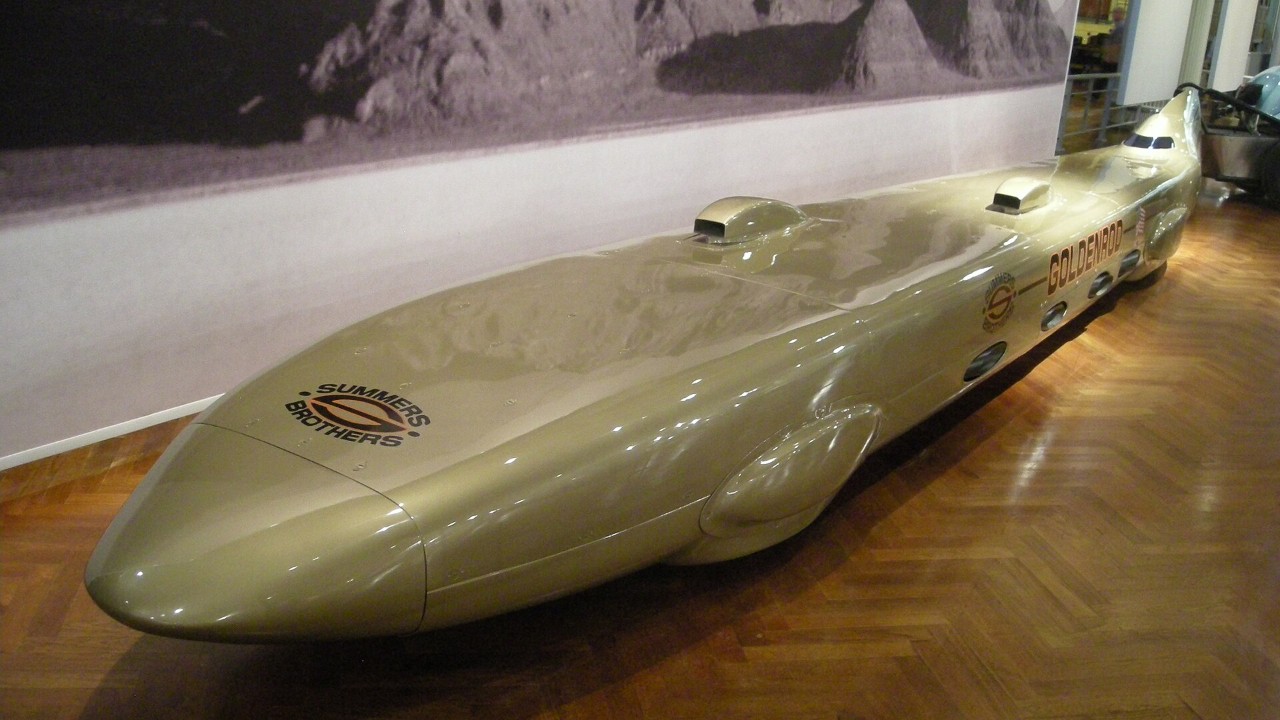
Bob Summers had one hour to make two runs across the Bonneville Salt Flats on November 12, 1965. When the timers finished, his Goldenrod streamliner had averaged 409.277 mph. The car carried four engines, drove all four wheels and used no jet power at all.
That last detail set it apart that fall. Cars pushed by jet aircraft engines had already gone past 600 mph in 1964 and 1965. However, the Summers brothers wanted a different prize: the fastest speed for a car driven through its wheels.
They built that car with help from sponsors and a borrowed set of Chrysler engines. Then they spent weeks waiting for the salt to dry. Here is how two hot rodders from California got there.
Two brothers from the dry lakes
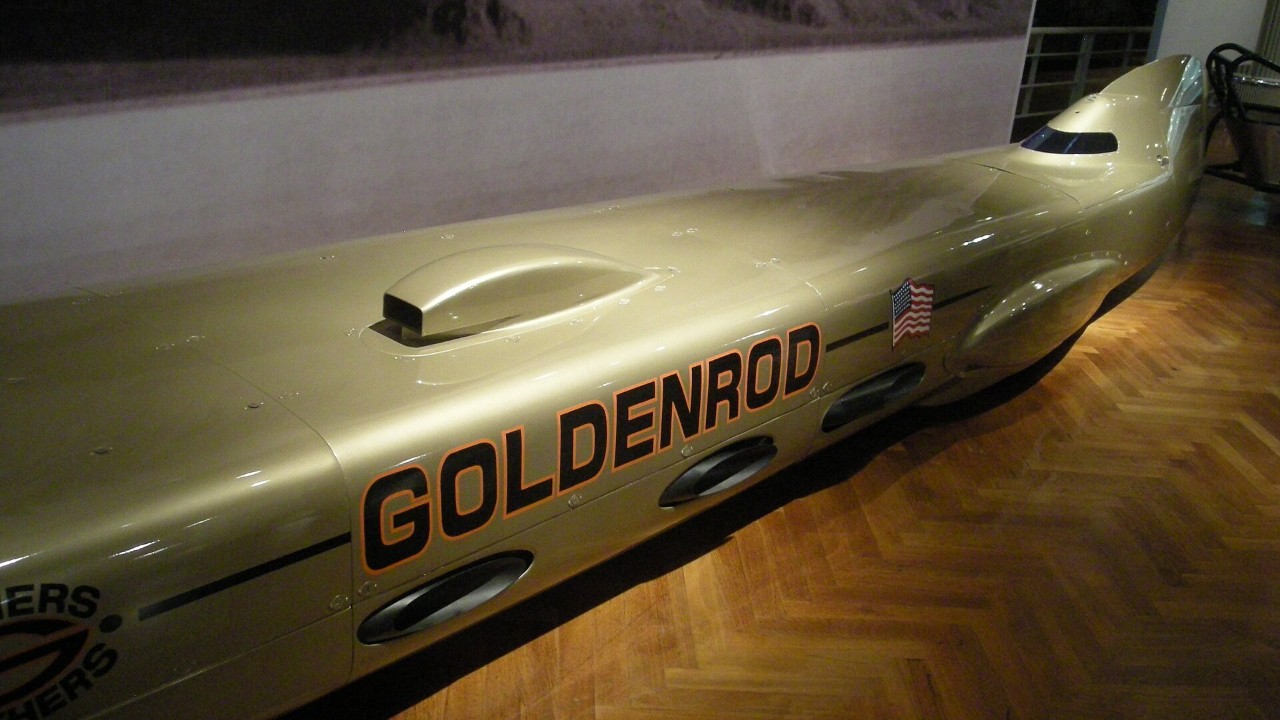
Bill and Bob Summers were California hot rodders, according to The Henry Ford’s history of Goldenrod, the museum where the car is displayed today. SEMA News describes them as essentially self-taught. They had raced on California’s dry lakes since the 1950s, and in 1963 they set a 279-mph Class C Streamliner record with a Hemi-powered car.
That same year, they set their sights higher. The Henry Ford says they decided to chase the absolute land speed record of 394.196 mph, set by John Cobb in 1947. Before they could start, though, Donald Campbell of Britain raised the mark to 403.10 mph. SEMA News notes that Campbell’s Bluebird was turbine-powered, and that 403-mph wheel-driven figure became the brothers’ target.
Shaping the Goldenrod streamliner
First, the brothers tested models in a California Institute of Technology wind tunnel, according to The Henry Ford. The shape they settled on was long and very slim. SEMA News puts the car at 32 feet long, 48 inches wide and 42 inches high.
The Henry Ford adds that the 42-inch figure was the top of the tail fin. At the engine covers, the Goldenrod streamliner stood only 28 inches tall. The museum also says this design set the pattern for later Bonneville streamliners, which are still built long and slim today.
Construction began in January 1965, in a shop that had once been a vegetable stand. SEMA News places that shop in Ontario, California. By August, the car was done. Then came two months of testing and changes before it was ready for the salt.
Four Hemis in a row
Instead of jets, power came from four 426-cubic-inch Chrysler Hemi V8 engines, The Henry Ford says. Chrysler loaned the engines to the brothers rather than selling them. According to SEMA News, the Hemis sat inline, one behind another, and stayed essentially stock apart from added fuel injection.
Getting all that power to the ground took a complex drivetrain. It sent power to the front and rear wheels, so all four did the work. Meanwhile, Hurst Performance helped build the transmissions and shifter mechanisms, SEMA News reports.
Paying for Goldenrod
The car wasn’t cheap, but it was cheap next to its rival. The Henry Ford puts Goldenrod’s cost at $250,000, well below the $3,000,000 Campbell needed for his car. Still, $250,000 was far more than the Summers brothers had.
So they found sponsors. George Hurst, the maker of shifters and forged wheels, signed on first, according to the museum. Next, Firestone agreed to make special low-profile tires and wheels. Chrysler loaned the engines, while Mobil Oil supplied fuel and funding. SEMA News adds Champion spark plugs to the list.
Record day at Bonneville
The weather nearly stopped them. SEMA News says poor weather kept Bonneville too wet to race through October 1965. In the end, the team ran in time first booked by Firestone for Art Arfons. Early runs also suffered from damaged wheel bearings.
The rules, however, were strict. A record needed two runs in opposite directions within one hour, The Henry Ford explains. On November 12, Bob Summers made his first run at 417 mph. After a full inspection, he left on the return run with only five minutes to spare. His two runs averaged 409.277 mph.
Goldenrod ran just once more, the next day, SEMA News reports. Afterward, Chrysler took its engines back.
Where Goldenrod is now
After that, the mark held for a long time. The Henry Ford says the record stood for more than 25 years. Bob Summers died in 1992, and Bill Summers died in May 2011, according to SEMA News.
Fortunately, their car survives. Goldenrod is on exhibit in the Driven to Win: Racing in America exhibition at the Henry Ford Museum of American Innovation, according to The Henry Ford.
More from Fast Lane Only