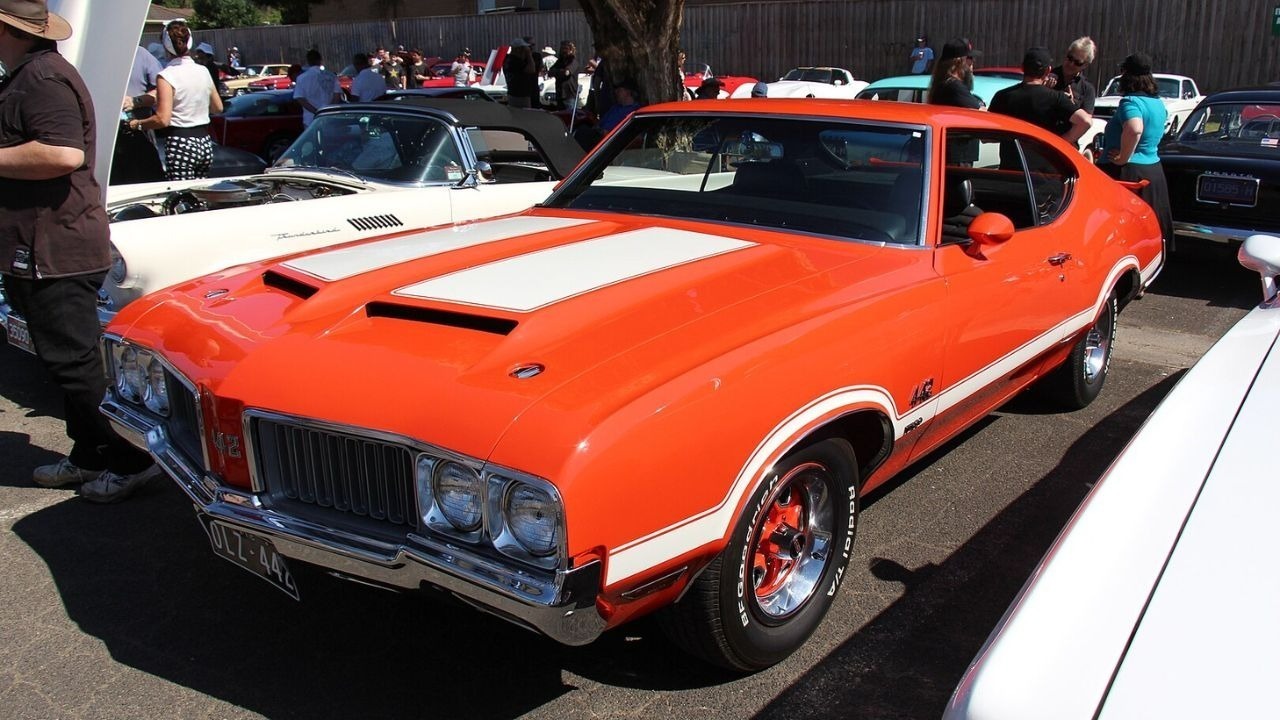
The 1970 Oldsmobile 442 arrived at the peak of Detroit’s horsepower wars with the hardware to match any street legend of its era. Yet half a century later, it rarely gets the same instant recognition as a Chevelle SS or a Hemi ’Cuda, even as collectors quietly push values higher. The story of how such a capable, charismatic car ended up in the shadow of its peers says as much about branding and nostalgia as it does about quarter-mile times.
As interest in overlooked 1970s performance cars grows, the 1970 442 is finally getting a second look from enthusiasts who want muscle car drama without paying headline-grabbing prices. That late recognition is reshaping how the car is discussed, collected, and restored.
From option code to performance flagship
The Oldsmobile 442 did not start life as a standalone model. It began as a performance package on the Cutlass, a mid-size entry in General Motors’ crowded portfolio of intermediate cars. By 1970, the 442 had evolved into its own distinct identity, with a big block V8, aggressive suspension tuning, and visual cues that set it apart from the more sedate Cutlass lineup.
That evolution created a car that could run with the most respected Detroit muscle machines of the period. Period road tests highlighted the 442’s blend of straight-line speed and surprising refinement, a combination that reflected Oldsmobile’s reputation for building slightly more upscale cars than its Chevrolet and Pontiac siblings. Yet that same positioning also planted the seeds of its later obscurity. Buyers who wanted raw, budget performance often gravitated to more youth-focused brands, while Oldsmobile’s image skewed older and more conservative.
Collectors now revisiting the era have started to treat the 1970 442 as one of the underappreciated standouts among 1970s muscle cars. It offers the same basic formula as more famous GM A-body models, but with a distinct Oldsmobile character and styling that has aged gracefully.
Styling that whispered instead of shouted
One reason the 1970 442 never dominated posters and T-shirts the way some rivals did lies in its design language. The car had presence, with its sculpted fenders, quad headlights, and available stripes, but it rarely crossed into cartoonish territory. Many examples were ordered with vinyl roofs, bright trim, and tasteful colors that emphasized elegance over menace. On a crowded boulevard, it could blend in with Cutlass Supremes and Delta 88s instead of screaming for attention.
That understated approach has become a selling point for modern buyers who want period-correct flair without the visual excess. Enthusiasts who study the era often point out how certain vinyl topped muscle from the golden age now look more sophisticated than the bare-metal bruisers that dominated magazine covers. The 1970 442 fits neatly into that category, especially in higher trim levels that added premium interiors and subtle exterior details.
At the time, however, that balance between luxury and aggression made the 442 harder to market to the youth crowd that defined muscle car mythology. When enthusiasts later built their mental picture of the era, they tended to remember the loudest designs first, which pushed the Oldsmobile toward the margins of popular memory.
Outgunned in the nostalgia wars, not on the street
In pure performance terms, the 1970 442 had little reason to hide. Its big block powerplants and heavy-duty components gave it the ability to run with, and sometimes outrun, more famous rivals on the drag strip. Yet as muscle car nostalgia took off in later decades, the spotlight settled on a small group of nameplates that became shorthand for the entire era.
Enthusiast communities often cite cars like the Chevrolet Chevelle SS 454, Pontiac GTO Judge, and Plymouth Road Runner as the default icons. Lists of muscle cars enthusiasts tend to feature these headline models, which were heavily promoted in period advertising and later immortalized in movies, TV shows, and die-cast collections. The 442, despite similar capability, appeared less frequently in that pop culture mix.
Brand hierarchy inside General Motors also played a role. Chevrolet and Pontiac had long been positioned as the performance divisions, while Oldsmobile balanced technology and comfort. That meant fewer wild special editions, fewer racing tie-ins, and less of the rebellious marketing that made other cars cultural touchstones. As a result, when younger generations looked back, the 442 was often seen as a “grown-up” muscle car, respectable but not mythic.
Overshadowed by its own little brother
The 442’s identity was further complicated by Oldsmobile’s decision to chase younger buyers with a cheaper, smaller performance model. The company developed the Cutlass-based Rallye 350, a budget-oriented muscle car with a distinctive appearance package and lower price point aimed at drivers who could not afford the higher-end 442.
Modern coverage of Oldsmobile’s performance history often highlights how this cheaper muscle car has faded almost completely from public memory. That amnesia illustrates a broader pattern. Oldsmobile’s performance efforts were fragmented across several nameplates and strategies, which diluted the 442’s role as the clear halo car. While the 1970 model year delivered one of the most capable versions of the 442, the brand’s overall messaging never cemented it as the single definitive Oldsmobile performance icon.
As Oldsmobile’s fortunes declined in later decades and the brand eventually disappeared, the historical narrative around its muscle era became even harder to maintain. Without a modern showroom presence or contemporary advertising to keep the badge in front of younger enthusiasts, the 442 slipped further behind better-known rivals from still-active brands.
Why the 1970 442 speaks to collectors now
Current market behavior suggests that the 1970 442’s time in the shadows may be ending. Collectors who have been priced out of the most famous muscle cars are increasingly hunting for models that deliver similar performance and period authenticity at a relative discount. In that search, the Oldsmobile checks several boxes at once.
Analysts who track auction results and private sales frequently group the 442 among underrated muscle cars that offer strong value compared with their more hyped peers. The car’s combination of big block power, distinctive Oldsmobile styling, and relative rarity on modern roads gives it a sense of occasion that some more common models lack. At the same time, parts interchangeability with other GM A-body platforms helps keep restoration costs manageable.
For many buyers, the appeal lies in owning something that feels authentic to the era but still stands apart at shows and cruise nights. A 1970 442 in a rich metallic color with a period vinyl roof and factory wheels can look both familiar and slightly unexpected, a reminder that Detroit’s performance story was more diverse than the short list of usual suspects.
Preserving an underdog’s legacy
The renewed interest in the 1970 Oldsmobile 442 raises questions about how enthusiasts and historians preserve automotive heritage. When attention and money flow toward a small group of superstar models, other cars that shaped the same era risk being forgotten, even if they delivered similar thrills to their original owners.
Clubs and online communities dedicated to Oldsmobile performance have taken on some of that preservation work, sharing documentation, decoding trim tags, and cataloging surviving cars. As more collectors seek out 442s, those grassroots efforts gain importance. They help verify original specifications, track rare option combinations, and keep knowledge circulating among new owners who may be encountering the brand for the first time.
There is also a cultural dimension. The 1970 442 embodies a particular vision of American performance that combined speed with comfort and a hint of formality. Recognizing its place in history means acknowledging that muscle car culture was never monolithic. It included buyers who wanted a car that could run hard on Saturday night and still feel appropriate in an office parking lot on Monday morning.
What the future might hold for Oldsmobile’s quiet heavyweight
Looking ahead, the 1970 Oldsmobile 442 is likely to continue its climb from overlooked player to respected alternative. As new generations of enthusiasts discover the car through digital media, auction coverage, and word of mouth, its profile should keep rising, even if it never reaches the price peaks of the most famous nameplates.
More from Fast Lane Only
- Unboxing the WWII Jeep in a Crate
- 15 rare Chevys collectors are quietly buying
- 10 underrated V8s still worth hunting down
- Police notice this before you even roll window down
*Research for this article included AI assistance, with all final content reviewed by human editors