The last years of the second-generation Chevrolet Camaro looked, on paper, like the wrong moment for a pony car to surge. Emissions rules, fuel crises, and shrinking performance had hollowed out the segment that the Ford Mustang had once dominated. Yet as the 1970s closed, the final evolution of this long-running Camaro quietly turned into a sales force, outpacing rivals that had defined the class only a decade earlier.
By the late 1970s, the Camaro had become the rare survivor in a shrinking field, and it did more than simply hang on. It leveraged a distinctive blend of European-influenced styling, driver-focused dynamics, and timely updates to pull ahead of competitors that either retreated from performance or disappeared entirely. The result was a car that not only beat expectations but, in key years, beat the Mustang for the first time.
From underdog to segment leader
The Camaro did not begin the decade as the obvious favorite. After the Ford Mustang had defined the pony car template in the 1960s, Chevrolet spent the early 1970s chasing a rival that still controlled the segment. Even as the second-generation Camaro arrived with a more sophisticated chassis and sleeker body, the balance of power remained tilted toward Dearborn, a reality summed up in period accounts that describe how, after the Ford Mustang set the pace through the 1960s and much of the early 1970s, the tables only began to turn later in the decade.
What changed was not a single breakthrough but a steady repositioning of the Camaro as the enthusiast’s choice just as other nameplates lost their nerve. GM engineers described the second generation as more of a Driver Car than the original, a machine tuned for handling and feel rather than straight-line bravado. Contemporary commentary on the 1975 Camaro noted that this “new Camaro” won acclaim as a driver oriented car with handling that was vastly superior to most American cars of the time, a reputation that helped it stand out as performance numbers across the industry softened. That shift in character laid the groundwork for the sales surge that would follow when the market began to reward cars that still felt engaging even if raw horsepower had declined.
Styling that aged into an advantage
Design turned out to be one of the Camaro’s most durable weapons. The second-generation car drew clear inspiration from European grand tourers, with long-hood, short-deck proportions and a flowing roofline that critics compared to Italian and European exotics. One detailed design retrospective even juxtaposed the Camaro with the Ferrari 250 GT Lusso and noted how the Lusso appeared purely Italian and European while the Camaro still somehow had an Amer identity, a telling contrast that underscored how Chevrolet had managed to blend continental elegance with domestic muscle.
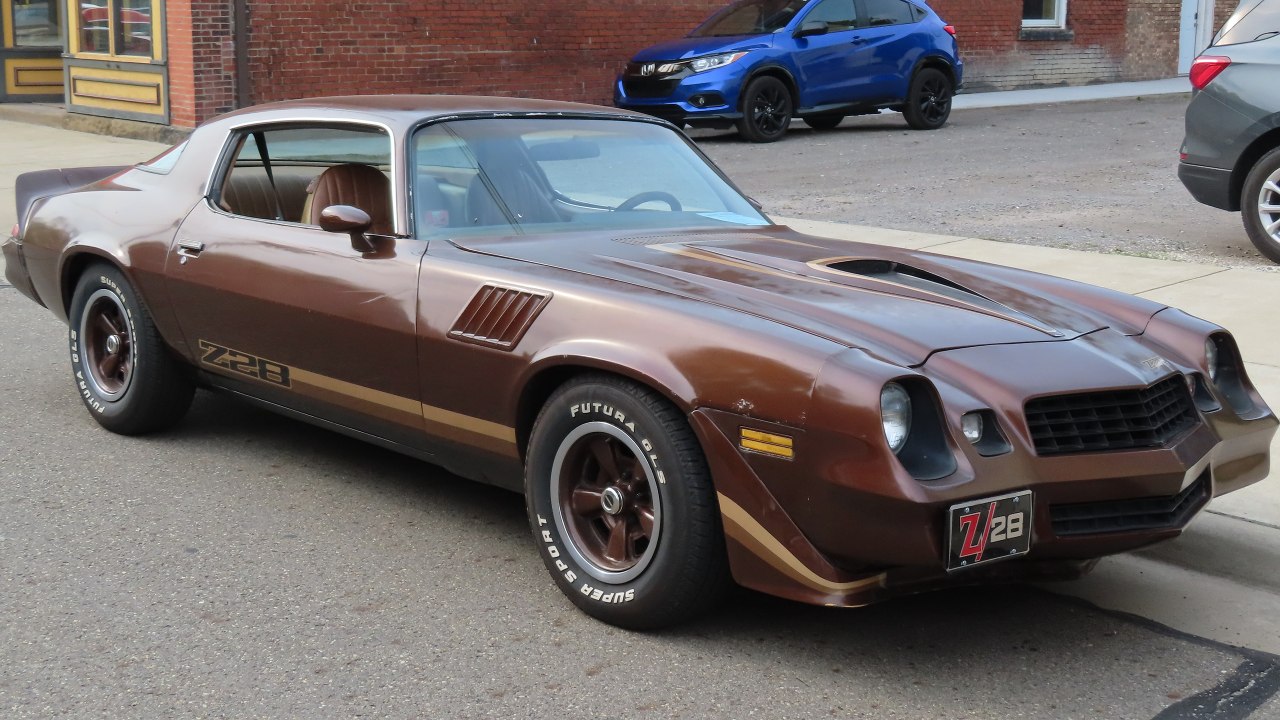
That visual balance mattered more as the decade wore on and rivals either grew awkward or disappeared. Where some competitors adopted blockier shapes or compromised proportions to meet bumper and safety rules, the Camaro’s basic form proved adaptable. A later refresh, described as Restyled Refreshed for the second time, gave the 1978 Chevy Camaro new life with updated front and rear treatments that modernized the look without sacrificing the familiar profile. By the time the license plate on one well-known example read “LAST 1,” the car’s styling had become a recognizable constant in a segment that had otherwise fragmented, helping Chevrolet keep buyers who wanted something that still looked like a proper pony car.
Engineering a “driver’s car” in an era of constraints
Under the skin, the Camaro’s evolution through the 1970s shows how careful engineering could turn regulatory headwinds into a relative advantage. As compression ratios fell and catalytic converters arrived, outright power figures dropped across the board, but Chevrolet worked to preserve the car’s character. GM engineers later said the second generation was much more of a Driver Car than its predecessor, a claim borne out by period road tests that praised its balance and steering even when acceleration numbers no longer matched late 1960s muscle.
The Z28 in particular became a halo that kept enthusiasts engaged. When Chevrolet revived the Z28 mid-decade, it used a 350 cu in (5.7 L) LM1 V8 with a four-barrel carburetor producing 185 hp (138 kW; 188 PS), with some versions rated at 175 hp (175) depending on configuration. Those figures no longer shocked anyone raised on big-blocks, yet the combination of a responsive small-block, four-speed manual, and chassis tuning still made for an “awesome performer” in the words of one detailed history of the Z28’s first 25 years. Even as the Rally Sport option disappeared by 1974 and All Z28s adopted a more unified appearance, the mechanical package kept the Camaro credible with drivers who cared about more than straight-line bragging rights.
Competitors retreat while Camaro holds the line
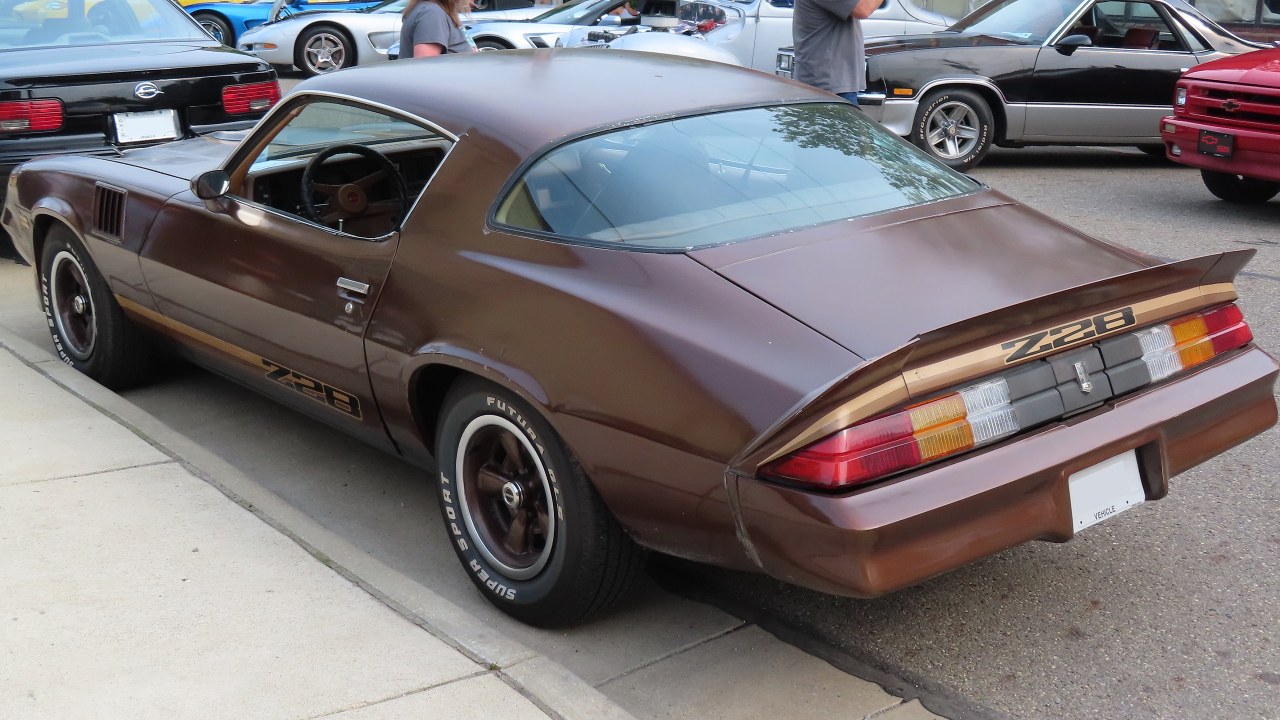
The Camaro’s late-1970s success cannot be understood without looking at what happened to the rest of the pony car field. As insurance costs, emissions rules, and fuel prices rose, several once-formidable rivals either shrank into softer personal coupes or vanished entirely. A detailed review of early 1970s high-performance pony cars notes that The Trans Am was a marginal player early on, with output hitting a low of 1,266 units in 1972, and that by the middle of the decade other nameplates such as the Cougar and Javelin/AMX were discontinued or repositioned away from the original formula. Against that backdrop, the Camaro and its F-body sibling, the Pontiac Firebird, became the surviving compact-based pony cars almost by default.
Survival alone did not guarantee success, however, and even GM briefly questioned whether it was worth keeping the program alive. One in-depth history recounts how, Facing those problems, GM seriously considered dropping both the Camaro and Pontiac Firebird as the oil crisis and tightening standards bit into sales. Instead, Chevrolet doubled down on incremental improvements, refining ride and handling, improving build quality, and keeping performance-oriented trims alive even as absolute power numbers fell. That decision paid off when buyers who still wanted a sporty coupe found that the field had narrowed to essentially two choices, and the Camaro, with its more aggressive image and growing reputation as a driver’s car, often came out ahead.
How the final ’70s Camaro beat the Mustang at its own game
The most striking measure of the late second-generation Camaro’s impact is that it finally managed to outsell the Mustang, a feat that had eluded Chevrolet since the nameplate’s birth. Reporting on the rivalry notes that Camaros from 1977-78 brought more power and that Chevrolet’s Camaro outsold the Mustang for the first time in 1977, a symbolic turning point in a contest the Mustang had dominated for more than a decade. Another long-view analysis of the sales battle points out that while the Mustang controlled the segment through the 1960s and much of the early 1970s, The Camaro Fights Back in the 70s and 80s, capturing key years as Ford’s strategy shifted toward the smaller, more economy-focused Mustang II.
Over the full decade, Ford still moved more metal, with Chevrolet selling 1,658,545 Camaros while Ford moved 2,081,007 M Mustangs in the 1970s. Yet those totals obscure how the momentum shifted once the Mustang II’s softer, downsized formula collided with a Camaro that still looked and felt like a serious performance car. Analysts who have revisited the era argue that Out Muscling the Mustang in specific model years mattered as much as the cumulative tally, because it showed that buyers were willing to reward a car that stayed true to the pony car idea even in lean times. In that sense, the late 1970s Camaro did not just win a sales race, it won an argument about what this kind of car should be.
The legacy of the “last” second-gen Camaro
By the time the second-generation Camaro reached its final model years, it carried the weight of a long production run and a changing market, yet it had also matured into a coherent product with a clear identity. Commenters looking back on early cars have called the 1970 Camaro one of GM’s greatest hits, with even European design houses like Pininfarina reportedly impressed, and later enthusiasts have debated whether the 1970 Camaro Z28 might be the greatest Camaro Z28 ever built. Those early accolades set a high bar, but the late 1970s cars met it in a different way, not through raw innovation but through refinement and resilience.
When I look at how the final 1970s Camaro outsold its competition, I see a car that succeeded by staying recognizably itself while the world around it shifted. It kept the long-hood stance that echoed Italian and European grand tourers yet remained unmistakably Amer, preserved a Driver Car feel even as horsepower ratings like 185 and 175 replaced the wild figures of the muscle era, and weathered corporate doubts that had GM considering the end of Camaro and Pontiac Firebird production altogether. In a decade when many performance nameplates blinked, the Camaro’s persistence, and its late-decade sales victories over the Mustang, turned the “last” of the second generation into something more than a swan song. It became proof that a well-executed pony car could adapt to new rules and still come out ahead.
More from Fast Lane Only: