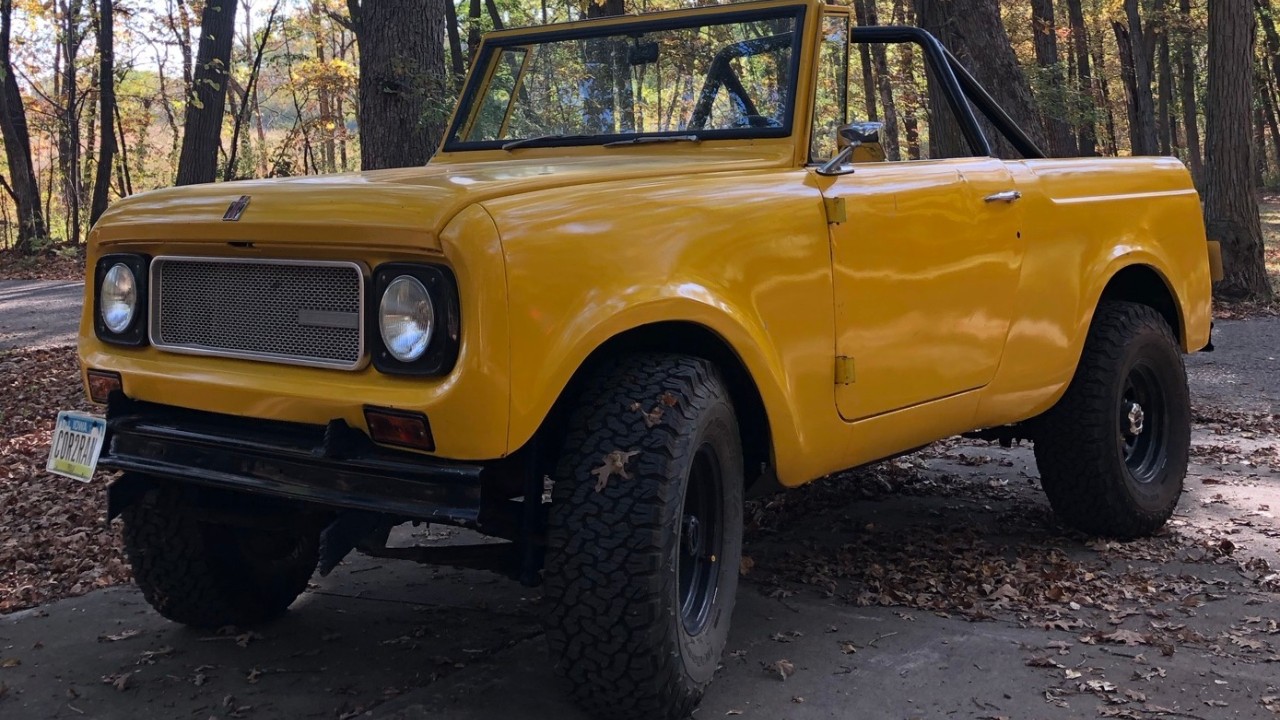
The first International Harvester Scout 80 had a windshield that folded down. Its wipers sat at the top of that glass instead of the bottom, and they worked on vacuum.
Those two details say a lot about the little truck. International built it as a plain, open utility rig to take on the Jeep, and the open-air hardware stayed for most of the first model’s run.
Here is how the Scout 80 was put together, what the folding glass and top-mounted wipers meant in practice, and when International finally changed them.
A Scout 80 built as a work truck
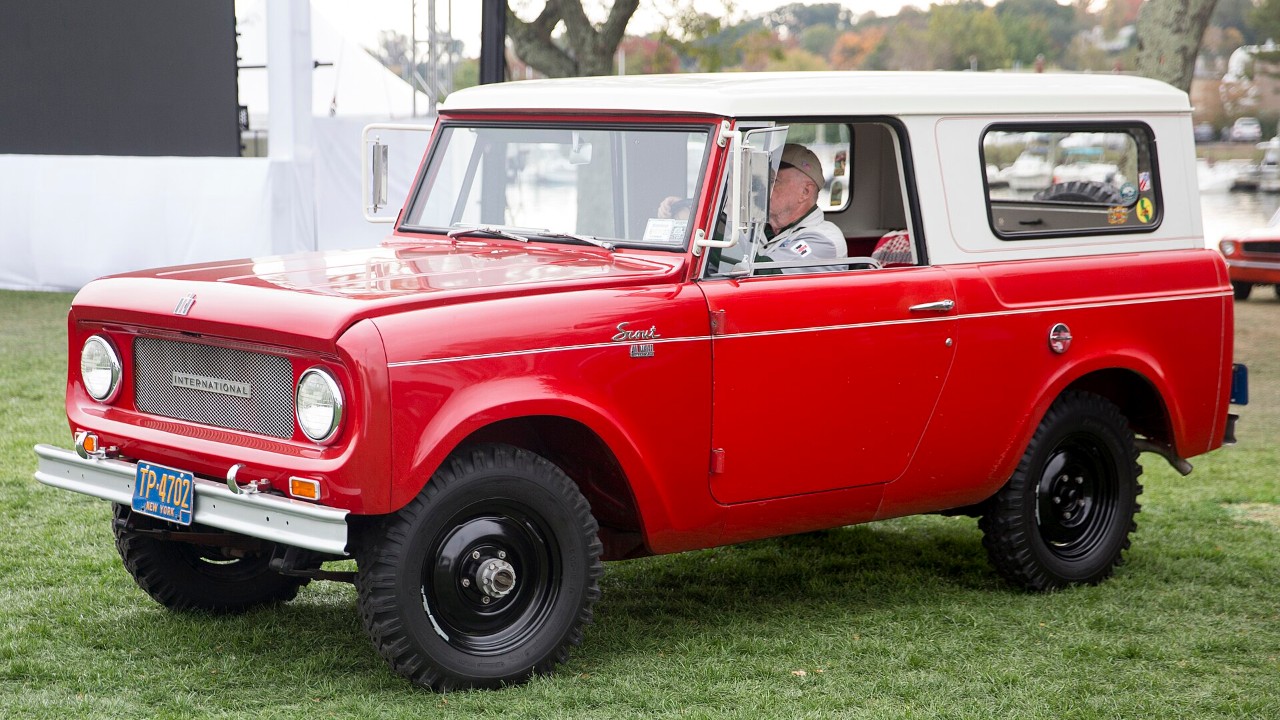
International Harvester introduced the Scout in late 1960 as a 1961 model. According to Off Road Xtreme’s history of the first Scouts, it went on sale as a commercial utility truck. The same history calls it an intended competitor for the Jeep CJ.
Production took place at the company’s plant in Fort Wayne, Indiana, says Autotrader Classics in its buyer’s guide. The guide also says International developed the body as an open vehicle, which is why the folding windshield came with it.
The basic idea came from inside the company. Sports Car Market credits lead design engineer Ted Ornas with the concept. It adds that International offered three body styles: a pickup, a wagon called the Traveltop, and an open body.
Underneath, the hardware stayed simple. SlashGear describes a stout ladder frame with solid axles on leaf springs. Buyers could also choose two-wheel or four-wheel drive, both SlashGear and Autotrader say.
The windshield that folded down
The headline feature was the glass itself. Off Road Xtreme lists the fold-down windshield among the Scout 80’s defining traits and notes that it lasted longer than some other early features. Sports Car Market adds that it stayed through the end of Series 80 production in late 1964.
International sold the idea hard. SlashGear quotes period Scout advertising that promised “even the windshield folds down,” along with doors and windows that were “easy to take off.” In other words, the Scout could be a fully open truck when the weather allowed.
The early side glass followed the same thinking. Off Road Xtreme says sliding side windows, which were also removable, disappeared after the very early 1962 models. Meanwhile, Autotrader notes that roll-up windows, arm rests, a radio and a heater/defroster were options on early trucks.
Why the Scout 80 wipers sat above the glass
On the Scout 80, the wipers mounted at the top of the windshield rather than at its base. Autotrader describes them as vacuum-operated, and Off Road Xtreme calls them vacuum-controlled.
That setup fit the truck’s bare-bones brief. Autotrader groups the vacuum wipers with a lack of carpet and the missing roll-up windows as signs of how basic the first Scouts were.
The change came with fixed glass. When the Scout 800 replaced the 80, Autotrader says, a fixed windshield took over from the folding design. As a result, the wipers moved from the top of the windshield to the bottom. Off Road Xtreme likewise lists a stationary windshield, bucket seats and push-button door handles on the 800.
The sources differ on that timing, however. Autotrader and Off Road Xtreme place the Scout 800 in 1965, while SlashGear says International refreshed the truck as the Scout 800 in 1966.
What powered it
Every Scout 80 used a four-cylinder engine. Off Road Xtreme calls the 152-cubic-inch four standard, and SlashGear says it was the only engine on offer. SlashGear also explains its origin: it was basically half of International’s 304-cubic-inch V8.
Autotrader names the engine the Comanche and rates the base 152 at 90 hp and 135 lb-ft of torque. Sports Car Market, for its part, calls it a slant-four derived from that V8.
Inside, the truck stayed just as plain. Sports Car Market mentions a bulkhead behind the front seats that walled off the rear compartment. Later, Autotrader says, International dropped that bulkhead on Traveltop models in 1962.
Sales, survivors and values
The plain recipe worked. By the end of Series 80 production, Sports Car Market says, International had built more than 100,000 Scouts. It marked the milestone in 1964 with the limited-edition Red Carpet Special, and Off Road Xtreme says only 3,000 of those came out.
Price helped, too. Autotrader puts the original 4×4 at around $2,100. The first-generation Scout then ran until late 1970, Sports Car Market says.
Today, the early trucks draw real money. Sports Car Market reports that a restored and lightly modified 1962 Scout 80, Lot 706, sold for $33,000 with buyer’s premium at Barrett-Jackson’s Palm Beach auction on April 13, 2014.
More from Fast Lane Only