Jim Clark gave the Lotus 49 a win in its very first race, the Dutch Grand Prix at Zandvoort on June 4, 1967. It was also the first race for the engine bolted behind him, the Ford-funded Cosworth DFV V8.
That sounds like a perfect debut. Even so, the weekend was far from smooth for Team Lotus. Clark started back in the pack, and his teammate’s car broke while it was leading.
So here is how the race unfolded, what made the new car different, and how the rest of Clark’s 1967 season played out.
A new kind of car in the Lotus 49
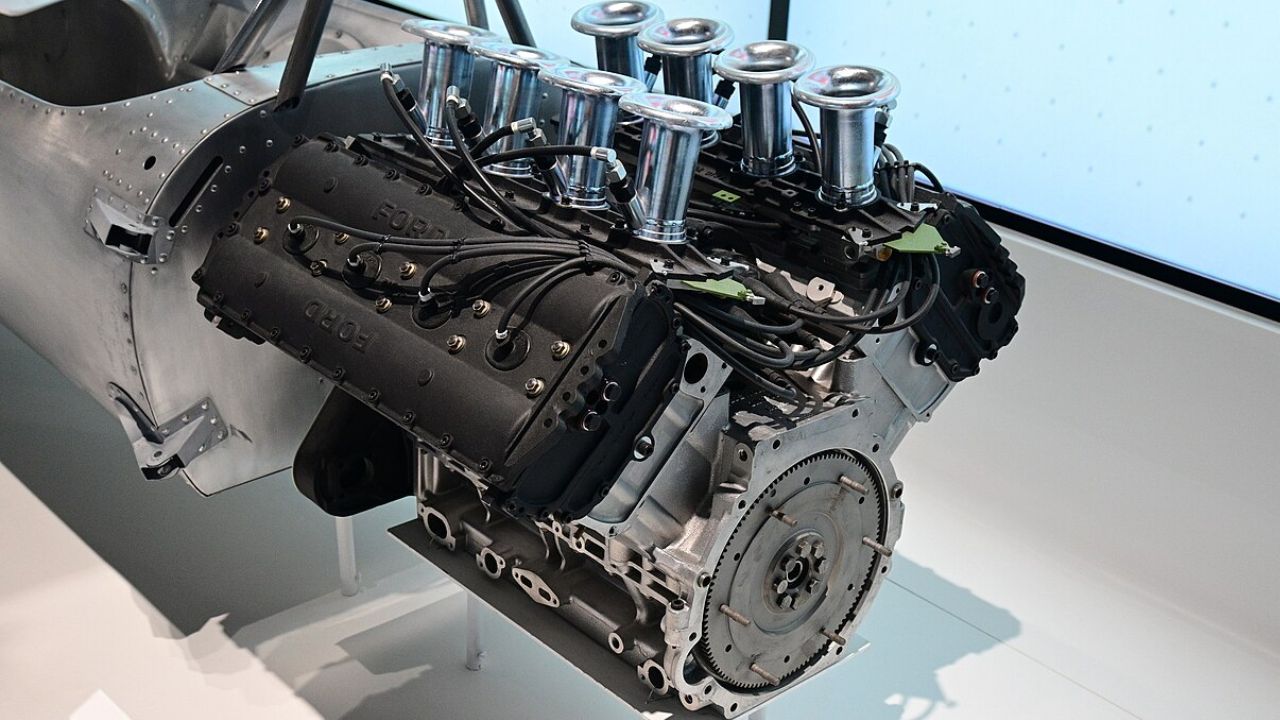
First, the idea came from Colin Chapman. According to historian Doug Nye, writing for the Revs Institute’s history of chassis 49/2, Chapman conceived the car and Maurice Phillippe handled the detail design. Keith Duckworth designed the engine. Ford of Dagenham, England, funded its initial design and development.
The packaging was the big step, though. Nye explains that the V8 served as the car’s rearmost structural chassis member. Just four bolts attached it to the front monocoque, right behind the driver’s seat back. In turn, the engine carried all the major rear suspension and drive loads.
Meanwhile, the power was serious, too. In his report for the July 1967 issue of Motor Sport, Denis Jenkinson wrote that Team Lotus brought two Lotus 49 cars to Zandvoort with Cosworth 3-litre V8s, “each with well over 400 bhp.”
A rough practice for Clark
At first, it looked like Graham Hill’s weekend. In qualifying, Jenkinson reported, the official timekeepers gave Hill a pole time of 1min 24.6sec, though many spectators clocked him at 1min 25.0sec.
Either way, the gap was clear. GrandPrix.com’s race record says Hill was about half a second faster than Dan Gurney’s Eagle-Weslake and a full second quicker than Jack Brabham. As a result, Hill and Gurney shared the front row, with Brabham third.
Clark, by contrast, had trouble. Jenkinson wrote that a ball-race in the right-rear hub of his car broke up and split the hub carrier. As a result, he started eighth on the grid, according to GrandPrix.com’s results table.
How the race at Zandvoort unfolded
Hill then made the start count. In Jenkinson’s words, “Hill led from Brabham round the first corner, with Rindt, Gurney, Amon and Clark right behind.” Gurney’s chance ended early. The official record shows his Eagle out after eight laps.
Then the leading Lotus failed. GrandPrix.com says Hill’s car suddenly slowed on the 11th lap, and Brabham took over the lead. Jenkinson found the cause: teeth had broken off one of the camshaft drive gears. Afterward, Jenkinson noted, a crowd huddled around the stopped car’s Cosworth V8. The official Formula 1 result lists Hill as a retirement after 11 laps.
That left Clark to carry the new car. GrandPrix.com says he passed Jochen Rindt on lap 15 and took the lead on lap 16. From there, Jenkinson wrote, Clark “just motored relentlessly on into the distance.”
After that, he never needed to push. Jenkinson describes Clark lapping at just over 1min 28sec, “his driving being smooth and effortless, while the Cosworth V8 engine never missed a beat.”
The official result
The official Formula 1 result shows Clark winning in his Lotus Ford after 90 laps, in 2 hours, 14 minutes and 45.1 seconds. He also collected 9 points for it.
Behind him, Brabham finished second, 23.6 seconds behind. His teammate Denny Hulme took third at 25.7 seconds, while Chris Amon brought his Ferrari home fourth, 27.3 seconds back. Mike Parkes and Ludovico Scarfiotti completed the points for Ferrari, both a lap down.
What came after the Lotus 49 debut
Clearly, the win was no fluke. Formula 1’s 1967 results show Clark winning three more times in the Lotus Ford that season: the British Grand Prix on July 15, the United States Grand Prix on October 1 and the Mexican Grand Prix on October 22.
Clark still missed the title, however. The official 1967 standings put Hulme first with 51 points and Brabham second with 46. Clark finished third with 41.
Meanwhile, the engine’s run had only begun. Nye writes that the DFV went on to win 11 more World Championship Grands Prix in Lotus 49 chassis, and 155 in all. It also took seven straight titles from 1968 to 1974, Nye says. Those came in Lotus, Matra and Tyrrell cars. As for Clark’s 1967 victories, Nye notes that chassis 49/2 carried him to the Dutch, British and United States wins.
More from Fast Lane Only