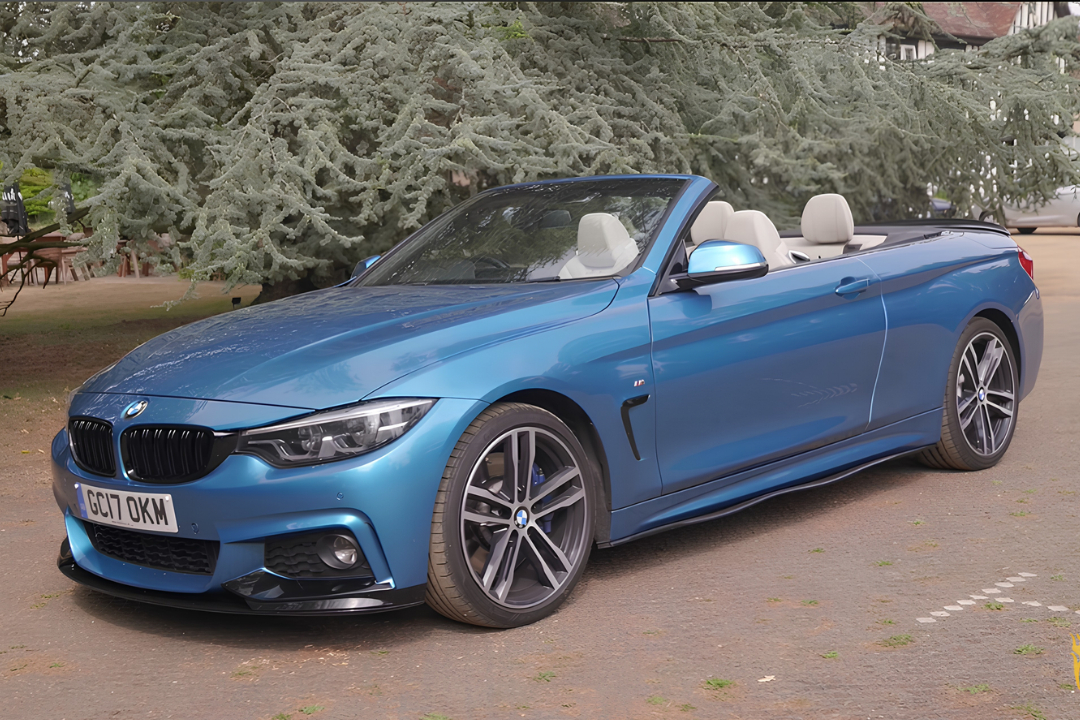
Some cars get judged unfairly before you even turn the key. The BMW 4 Series was one of them. When BMW split the 3 Series lineup thirteen years ago, carving the coupe and convertible off into a new nameplate, the naming split became the most talked-about part of the launch, with plenty of longtime fans questioning whether it was really a new model at all.
The convertible version of that first-generation 4 Series, badged the 440i once the B58 engine arrived in 2016, has spent years living in the shadow of flashier siblings. It never had the M badge, the naturally aspirated drama, or the reputation that follows the E93 M3 around every enthusiast forum. What the driving impressions suggest instead is a car built around being comfortable, composed, and sensible enough to use every day.
That is exactly the question worth asking about a well-used example with 86,000 miles on the clock. Can a turbocharged straight-six convertible, now available for around £13,000, genuinely out-argue a car as beloved as the E93 M3 when the only metric that matters is which one you would rather own?
The first impression undersells it
Stepping on the throttle for the first time is not where this car makes its case. Despite carrying the B58, an inline-six that has become something of a modern legend for how easily it can be tuned well past its factory output, this particular car felt oddly reluctant lower in the rev range. At just 326 horsepower and 322 lb-ft from the factory, the numbers were always modest for the engine’s potential, and nearly 1.9 tons of convertible does not help matters.
The initial reaction was genuine disappointment, with turbo lag more noticeable than expected on something built around forced induction. Overtaking on a country road took more planning than it should have, and for a few minutes the car looked like it was heading toward a fairly unflattering verdict.
That impression did not last, and the reason why matters more than the impression itself.
Driving it wrong is the whole problem
The trick, it turns out, is to stop treating the B58 like a turbo engine at all. Push the revs past 3,500 to 4,000 RPM and the lag effectively disappears, the gearbox sharpens up, and the whole car shifts into something closer to a sports car than a boulevard cruiser. Once you adjust your driving style to match what the engine actually wants, the earlier disappointment mostly evaporates.
The chassis backs that up in a way that surprised even a reviewer who has spent plenty of time in older BMW convertibles. Scuttle shake, the flex and shudder that plagues so many drop-top cars once the roof comes off, is barely present here. That marks a real difference from the E46 convertible, whose lack of rigidity was singled out as its biggest weakness by an owner who had loved that car and regretted selling it.
Steering feel follows the same pattern. It will not be confused with a Lotus Elise, but there is genuine feedback through the wheel, more than in several other modern BMWs and, more provocatively, more than in the well-loved E46. That is not a small claim to make about a car most enthusiasts assume is the more emotional, more engaging machine by default.
The comparison nobody expects to win
This is where the E93 M3 becomes relevant, not as a rival on a track day but as the obvious car cross-shopped by anyone browsing this price range. The M3 has the naturally aspirated V8, the motorsport pedigree, and a following that borders on religious.
The 440i counters with the kind of ownership case the M3 was never built to make. It gets nearly 40 miles per gallon driven gently, comes without a particulate filter muting its exhaust note since it predates that regulation, and still packs a stereo, proper climate controls, and a dashboard that mixes analog gauges with digital displays, a layout its own reviewer said he preferred over the current trend of screens bolted onto the dash. The exhaust itself earns real praise, with enough crackle and pop on overrun to feel special without crossing into obnoxious.
At the used values these cars have settled into, easier warranty coverage, more modern equipment, and meaningfully better fuel economy all tilt daily practicality firmly toward the 440i, even before considering the M3’s reputation for expensive upkeep as an older performance V8.
Practicality has its own kind of charisma
None of this means the 440i is the more exciting car in isolation. It is not trying to be. What it offers instead is the sense that BMW got the fundamentals right in a way that only becomes obvious once you stop expecting fireworks. A folding hardtop that operates cleanly, seats that hold up well after 86,000 miles despite some wear on the dashboard trim elsewhere, and a car that still feels composed on rough tarmac even on passive, non-adaptive suspension.
The verdict is not that the 440i beats the M3 on any single measure that enthusiasts care about most. It is that the M3’s advantages live almost entirely in feeling, while the 440i’s advantages live in every single day you would actually spend behind the wheel. For a car nobody took seriously when the badge first appeared, that is a fairly complete kind of vindication.
More from Fast Lane Only
- Unboxing the WWII Jeep in a Crate
- 15 rare Chevys collectors are quietly buying
- 10 underrated V8s still worth hunting down
- Police notice this before you even roll window down
*Research for this article included AI assistance, with all final content reviewed by human editors.