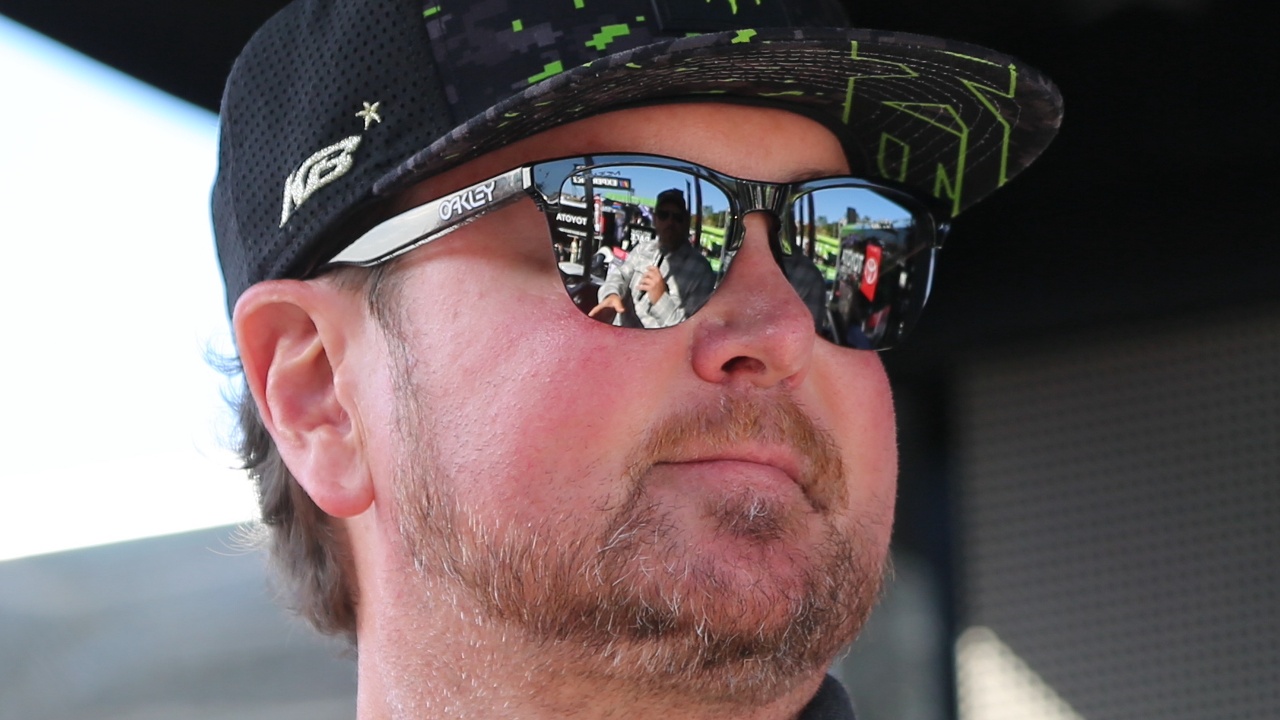
Kurt Busch had already convinced himself that his time in the NASCAR spotlight was winding down when a short, pointed message from Michael Jordan altered the trajectory of his final years. The private note, delivered as the two prepared to link up at 23XI Racing, did more than flatter a veteran champion. It challenged Busch to see his own career through Jordan’s relentlessly competitive lens and, by his account, effectively kept him in the car for one last defining chapter.
That message, which Busch has now described publicly, became a quiet hinge point between retirement and renewal. It framed his late-career run not as a farewell tour but as a standard to live up to, and it echoed again when he stood on stage, fighting back tears, to thank Jordan for “fuelling the fire” behind his final push in stock car racing.
The moment Michael Jordan stepped in
By 2021, Kurt Busch was not simply contemplating the future, he was ready to walk away. Years of grinding competition, the physical toll of top-level racing, and the natural arc of a long career had him leaning toward the exit. According to accounts shared on Facebook, Busch had essentially decided his full-time driving days were over until Michael Jordan intervened. Jordan, who was building 23XI Racing with a vision of pairing elite talent with his own competitive ethos, saw something different in the veteran and made that clear in a direct, personal way.
In Busch’s retelling, Jordan told him he raced with a fire that reminded the basketball icon of his own approach, and that he did not want to see that intensity leave the grid just yet. The message reframed what Busch thought was a closing chapter into an invitation to suit up again, this time in the No. 45 car for one final run. The Facebook account of that conversation describes how Jordan’s words persuaded Busch to delay retirement and commit to leading 23XI Racing on track, a decision that would define the final stretch of his NASCAR career.
The private note that “extended” his career
When Busch recently spoke about Jordan’s influence, he did more than repeat a flattering anecdote. He revealed that a specific message from Jordan had, in his words, “extended his career,” turning a planned goodbye into a renewed mission. During an emotional appearance in front of fans and peers, Busch explained that Jordan had distilled his view of the driver’s legacy into a single line that left him “about melted,” a reaction he later described while recalling how Jordan summed up his NASCAR journey in one sentence. That concise assessment, delivered by someone whose own sporting legacy is unmatched, hit Busch with unexpected force.
Busch said he was “blown away” by Jordan’s characterization of his career, and that the note arrived at a moment when he was weighing whether to keep going. The message did not simply praise past accomplishments, it implied that the story was not finished. In recounting the exchange, Busch credited Jordan’s words with convincing him that there was still meaningful work to do in the car and within 23XI Racing. That sense of unfinished business, sparked by a private communication, became the emotional throughline of his final seasons and the reason he now speaks of Jordan as someone who literally prolonged his time in the sport.
From Kansas victory to Hall of Fame emotion
The impact of Jordan’s intervention was not theoretical. It translated into tangible results on track, most memorably at Kansas Speedway. Driving the No. 45 for 23XI Racing, Busch delivered a statement win that he later framed as a nod to Jordan’s expectations. In a television interview after that race, he said he felt like he had to “play like” Jordan, leaning into the pressure of representing a global icon in a different arena. The victory came after 33 tries at Kansas, a statistic that underscored both the persistence of Busch’s career and the significance of finally breaking through with Jordan’s number on the door.
That Kansas win became a centerpiece of how Busch’s late-career chapter is now remembered, including in exhibits at the NASCAR Hall of Fame that trace his journey from the NASCAR Southwest Tour Series to his final triumphs at the top level. When the Hall opened new displays featuring his career, it highlighted the arc from regional beginnings to that last win, which doubled as a validation of Jordan’s faith in him. The emotional weight of that arc was evident when Busch took the stage alongside other honorees and, as his brother Kyle Busch had predicted, struggled to hold back tears while speaking last among the trio.
“Fuelling the fire” behind a final chapter
In his public remarks, Kurt Busch has been careful to frame Jordan’s role not as a celebrity cameo but as a genuine catalyst. During an emotional NASCAR ceremony, captured in social media posts under the banner “Kurt Busch Pays Emotional Tribute to Michael Jordan for Fuelling the Fire Behind His Final NASCAR Chapter During,” he thanked Jordan for reigniting his competitive drive at a point when that fire was dimming. Busch described how Jordan’s belief in his abilities, and the standard that came with wearing the No. 45, pushed him to prepare and perform as if he were starting a new prime rather than winding down.
That tribute also extended to the 23XI Racing crew, whom Busch credited as the supporting cast for what he called his “final dance,” a deliberate echo of Jordan’s own last championship run in basketball. He portrayed the team as the group that allowed him to translate Jordan’s challenge into real-world performance, from engineering meetings to race-day execution. The emotional tone of his speech, and the way he linked Jordan’s message to the daily work of his crew, made clear that he saw his final seasons not as a solo epilogue but as a collaborative project built around one shared spark.
The hard stop: concussions and retirement
Even with Jordan’s encouragement and the Kansas victory, Busch’s career ultimately met a limit that no motivational note could overcome. After suffering concussions, he was forced to confront the long-term health implications of continuing to race. When he officially retired from full-time NASCAR competition, he did so acknowledging that the injuries he had sustained made it unsafe to keep going. Reports from DAYTONA BEACH, Fla, detailed how the concussions effectively ended his ability to compete at the level he demanded of himself, regardless of how strong the competitive fire still burned.
That reality adds a bittersweet layer to Jordan’s earlier intervention. The message that extended Busch’s career did so for only a finite window, but within that window, it allowed him to write a more complete final chapter than the quiet exit he had originally envisioned. Instead of slipping away, Busch left with a signature win in the No. 45, a deep connection to a new team, and a public platform to articulate what Jordan’s belief had meant to him. When he now recalls how Jordan summed up his NASCAR career in one line, and how he “about melted” hearing it, the story functions as both a personal thank you and a case study in how a few well-timed words from the right person can reshape the end of a sporting life.
More from Fast Lane Only