President Donald Trump has turned a speculative motorsport idea into a viral political spectacle, using an AI-crafted IndyCar video to ignite talk of a special race in the heart of the nation’s capital. The digital teaser, shared with his followers and quickly dissected by racing fans and critics alike, has blurred the line between fantasy and policy signal. It now sits at the center of a broader push from the Trump administration to bring top-level open-wheel racing to some of Washington’s most symbolic streets.
The clip has energized IndyCar superfans, who see a rare chance to showcase their series on one of the world’s most recognizable backdrops, while also raising questions about security, public space, and the growing role of AI imagery in political communication. What began as a stylized vision of cars streaking past monuments has become a test of how far the White House is willing to go to turn a viral moment into a real event.
From AI fantasy to political signal
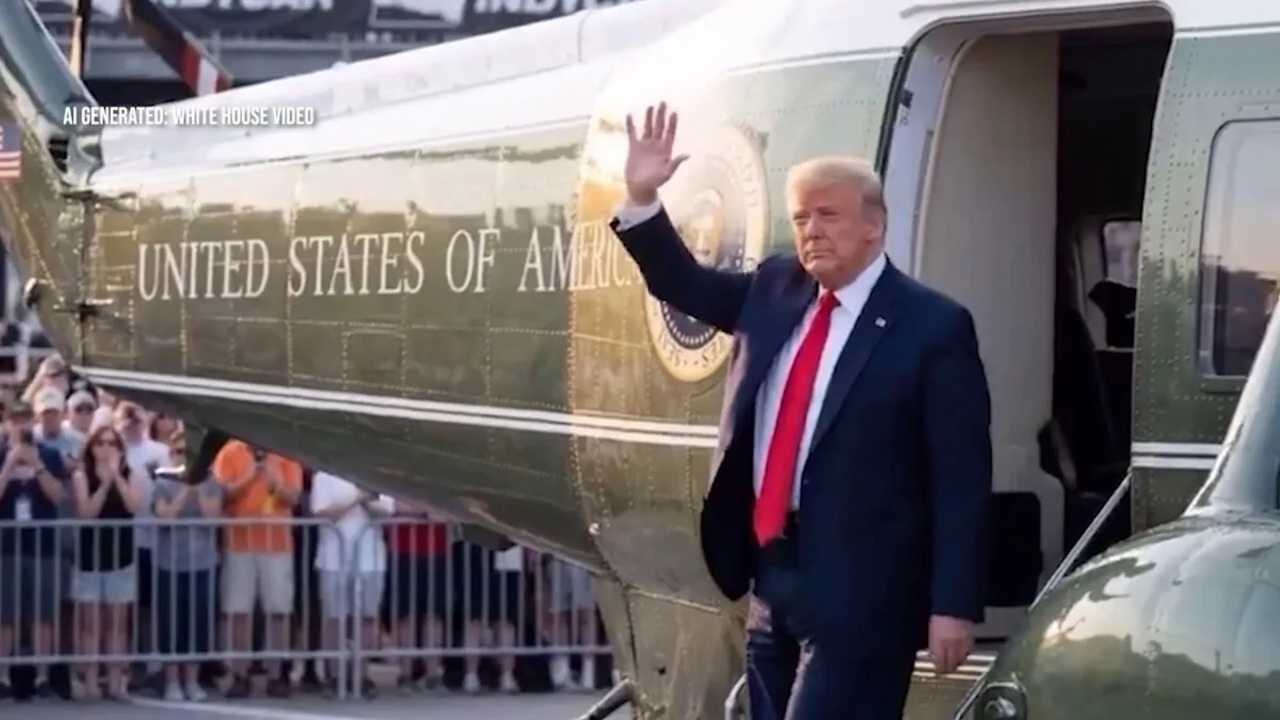
The spark for the current frenzy was a 47-second AI-generated video that President Trump posted on his social platform, depicting an IndyCar-style street race unfolding across central Washington DC. In the clip, sleek open-wheel cars blast along a course mapped onto the National Mall, with one driver’s cockpit view carrying the viewer through to a dramatic race win. The stylized footage, which Trump shared as part of a broader motorsport message, instantly raised the question of whether it was simply digital fan art or a deliberate hint at policy.
Trump’s post did not arrive in a vacuum. The Trump administration has been actively promoting the idea of an IndyCar event branded as an America 250 celebration, tying the concept to the nation’s upcoming semiquincentennial. Officials have floated the name America 250 for a potential race and have framed the project as a way to blend patriotic commemoration with a marquee sporting spectacle. By placing the AI video on Truth Social, Trump signaled that the imagery of cars streaking past the National Mall was more than idle daydreaming, it was a visual shorthand for a proposal his team is already advancing.
IndyCar’s cautious engagement with Washington
While the video captured the public imagination, the more consequential development has been behind-the-scenes talks between the series and the White House. IndyCar has confirmed that it has held what it describes as Confirms Discussions With President Trump For Washington Race, acknowledging that the idea of a Washington street event is on the table. Those conversations have centered on the possibility of using the National Mall as the centerpiece of a temporary circuit, a layout that would place high-speed racing within sight of the Capitol Building and other landmarks.
For IndyCar, the prospect is both enticing and fraught. The series has long sought high-visibility venues that can showcase its cars to casual viewers, and a Washington DC race would instantly rank among its most telegenic events. At the same time, executives must weigh the logistical and political complexities of closing federal streets, protecting historic grounds, and coordinating with multiple layers of government. The fact that the series is willing to publicly acknowledge discussions with President Trump suggests genuine interest, but officials have stopped short of confirming that a race is imminent or that a final route has been approved.
Superfans, skepticism, and the Capitol backdrop
Among IndyCar’s most devoted followers, the AI video has functioned as both hype reel and Rorschach test. Some fans have embraced the imagery of cars sweeping around the Capitol Building as a dream scenario, sharing clips and stills as if they were early concept art for a future grand prix. Social posts reacting to Trump’s share of the AI-generated race around the Capitol Building capture a mix of awe at the visuals and disbelief that such a layout could ever be sanctioned in reality, especially given the security sensitivities surrounding the complex.
Others in the racing community have responded with more caution, noting that the AI clip glosses over the practical constraints that define real-world street circuits. Veteran observers point out that even established events like the Long Beach Grand Prix or the Toronto street race require years of planning, extensive local buy-in, and significant infrastructure investment. By comparison, the notion of threading an IndyCar field around the Capitol Building and across the National Mall would demand an unprecedented level of coordination, from protecting monuments to managing crowds and emergency access. That tension between digital ease and physical difficulty has become a central theme in the debate.
Trump’s motorsport messaging strategy
For President Trump, the IndyCar concept fits neatly into a broader pattern of using sports imagery to project energy, spectacle, and national pride. The recent AI video is only the latest example of Trump leveraging high-octane visuals to rally supporters, this time tying the idea of a Washington DC street race to his administration’s America 250 branding. In sharing the clip on Truth Social, Trump positioned himself not just as a spectator but as an active promoter of a potential America 250 event, with the White House described as pushing for an IndyCar race on the National Mall.
Trump’s messaging has also been explicit about the artificial nature of the footage, with coverage noting that he pointed out the AI origins even as he used the video to stoke anticipation. Reports describing how Donald Trump fuels hopes for a special IndyCar race with AI video tease underline that the president is comfortable blending digital fabrication with real policy ambitions. The framing of Donald Trump Stuns Fans With Washington DC Street Race Tease Amid Ongoing Rumors underscores that the administration sees value in keeping the line between confirmed event and tantalizing possibility slightly blurred, allowing supporters to project their own expectations onto the project.
AI spectacle, public space, and political risk
The controversy surrounding the clip is not limited to motorsport logistics. Trump’s use of an AI-generated race sequence that wraps around the Capitol Building and sweeps across the National Mall has intensified an ongoing debate about synthetic media in politics. Critics argue that even clearly stylized AI content can normalize altered imagery of sensitive sites, especially when shared by the president. Supporters counter that the video is an obvious fantasy and that its purpose is to illustrate a potential event rather than to mislead viewers about something that has already occurred.
At the same time, the proposal raises substantive questions about how public space in Washington should be used. A National Mall race would transform a civic commons into a temporary motorsport venue, with all the attendant noise, disruption, and commercial branding. Advocates see that as an opportunity to showcase American engineering and attract global attention during the America 250 commemorations. Skeptics worry about the precedent of turning the Mall into a racetrack and about the optics of high-speed cars circling within sight of the Capitol Building at a moment of heightened political polarization. Those unresolved tensions ensure that, even if the AI video remains the only race to run through Washington’s monuments, the debate it sparked will continue to shape how the Trump administration’s IndyCar ambitions are received.
More from Fast Lane Only