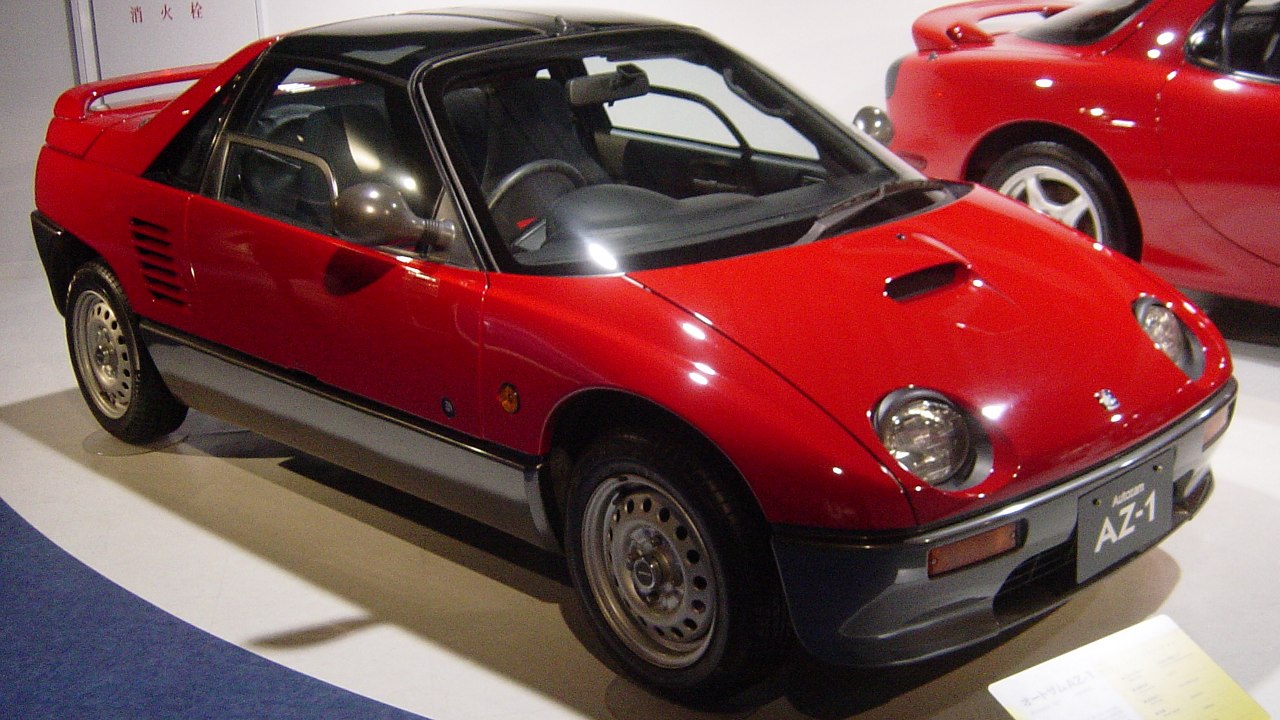
The Autozam AZ-1 is a tiny Japanese sports car with gullwing doors and a turbocharged three-cylinder engine behind the seats. Mazda sold it from 1992 through its Autozam dealer network, and it fit inside Japan’s kei class for small cars. On paper it was a fun little commuter, but in person it looked like a scaled-down supercar.
Few cars of the early 1990s tried to pack so much drama into so little space. The AZ-1 combined a mid-mounted engine, rear-wheel drive and doors that swung upward. However, Japan’s economy turned just as it arrived, and the car never reached the volume its makers hoped for.
That short life makes it a favorite among fans of Japanese oddities today. Here is where it came from, what made it different, and what one costs now.
How the Autozam AZ-1 came together
The AZ-1 began at Suzuki, not Mazda. According to The Truth About Cars, Suzuki showed its first mid-engine sports kei concept, the RS/1, at the 1985 Tokyo Motor Show. In fact, that concept was a working car with a 1.3-liter engine. A follow-up, the RS/3, appeared for the 1987 show, but Suzuki set it aside in favor of a roadster that became the Cappuccino.
Mazda then picked up the idea. It renamed the project AZ-550 and showed three different body styles at the 1989 Tokyo show. The version that reached production kept the gullwing doors that make the car famous today.
Development fell to a familiar name. Motorious reports that Toshihiko Hirai, known for his work on the MX-5 Miata, led the program. Significant development work also took place in England, the same story adds. In other words, a Suzuki concept became a Mazda product with input from the man behind one of Mazda’s best-loved sports cars.
A 657 cc turbo three behind the seats
The kei class kept the AZ-1 small, and that included the engine. Its engine was a turbocharged Suzuki F6A inline three of 657 cc. Motorious puts output at 63 to 66 horsepower, depending on specification. Meanwhile, a Hagerty sale record lists a 1994 car at 64 horsepower with multi-point fuel injection and a turbo.
Better still, the engine sat in the middle of the car and drove the rear wheels. The only transmission was a five-speed manual, The Truth About Cars notes. So every AZ-1 is a stick-shift car, which suits its character.
Above all, weight was the real secret. Motorious lists the AZ-1 at 720 kilograms, or about 1,587 pounds. That’s light enough to make modest horsepower feel lively. The car used a steel unibody with lightweight composite outer panels, which helped keep the mass down.
Gullwing doors on a kei car
The doors are the reason most people stop and stare. They hinge at the roof and swing upward, a feature usually found on far more expensive cars. On a car this small, the effect is almost comic, and that’s a big part of its charm.
The doors also shaped the car’s identity. Motorious lists them among the AZ-1’s defining elements, along with the mid-engine layout. Meanwhile, The Truth About Cars calls them a signature feature. The early cars came in two-tone grey, with either red or blue upper sections, which made the doors stand out even more when open.
Mazda didn’t build the cars itself. The Truth About Cars says Suzuki assembled them at its own plant, and Mazda sold them through its Autozam dealerships. Suzuki also sold its own version as the Suzuki Cara, according to model histories.
Price, production and the bubble that burst
At launch, the AZ-1 asked over $12,000, The Truth About Cars reports. That put it below a Japanese-market MX-5 but above its kei rivals, the Honda Beat and the Suzuki Cappuccino. As a result, it was the priciest of Japan’s three little sports cars of the era.
Timing worked against it. Motorious writes that “Japan’s early-1990s economic downturn quickly dampened sales expectations.” Mazda added special editions to stir interest, but production never reached its original targets, the same story says.
The final count depends on how you tally it. The Truth About Cars puts total production just short of 5,000 cars. Model histories break that down as 4,392 Autozam AZ-1s built between October 1992 and October 1994, plus 531 Suzuki Caras. Together, those add up to 4,923.
What an AZ-1 is worth now
Because Mazda sold the car only in Japan, most examples in other countries arrived as imports. In 2018, The Truth About Cars featured a blue 1992 car with 63,000 miles at a Virginia import dealer. Its asking price, in fact, was $17,995.
Today, Motorious calls it “one of the most daring interpretations of the Kei car formula ever brought to market.” For a wider look at Japan’s small-car culture, see our list of kei cars that proved small can be cool.
A recorded sale shows what a well-used example can bring. According to Hagerty’s past-sales data, a 1994 Autozam AZ-1 with 181,000 kilometers on the clock sold for $23,100.
More from Fast Lane Only