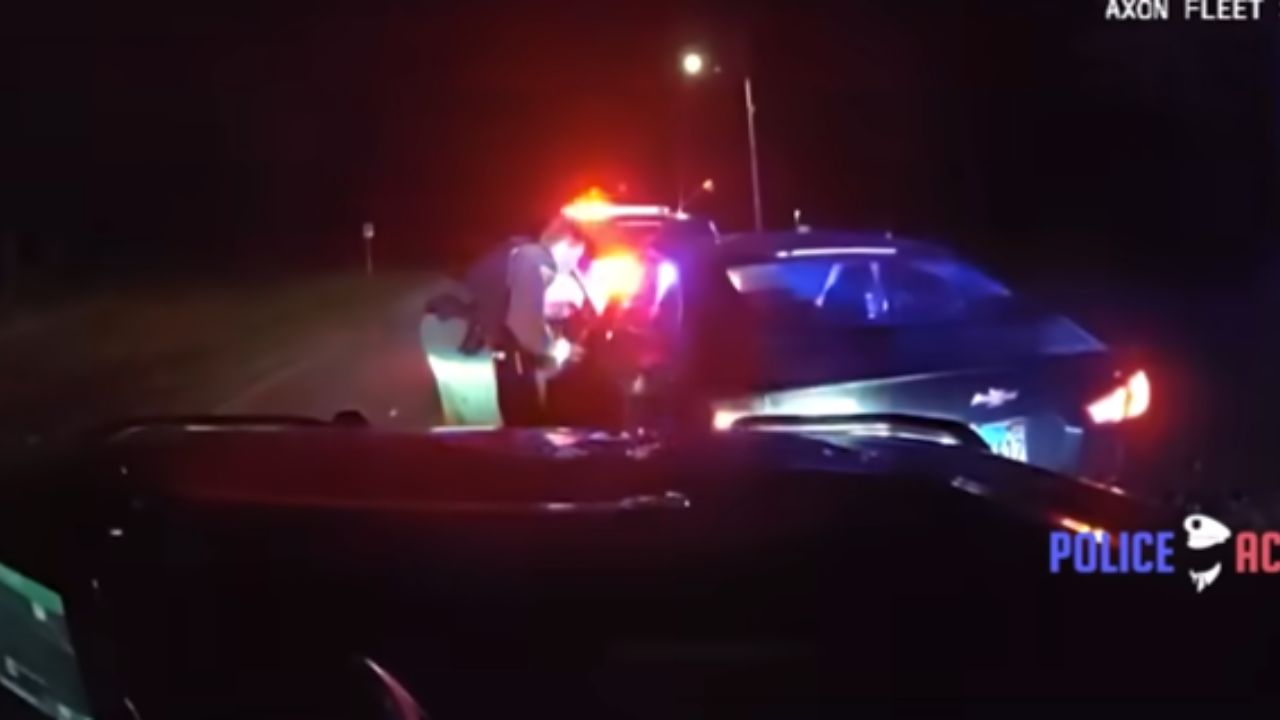
You can hear the panic before you ever see the flashing lights. A pregnant driver, 20 weeks along, tells a 911 dispatcher that her brakes have failed and her car will not stop as it heads toward a southern Illinois lake. Moments later, a Williamson County deputy uses his own cruiser as a moving shield, letting his dash cam record the instant he nudges her runaway vehicle away from the water and brings it to a grinding halt.
What unfolds in those few minutes is more than a dramatic rescue. It is a real-time lesson in how training, calm communication and split-second judgment can turn a likely tragedy into a story of survival for both a mother and her unborn child.
The 911 call that turned a routine night into a race against the lake
You first meet the driver through her voice. She calls 911 and tells the dispatcher, “I need help. My brakes won’t stop. My car won’t stop. My brakes aren’t working,” making clear that she has already tried everything she can think of to slow down. In the same breath, she adds that she is 20 weeks pregnant and pleads, “I cannot die today,” a line that would later echo through coverage of the incident and underscore the stakes for the Williamson County deputies who respond in Dec. On the other end of the line, the dispatcher keeps her talking, asking where she is, how fast she is going and whether she can shift gears, all while relaying critical details to deputies already rolling toward her.
As you listen to that exchange, you can sense how quickly a standard emergency call turns into a coordinated rescue plan. The dispatcher learns that the car is traveling on a dark rural road in Southern Illinois, heading toward Crab Orchard Lake, and that the driver cannot get the vehicle below roughly 30 miles per hour despite pumping the pedal and trying to downshift. Those details, shared in real time, allow Williamson County, Illinois deputies to position themselves ahead of her path and prepare for what they know will be a risky maneuver to keep the car from reaching the water, a sequence later confirmed in Southern Illinois reporting.
A deputy’s split-second decision on a dark Illinois road
By the time you see the dash cam footage, the groundwork has been laid. Sheriff’s Deputy Tyler Coffey positions his cruiser in front of the runaway car, watching in his rearview mirror as its headlights grow larger. He knows from radio traffic that the driver’s brakes have malfunctioned and that she is still unable to stop, so he eases his own speed down until she makes contact with his rear bumper. In that moment, he effectively turns his patrol vehicle into a rolling brake, a tactic that requires precise control to avoid sending either car into a spin, as later descriptions of the maneuver in Dec coverage make clear.
From your vantage point as a viewer, the scene looks deceptively simple: two vehicles, one pushing the other, both slowing together. In reality, Coffey is calculating distance to the lake, the condition of the road surface and the risk that a sudden jerk could send the pregnant driver into oncoming traffic. Sheriff Jeff Diederich would later praise how the deputy used his training to bring the car to a stop without causing a secondary crash, noting that the brake lights on the woman’s vehicle stayed illuminated even as she struggled to slow down, a sign she was doing everything she could while the deputy absorbed the impact. That combination of driver effort and law enforcement control, documented in She focused accounts, is what ultimately keeps both cars upright and out of the lake.
Dash cam and social video turn a local rescue into a national moment
Once the immediate danger passes, the story of what happened does not stay confined to Williamson County. Dash cam video from the sheriff’s office shows the entire sequence, from the moment the deputy’s cruiser pulls in front of the runaway car to the final seconds when both vehicles come to rest short of Crab Orchard Lake. That footage, paired with the driver’s plea, “I’m 20 weeks pregnant, I cannot die today,” quickly circulates online, where you can see it shared in a Dashcam post that highlights both the terror of the call and the precision of the response. The clip’s rawness, with its unvarnished audio and unsteady camera angle, gives you a front-row seat to a kind of incident that usually plays out far from public view.
On Instagram, short edits of the rescue emphasize the “terrifying ordeal overnight for a pregnant woman in downstate Illinois when her brakes failed,” inviting you to imagine what it would feel like to press the pedal and feel nothing happen as the car keeps rolling toward the water. One widely shared Illinois reel condenses the chase, the contact and the stop into a few seconds, underscoring how quickly the deputy has to act. That social amplification turns a regional incident into a national talking point about both the fragility of modern vehicles and the expectations you place on law enforcement officers who are asked to solve life-or-death problems in real time, often with little margin for error.
Inside the deputies’ tactics and the sheriff’s calculus
From a tactical standpoint, what you see on the video is the product of layered decisions. The Williamson County Sheriff’s office describes how deputies formed a kind of rolling roadblock, coordinating over the radio to clear traffic and create space for Coffey to get in front of the runaway car. In interviews, the sheriff explains that the goal was to intercept the vehicle before it reached the shoreline of Crab Orchard Lake, where a plunge into cold water could have been fatal for the driver and her unborn child, a risk that is spelled out in Deputies accounts. The decision to use a patrol car as a physical barrier is not taken lightly, since it risks injury to both the deputy and the driver, but in this case, the alternative is letting the car continue unchecked toward the lake.
As you look closer at the reporting, you see how the sheriff frames the outcome as the product of both courage and preparation. Sheriff Jeff Diederich notes that his team trains for high-risk vehicle interventions and that Coffey’s choice to let the runaway car hit his cruiser from behind, rather than trying to spin it out, reflects a calculation about stability and control. In later summaries, the incident is described as a “rolling road block” that kept the vehicle from plunging into the freezing water of Crab Orchard Lake, a phrase echoed in Hero coverage that also stresses how close the car came to the shoreline. For you as a viewer, those details help explain why the sheriff publicly calls his deputies heroes while also pointing to the policies and drills that made such a risky maneuver possible.
What the rescue reveals about everyday driving risks
It is tempting to treat this story as a one-in-a-million fluke, but the details invite you to think more concretely about your own time behind the wheel. The driver’s brakes malfunctioned without warning, turning an ordinary trip into a crisis in seconds, a failure that Williamson County officials say caused her vehicle to keep rolling even as she tried to slow down, as noted in Deputy Tyler Coffey focused reporting. You may assume that modern cars, with anti-lock braking systems and electronic stability control, will always respond when you press the pedal, but this case is a reminder that mechanical systems can and do fail, sometimes at the worst possible moment.
More from Fast Lane Only