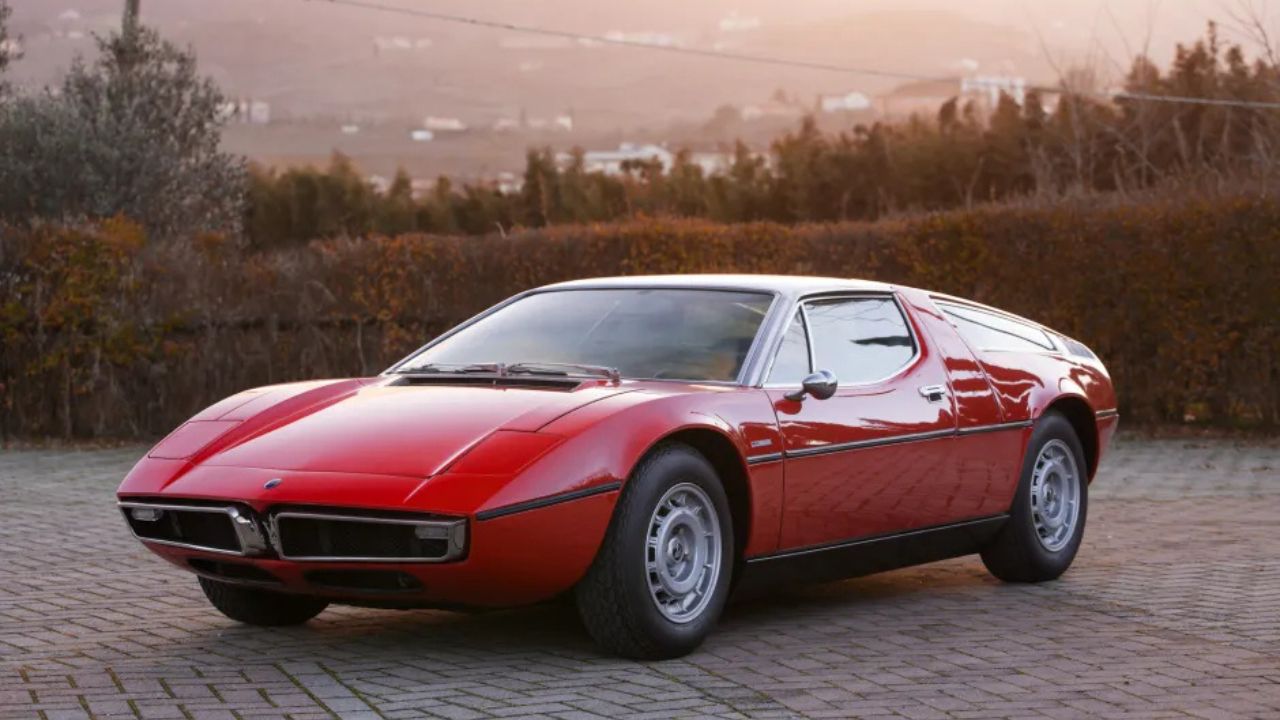
The Maserati Bora has long lived in the shadow of louder, redder and more famous 1970s supercars, yet a well-sorted 1973 example shows how misplaced that hierarchy can be. Judged on design clarity, engineering ambition and real-world performance, the mid-engined Maserati does not just rely on rarity; it stands shoulder to shoulder with the era’s icons.
Look past the production numbers and auction headlines and the Bora emerges as a complete, usable supercar that anticipated how high-performance road cars would evolve. Its combination of a powerful V8, sophisticated chassis and rare concessions to comfort shows that Maserati was thinking about more than top speed figures.
What happened
By 1973 the Maserati Bora had reached its most resolved early form, pairing a mid-mounted 4.7‑liter V8 with the wedge styling that defined the first half of the decade. It sat on a steel monocoque with a separate rear subframe that carried the engine and transaxle, a layout that gave the Bora both rigidity and serviceability. Maserati offered the 4.7‑liter engine alongside a larger 4.9‑liter unit, but the 1973 4.7‑liter specification already delivered serious pace, with power quoted at around 310 horsepower and a top speed close to 170 mph, figures that placed it firmly in supercar territory.
The Bora’s shape came from Giorgetto Giugiaro at Italdesign, who wrapped the mid-engine package in a low, sharp-edged body with a long, flat nose and almost horizontal rear deck. He used pop-up headlamps and a glazed rear section that visually extended the roofline, creating a clean silhouette that avoided the flying buttresses seen on some rivals. Details such as brushed stainless steel for the roof panel and slim bumpers gave the car a distinctive, almost architectural presence that set it apart from more ornate contemporaries.
Beneath the styling, Maserati engineered the Bora with a level of civility that surprised many period testers. The cabin was fully trimmed and insulated, with sound deadening that reduced mechanical noise to a level that made long-distance driving realistic. A hydraulic system derived from Citroën components powered the brakes, the adjustable pedal box and the pop-up headlights, an unusual solution that allowed the driver to tailor the driving position without moving the seat. Contemporary coverage of the Bora’s innovations highlighted how these features set it apart from more spartan Italian exotics.
Production of the Bora remained limited throughout its run, with total numbers reported in the low hundreds across all years and engine variants. The 1973 cars sit near the midpoint of that production story, benefitting from early development work while retaining the original design purity. Surviving examples often show a mix of original components and sympathetic upgrades that reflect how owners have used the car as both investment and driver’s machine.
On the road, the 1973 Bora delivered strong acceleration, helped by the V8’s broad torque curve and the relatively compact dimensions of the body. Double wishbone suspension at all four corners, with coil springs and telescopic dampers, and ventilated disc brakes provided strong stopping power for the period. The combination of mid-engine balance and a relatively long wheelbase gave the Bora stable high-speed manners, while the steering remained direct and communicative.
Inside, the Bora’s dashboard placed large, legible instruments directly in front of the driver, with secondary gauges grouped around the main binnacle. The adjustable pedal box meant that drivers of different heights could achieve a good driving position without compromising the seat’s relationship to the roof and side glass. Seats were more generously padded than those in some rival supercars, and the cabin offered meaningful luggage space behind the seats and in the front compartment, reinforcing the car’s grand touring ambitions.
All of these details meant that a 1973 Bora could be driven for long distances without leaving its occupants exhausted. Period testers often remarked on the car’s ability to cruise at high speeds in relative comfort, with the engine turning at moderate revs in top gear and the cabin remaining calmer than expected. Usability did not dilute the sense of occasion; the V8 still delivered a distinctive soundtrack, and the view over the low nose reminded the driver of the performance available with a small squeeze of the throttle.
Why it matters
The Bora’s significance lies in how it bridged the gap between raw 1970s supercars and the more rounded high-performance GTs that followed. While many enthusiasts instinctively reach for names like Ferrari and Lamborghini when thinking about the era, the Maserati offered a different balance of priorities. It combined a mid-engine layout and serious speed with noise insulation, adjustable ergonomics and real luggage space. That mix anticipated the way later supercars would be expected to function as everyday transport as well as weekend toys.
Against its period rivals, the Bora holds up convincingly. Compared with the Ferrari 365 GTB/4 “Daytona,” which used a front-mounted V12, the mid-engined Maserati offered more modern weight distribution and a shorter overall length, which translated into agility on twisty roads. Set against the Lamborghini Miura, the Bora traded some flamboyance for stability and refinement; the Maserati’s chassis and suspension gave it more predictable behavior at high speeds, and its cabin insulation reduced the fatigue that often accompanied long drives in the transverse V12 Lamborghini.
Even when placed beside the later Ferrari Berlinetta Boxer and Lamborghini Countach, the Bora does not look out of its depth. Its power output and top speed were competitive, and its braking and high-speed stability compared well with those more famous names. The Maserati’s understated styling has also aged gracefully, avoiding the period-specific add-ons and spoilers that can date some 1970s designs. Collectors who value clean lines and subtle detailing often place the Bora high on their list of favorite shapes from the decade.
The car’s limited production amplifies its appeal, but the Bora’s rarity is only part of the story. Many low-volume exotics from the 1970s are now remembered more for their fragility or quirks than for their driving qualities. The Bora, by contrast, has earned a reputation among specialists as a fundamentally sound design. Its steel monocoque, robust V8 and straightforward suspension layout have proven durable when maintained correctly, and the hydraulic systems, while complex, are manageable with proper expertise.
That engineering integrity matters in the current classic car market, where buyers increasingly look for vehicles that can be driven and enjoyed rather than parked as static assets. A 1973 Bora that has been maintained and sorted can cover serious mileage on tours and rallies while still delivering the drama expected of a 1970s Italian supercar. This usability helps explain why the Bora’s reputation has been climbing among enthusiasts who have experienced the car from behind the wheel.
From a historical perspective, the Bora also marks an important phase in Maserati’s story. It was the company’s first mid-engined road car, and it arrived at a time when the brand was navigating changes in ownership and direction. The decision to move the engine behind the driver signaled Maserati’s intention to compete directly in the emerging supercar segment, not just in more traditional front-engined GT territory. The Bora’s success in that role paved the way for later mid-engined models and influenced how the brand thought about performance flagships.
The Bora’s cabin design foreshadowed modern expectations for supercar ergonomics. Features such as the adjustable pedal box and comprehensive sound insulation showed that Maserati understood how tiring a traditional, noisy, cramped cockpit could be on long drives. Later high-performance cars from multiple manufacturers would adopt similar ideas, from adjustable steering columns and pedals to more effective insulation and climate control. In that sense, the Bora was ahead of its time, pointing toward a future where extreme performance did not require extreme discomfort.
In the collector world, the Bora occupies a sweet spot between the stratospheric values of some 1970s icons and the more accessible pricing of lesser-known exotics. Its rising profile reflects a broader shift among enthusiasts toward cars that offer authentic period character without the compromises that can make ownership frustrating. For buyers who want a 1970s supercar that can be driven confidently on modern roads, the Bora’s blend of performance, comfort and rarity makes a compelling case.
The 1973 specification in particular has gained attention because it represents the Bora in full early production form, before later regulatory changes altered some details. Enthusiasts often seek out cars from this window for their combination of original design and refined engineering. As more owners share their experiences of using these cars on long-distance events and high-speed tours, the Bora’s reputation as a genuinely capable performer continues to grow.
What to watch next
The next chapter in the Bora’s story will likely be written in the auction halls and on the open road. As awareness grows of the car’s capabilities, market observers are watching how values of well-documented 1973 examples evolve relative to more famous contemporaries. If the current trend continues, the Bora may move from “insider’s choice” to a more widely recognized benchmark among 1970s supercars.
Owners and specialists are also focusing on preserving the Bora’s unique engineering features. The hydraulic systems that control the brakes, pedals and headlights require careful maintenance, and the availability of correct components will shape how many cars remain fully functional. Workshops that understand both Maserati’s V8 engines and the Citroën-derived hydraulics are becoming key players in sustaining the model’s reputation on the road rather than just in static collections.
On the enthusiast side, more Bora owners are participating in high-profile driving events, where the car’s blend of comfort and performance can be demonstrated in real-world conditions. Multi-day rallies and touring events provide a platform to show how a properly set up Bora can cover long distances at speed while keeping occupants relatively fresh. As stories from these events circulate, they help shift perceptions of the car from rare curiosity to proven grand tourer.
Design appreciation is another area to watch. As interest in 1970s industrial design continues to grow, Giugiaro’s work on the Bora is receiving renewed attention. The car’s clean lines, restrained detailing and distinctive stainless steel roof treatment align well with contemporary tastes that favor minimalism over ornament. Exhibitions and publications that focus on period design are increasingly likely to feature the Bora alongside more famous shapes from the decade, further raising its profile.
There is also scope for deeper historical research into the Bora’s development, including the internal decisions that led Maserati to adopt specific engineering solutions and styling directions. As archives are explored and former engineers and designers share their recollections, a more detailed picture of how the Bora came to be is emerging. That context helps enthusiasts understand why the car feels the way it does on the road and how it fits into the broader evolution of high-performance cars.
For potential buyers, the key questions in the near term revolve around originality and usability. Cars that retain their correct 1973 specification while benefiting from thoughtful mechanical restoration are likely to be the most sought after. At the same time, some owners may choose subtle upgrades to improve reliability or drivability, such as modern cooling components or updated ignition systems. How the market values these choices will shape restoration strategies and influence which examples become reference cars for the model.
More From Fast Lane Only: