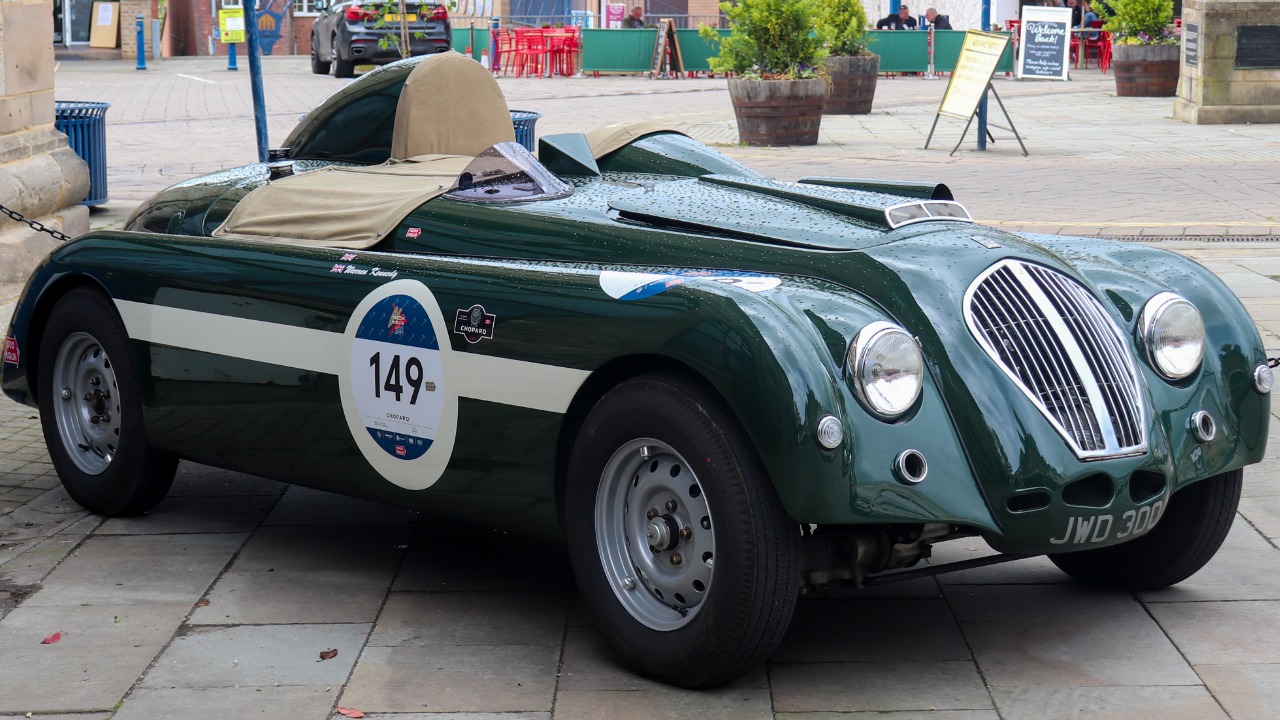
In June 1952, a Nash-Healey driven by Leslie Johnson and Tommy Wisdom finished third overall in the 24 Hours of Le Mans. Only the two factory Mercedes-Benz 300 SLs crossed the line ahead of it. That result remains the high point of the Nash-Healey Le Mans story, and it came from a car that paired a British chassis with Nash power.
The finish also won its class. More than that, it put an American-engined sports car on the podium of the world’s best-known endurance race. Behind it came a Cunningham, a Ferrari and a long list of retirements.
The car was the product of a deal struck at sea. It mixed a British chassis, Nash running gear and, later, Italian bodywork. Here is how the No. 10 car got to Le Mans, and what the team did there over four straight years.
How the Nash-Healey Le Mans effort began
Donald Healey wanted Cadillac V8s for a planned sports car, but Cadillac turned him down. Then, aboard the liner Queen Elizabeth, he met George Mason, the head of Nash-Kelvinator. According to Revivaler’s history of the car, the two men agreed on a joint project on that crossing.
The result used a widened, strengthened Healey Silverstone chassis with a Nash engine and an American transmission. Early road cars ran a 3,847 cc Nash inline-six. Healey fitted it with an aluminum head and twin SU carburetors, which raised output from 112 hp to 125 hp. Car Guy Chronicles says the 1952 race car used a Nash inline-six. However, no source we read gives its size or output, so those figures stay out here.
A fourth-place start in 1950
The racing story began before the production car was even on sale. In 1950, Healey Motors entered a prototype at Le Mans as No. 14. The race results for 1950 show that drivers Rolt and Hamilton finished fourth overall and third in the S5.0 class, completing 250 laps.
That was only six laps short of the winning Talbot-Lago T26 GS, which covered 256. As a result, Healey had proof that the concept could last 24 hours. The Nash-Healey made its official debut at the Paris Motor Show that autumn, Revivaler notes.
The 1952 race, lap by lap
Two years later, Healey came back with two cars. The Revs Institute’s record of the race lists the No. 10 Nash-Healey, entered by Healey, with Johnson and Wisdom driving. It confirms that the car “Finished the race in 3rd place overall and 1st in its class,” the S5.0 category.
The full 1952 results fill in the gaps. The Mercedes-Benz 300 SL of Lang and Riess won with 277 laps, ahead of its sister car on 276. Next came the Nash-Healey with 262 laps. Cunningham and Spear took fourth in a Cunningham C-4R with 252 laps, and a Ferrari 340 America Vignale Berlinetta finished fifth on 250.
That Ferrari ran in the same class as the Nash-Healey. In other words, the Anglo-American car beat a Ferrari to the S5.0 class win by 12 laps. Meanwhile, only 17 cars were classified as finishers.
Healey’s second car had a rougher weekend. The No. 11 car, shared by Veyron and Giraud-Cabantous, retired with gearbox failure, according to the same results.
What beat it: the Mercedes W194
The two cars ahead were no ordinary road cars. Revivaler identifies them as the works Mercedes W194s, the racing 300 SL coupes that Mercedes-Benz brought to Le Mans in 1952. By comparison, the Nash-Healey came from a small Anglo-American partnership that would build only a few hundred cars.
Car Guy Chronicles calls 1952 the marque’s best showing in its look at the car’s racing record. It describes a class win and third overall, behind the Mercedes-Benz 300 SL Gullwings. The same piece counts four straight Le Mans outings for the Nash-Healey.
One more try in 1953
Johnson returned in 1953, this time with Hadley. According to the 1953 results, their No. 11 car finished 11th overall and seventh in class after 265 laps. Its sister car lasted just nine laps before retiring with an oil-pressure problem.
There was an odd footnote that year, too. The 1953 race went to a Jaguar C-type driven by Rolt and Hamilton, the same pairing that had put the Nash-Healey prototype fourth in 1950. They covered 304 laps.
The road cars that followed
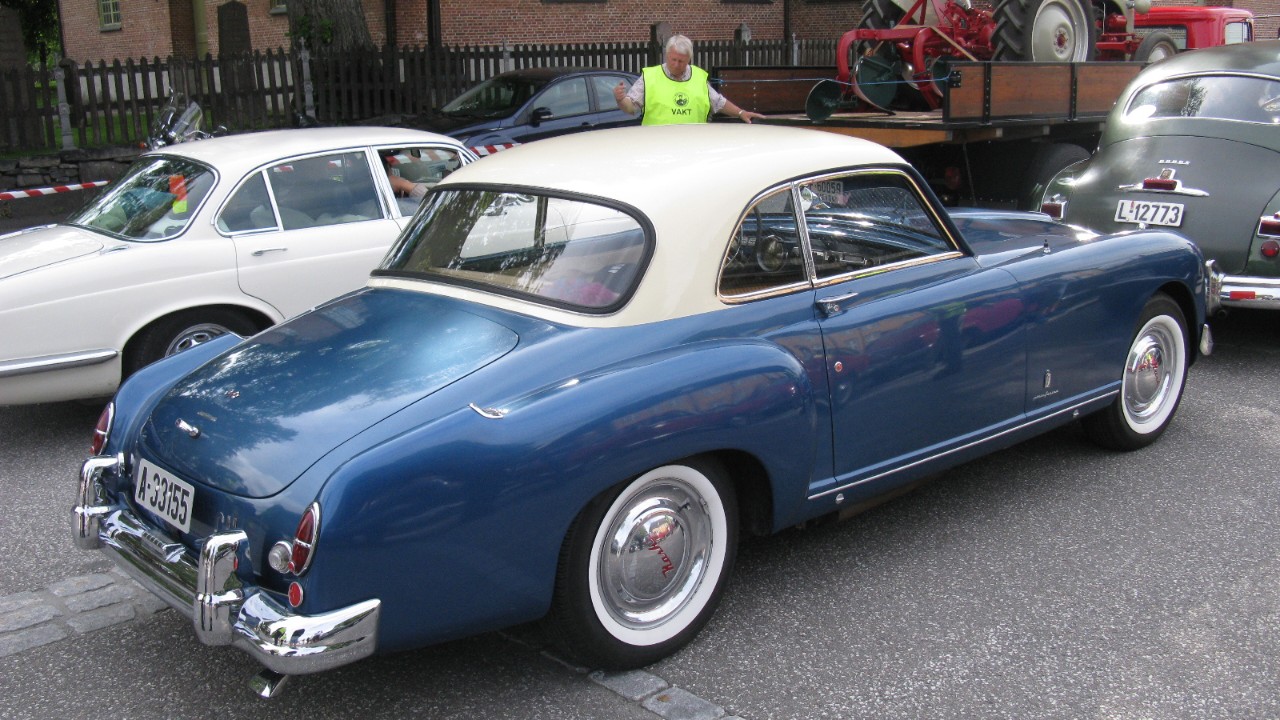
Production cars changed a great deal during this period. Panelcraft Sheet Metal of Birmingham, England, hand-formed the early aluminum bodies. Then, from 1952, Pininfarina bodied the roadster in steel. A hardtop called the Le Mans Coupé joined it in January 1953.
The shipping route was long. Nash sent mechanical parts from Kenosha, Wisconsin, to Healey in Britain. Next, the partly built cars went to Turin for bodywork before returning to the United States for sale. According to Revivaler, production ended in August 1954 after 506 cars: 104 early models, 312 Pininfarina roadsters and 90 Le Mans Coupés.
More from Fast Lane Only