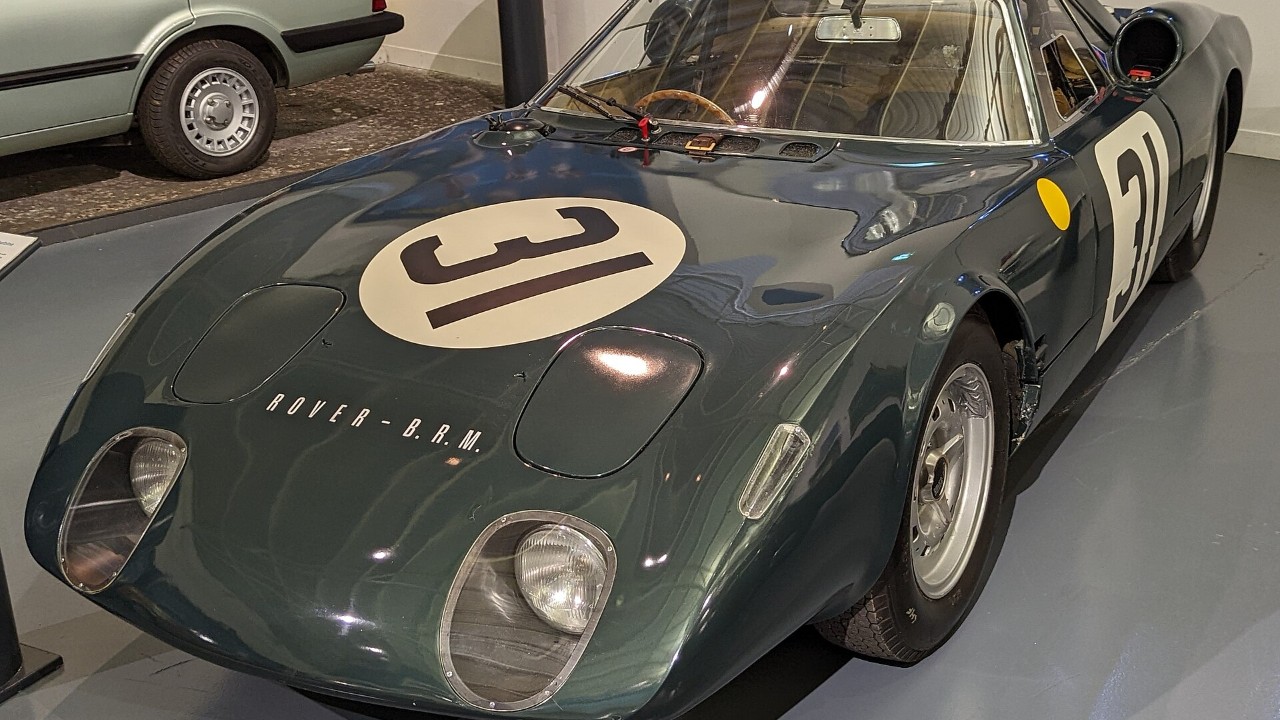
In 1965, a Rover-BRM gas turbine car crossed the finish line of the Le Mans 24 Hours in 10th place. Graham Hill and Jackie Stewart shared the drive, and the car had no pistons at all. Instead, a jet-style turbine spun inside it at tens of thousands of rpm.
The car came out of two very British companies. Rover had worked on gas turbines since the Second World War, and BRM was a Formula 1 team. Together, they built a car that whistled instead of roared, burned paraffin and had a single forward gear.
Its story covers three seasons. First came a demonstration run in 1963, then a missed race in 1964, and finally the official finish in 1965. Today, the car belongs to the British Motor Museum collection.
Where the Rover-BRM gas turbine came from
Rover’s turbine work started long before Le Mans. Classic & Sports Car notes that the company developed its turbine technology during the war. It later built JET1, a turbine car based on the Rover P4 that the magazine’s writer saw at London’s Science Museum. According to the Le Mans history site Maison Blanche, a Rover turbine car was timed at 152.9 mph in 1952.
The race organizers were curious, too. Maison Blanche records that the ACO added a turbine clause to its rules in 1953. Then, in 1957, it offered a prize of 25 million French francs for the first turbine car to cover more than 3,600 km at an average of 150 km/h.
The partnership itself began with a conversation. As the Federation of British Historic Vehicle Clubs tells it, BRM owner Sir Alfred Owen and Rover boss William Martin-Hurst struck up a chance discussion that led to the car. Maison Blanche dates the dinner meeting to October 23, 1962, and the go-ahead to December 27, 1962.
A turbine in a Formula 1 chassis
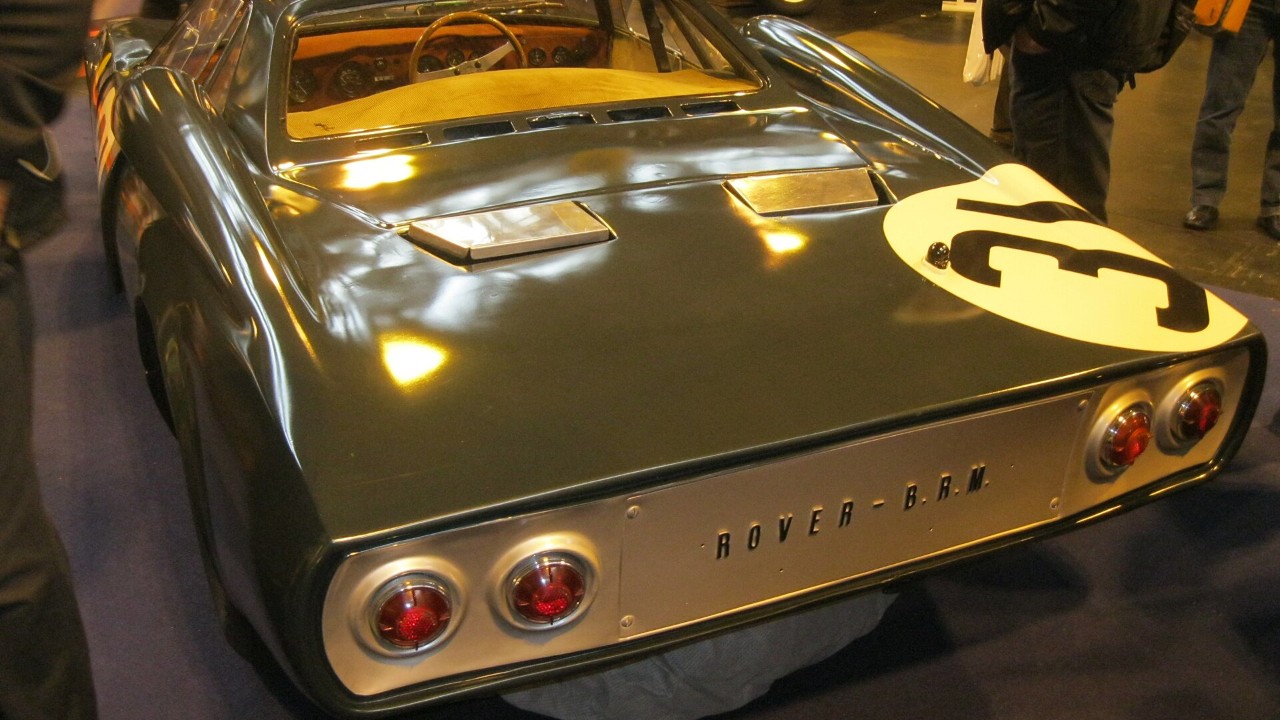
BRM supplied the chassis. The team’s own heritage site, British Racing Motors, says it came from Richie Ginther’s damaged car from the 1962 Monaco Grand Prix. BRM then clothed it in a custom open-top aluminium spyder body.
Behind the driver sat the turbine, mounted ahead of a single-speed transaxle. BRM describes the layout as a single centrifugal compressor, a single combustion chamber and a free turbine. That free turbine drove the output shaft on its own, separate from the turbine that spun the compressor.
Power figures vary by source and by year. BRM’s site rates the engine at 150 bhp, while Classic & Sports Car gives 140 bhp. Maison Blanche, meanwhile, quotes 126 bhp for the 1965 car. Even so, all three agree it was far from the most powerful car on the grid.
The instruments told the real story. Classic & Sports Car reports that the tachometer read to 7,000, but drivers had to multiply the markings by ten. In other words, the scale ran to 70,000 rpm. Maison Blanche adds that the turbine could rev to 60,000 rpm once warm.
How the Rover-BRM drove
A turbine has no engine braking, so the car needed help to stop. That’s why it carried very large brake discs, according to Classic & Sports Car. Throttle response also lagged, so a driver had to open the throttle a few seconds before he wanted the power.
Stewart was blunt about it. At a 2019 museum event, he called the car awful to drive, yet he said there was nothing like it at the time, as the FBHVC reported. He also described driving it at Le Mans as a revolution.
Later testers were kinder. Willie Green drove the car at Donington Park for a January 1985 Classic & Sports Car feature. He called it “a very, very pretty car” and compared full throttle to “taking off in a jet plane.”
1963 and 1964: a demonstration and a no-show
The car’s first Le Mans came in 1963, with Hill and Ginther driving. Because it ran as a demonstration entry, it was not classified. Still, the FBHVC says it won a prize as the first gas turbine car to complete the 24-hour race.
Maison Blanche records that the car wore number 00 and started 30 seconds after the field. It then covered 4,172.90 km at an average of 107.77 mph. By comparison, the winning Ferrari covered 4,561.710 km.
For 1964, the rules changed so a redesigned car could enter officially. However, it never started. Accounts differ on why: Classic & Sports Car says it fell off its trailer on the way back from the test weekend, while Maison Blanche says it simply was not ready. Maison Blanche credits Bill Towns with the 1964 coupe’s shape and gives it a drag coefficient of 0.32.
1965: Hill, Stewart and a 10th-place finish
For 1965, Stewart replaced Ginther, and the car raced as number 31. Rover had also added heat exchangers with ceramic elements to cut fuel use, according to Maison Blanche. As a result, consumption improved from 7 mpg in 1963 to 13.5 mpg in 1965.
The race was not trouble-free. Classic & Sports Car reports heat-exchanger damage, and engineer Tony Rudd blamed a button swallowed from someone’s overalls. Maison Blanche describes compressor vane damage from a foreign body and a 14-minute stop. It also says the car lost about 13% of its power, dropping its top speed from 142 mph to 131 mph.
Even so, the Rover-BRM gas turbine car reached the finish. BRM’s site lists it 10th overall and seventh in the prototype class. The FBHVC calls it the “first all-British car home.” Ahead of it, the number 21 Ferrari 250LM of Jochen Rindt and Masten Gregory won the race.
Where the car is now
Rover dropped the turbine racing project shortly after 1965, according to Maison Blanche. The car survived, though, and Classic & Sports Car notes it ran a demonstration at Le Mans Classic in 2014.
Today, it belongs to the British Motor Museum at Gaydon. On September 29, 2019, Stewart unveiled a new Michael Turner oil painting there of himself driving the car in 1965. According to the FBHVC, the painting hangs beside the Rover-BRM, which curator Stephen Laing called “one of the most prestigious cars in the Museum’s collection.”
More from Fast Lane Only