In 1963, Studebaker sold a station wagon with a roof panel that slid forward, so you could haul a refrigerator standing up. That car, the Studebaker Wagonaire, is a good reminder that the family hauler was once where Detroit tried its boldest ideas.
Most wagons from the 1950s and ’60s worked hard, rusted out and went to the crusher once the kids moved out. However, the survivors tend to be the oddballs. Think two-door sport wagons, one-year-only models, glass in the roof and fake wood on the sides. Park one at a cruise night today and people walk past the muscle cars to look at it.
These seven are our picks, in order of model year. The verdicts are our opinion, and every figure comes from published model histories and period reporting. If you’ve ever wanted a classic that starts conversations and carries the cooler, start here.
1. 1955 Pontiac Star Chief Custom Safari

Everybody knows the Chevy Nomad. Fewer people know that Pontiac built its own version of GM’s two-door sport wagon, and in our view it’s the better-dressed of the pair. The Safari shared the Nomad’s swept-back roof and two-door greenhouse. Even so, it wore Pontiac’s face and Star Chief trim on the 122-inch Chieftain chassis.
It arrived mid-year, on January 31, 1955, at $2,962. According to Mac’s Motor City Garage, that was around $500 more than a Nomad. For the money, you got a 287-cubic-inch V8 and leather upholstery as standard, while the Chevy came with a six and cloth.
That price kept the Safari scarce. Pontiac built about 9,000 of them from 1955 to 1957, compared with more than 22,000 Nomads. In fact, the 3,760 cars built for 1955 made it the lowest-production Pontiac that year. Our take: a Nomad turns heads at a show, but a Safari makes people walk over and ask what it is. We think that’s the better conversation, and it comes with Pontiac’s own grille and extra chrome on the tailgate.
2. 1956 Ford Parklane

Ford’s answer to the Nomad took a simpler route. It started with the plain two-door Ranch Wagon body and dressed it in Fairlane trim, including the stainless bodyside stripe. Inside, Ford carpeted the whole cabin, cargo floor included, and added a privacy cover for the load area.
Buyers liked the idea. Consumer Guide notes that the Parklane’s base price sat $180 below the Nomad’s. As a result, it outsold the Chevy by about two to one, with 15,186 built. A 223-cubic-inch six was standard. Meanwhile, the option sheet listed the 292 Thunderbird V8, the same engine family that powered Ford’s two-seater.
Then Ford dropped it after one season, even though a 1957 prototype existed. Two-door wagons were losing favor, and their buyers mostly wanted utility, not luxury. That leaves the Parklane as a true one-year car. We’d argue it’s the most underrated wagon on this list, because it has the Fairlane look and the V8 without the Nomad price tag. If you find a V8 car with the carpeted cargo floor intact, keep it, because that interior is what set the Parklane apart.
3. 1957 Ford Del Rio Ranch Wagon

When the Parklane disappeared, Ford didn’t give up on a dressy two-door wagon. Instead, it built the Del Rio. Consumer Guide calls it “a sort of cross between the Parklane and the former Custom Ranch Wagon.” It wore gold-anodized side trim borrowed from the two-tone Custom 300 sedans, with matching materials inside. Ford also gave it special ranch-pattern upholstery.
For its first year, the formula worked. Ford built 46,105 Del Rios for 1957, a huge number for a two-door wagon. By 1958, though, demand had collapsed to 12,687 cars, and a two-door Country Sedan replaced it for 1959. That 1958 car could carry Ford’s new 352-cubic-inch V8, which topped out at 300 horsepower with a four-barrel carburetor.
You’ll rarely see one at a show today. In our view, the 1957 Del Rio is the sweet spot. It has the new long, low Ford body, the gold trim and the sporty two-door profile. Look for original upholstery, because that ranch-pattern cloth is part of the charm. A Del Rio with its gold trim and two-tone paint is pure 1957 Ford.
4. 1958 Edsel Bermuda
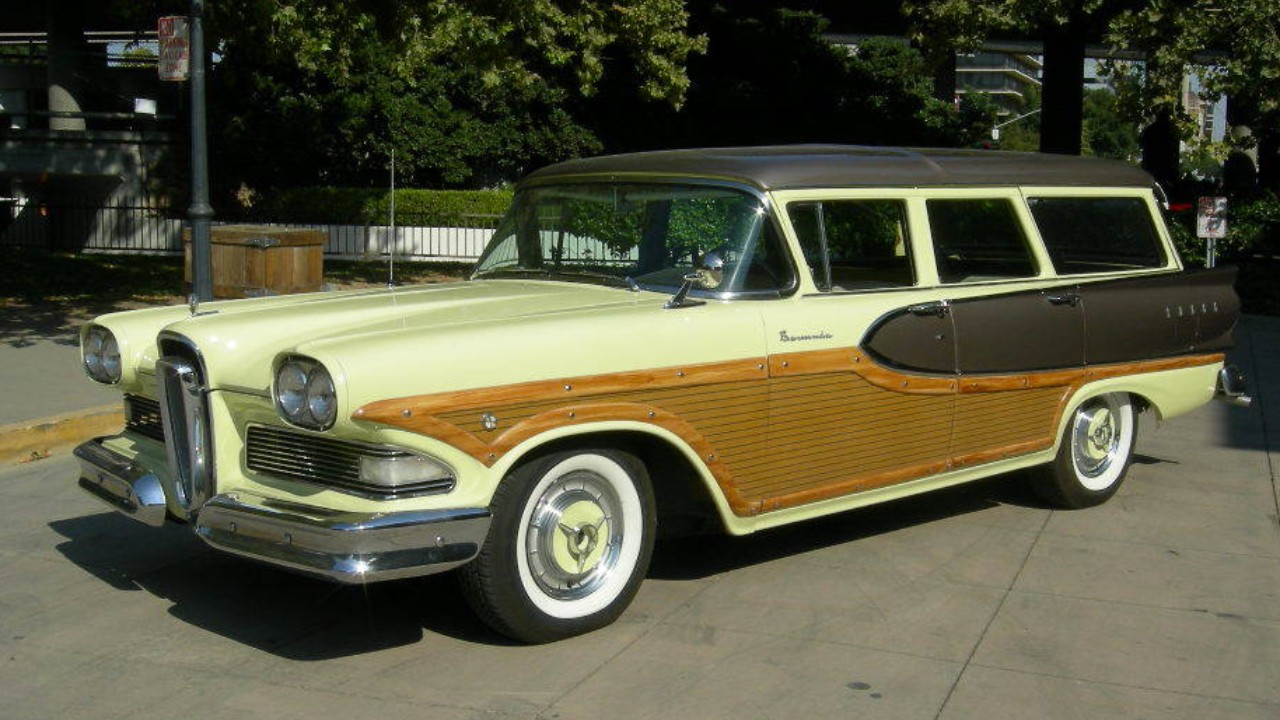
Edsel’s whole story is about bad timing, and the Bermuda is the wagon that got caught in it. It was the top-tier Edsel wagon, sold only for 1958, with simulated wood panels and frames on the sides. Underneath, it shared Ford’s 116-inch wagon wheelbase and its core body stampings.
Edsel built just 2,235 of them. The six-passenger version started at $3,155, and 1,456 found buyers. Meanwhile, the nine-passenger car started at $3,212, and only 779 left the line. That made it the rarest 1958 Edsel model. A 361-cubic-inch FE V8 came standard. Buyers could also order the Teletouch automatic, which put its drive buttons in the steering wheel hub.
Edsel dropped the Bermuda for 1959, leaving the Villager as its only wagon. We’d buy one for the face alone, because that vertical grille and the boomerang taillights look like nothing else in a parking lot. If you find a Teletouch car, budget time for the push-button system, which had a reputation for trouble. A conventional automatic or the standard three-speed manual is the easier car to live with day to day.
5. 1959 Mercury Colony Park
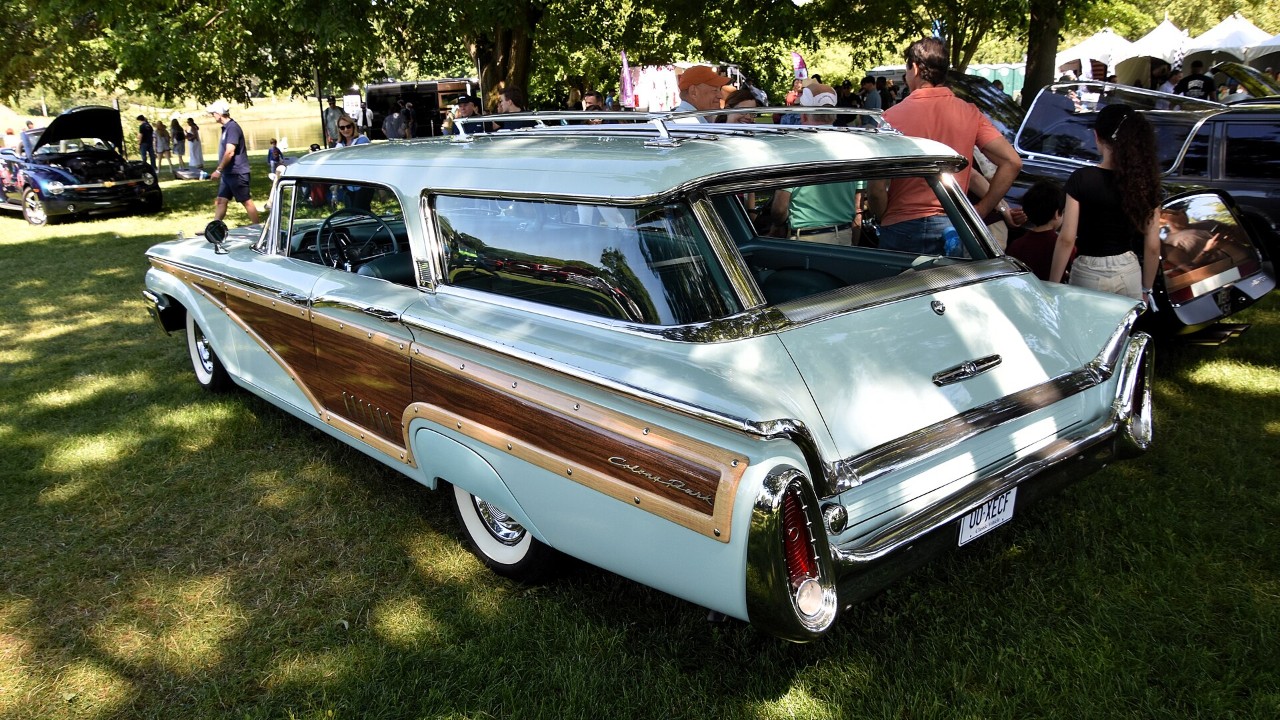
The Colony Park was Mercury’s flagship wagon, and for 1959 it moved into the new Country Cruiser series above the Commuter and the Voyager. It rode on a 126-inch wheelbase, a chassis first developed to be shared with the Edsel Corsair and Citation. Better yet, it kept a pillarless hardtop roofline, so the side glass looked as clean as a coupe’s.
That year, Mercury made the 383 Marauder its only V8, retuned to 322 horsepower. The pushbutton shifter went away, too, because a column-mounted Merc-O-Matic automatic became standard. The list price was $3,932, and Mercury built fewer than 6,000 of them. Published counts differ slightly, at 5,929 and 5,959.
We’ve rounded up plenty of classic wagons that make practical sense, but the 1959 Colony Park isn’t really about sense. It’s about the hardtop profile, the huge windshield and the sheer length of the thing. If you want one, check the hardtop glass and its seals first, because replacement pieces are hard to find. Then enjoy the rare wagon that looks this good with every side window rolled down.
6. 1964 Buick Skylark Sport Wagon
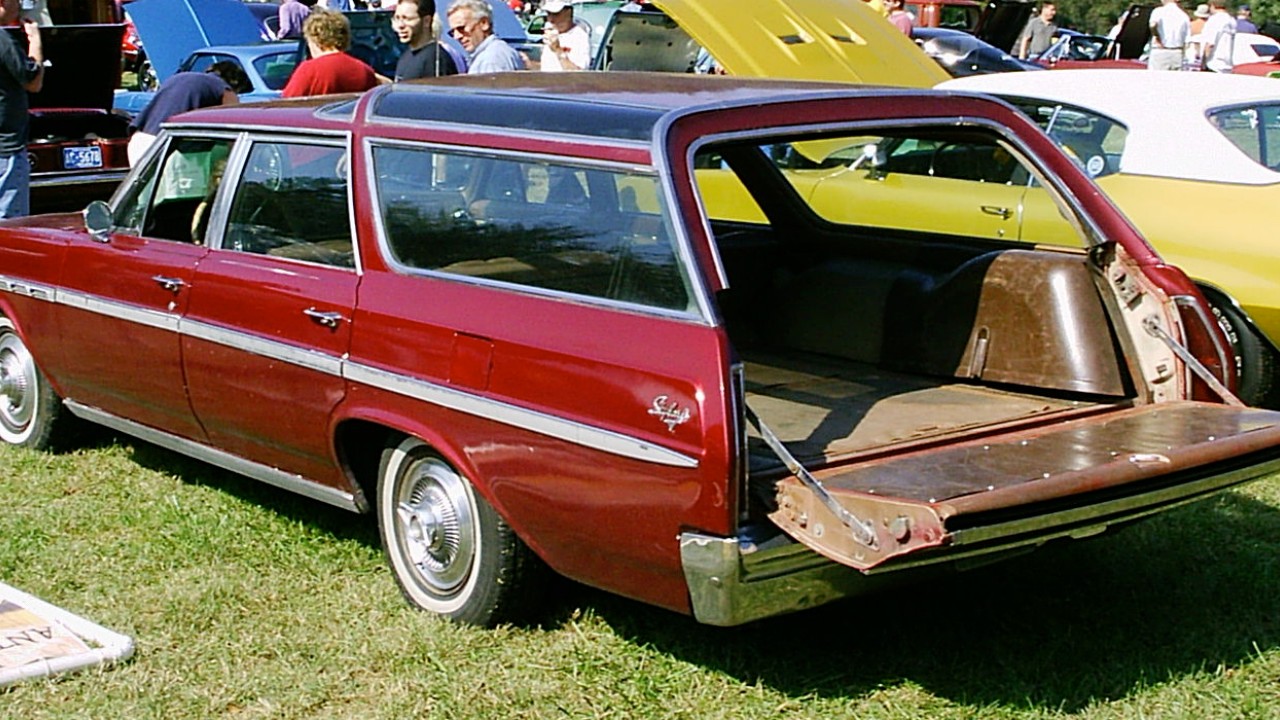
Buick’s first Sport Wagon looked like a regular Skylark wagon until you saw the roof. Toward the back, the roof stepped up, and four tinted glass panels ringed the raised section. The idea dated back to the 1954 GMC Scenicruiser bus. Buick also stretched the wheelbase to 120 inches, 5 inches longer than other Skylark sedans and coupes.
The 225-cubic-inch V6 came standard, with a 300-cubic-inch V8 on the option list. A forward-facing third row was optional, too. Buick built 13,654 Sport Wagons for 1964, its first year. The design was shared with the Oldsmobile Vista Cruiser, which kept its skylight until 1972.
Our take: the Vista Cruiser gets the fame, but the Buick is the classier way to get that skyroof. On a sunny day, the back of the car fills with light in a way no modern SUV matches. If you’re shopping, get the V8, and check every roof-glass seal for leaks before you hand over money. Then pack the third row and head for the beach, which is exactly the kind of trip this wagon suits best.
7. 1964 Studebaker Daytona Wagonaire
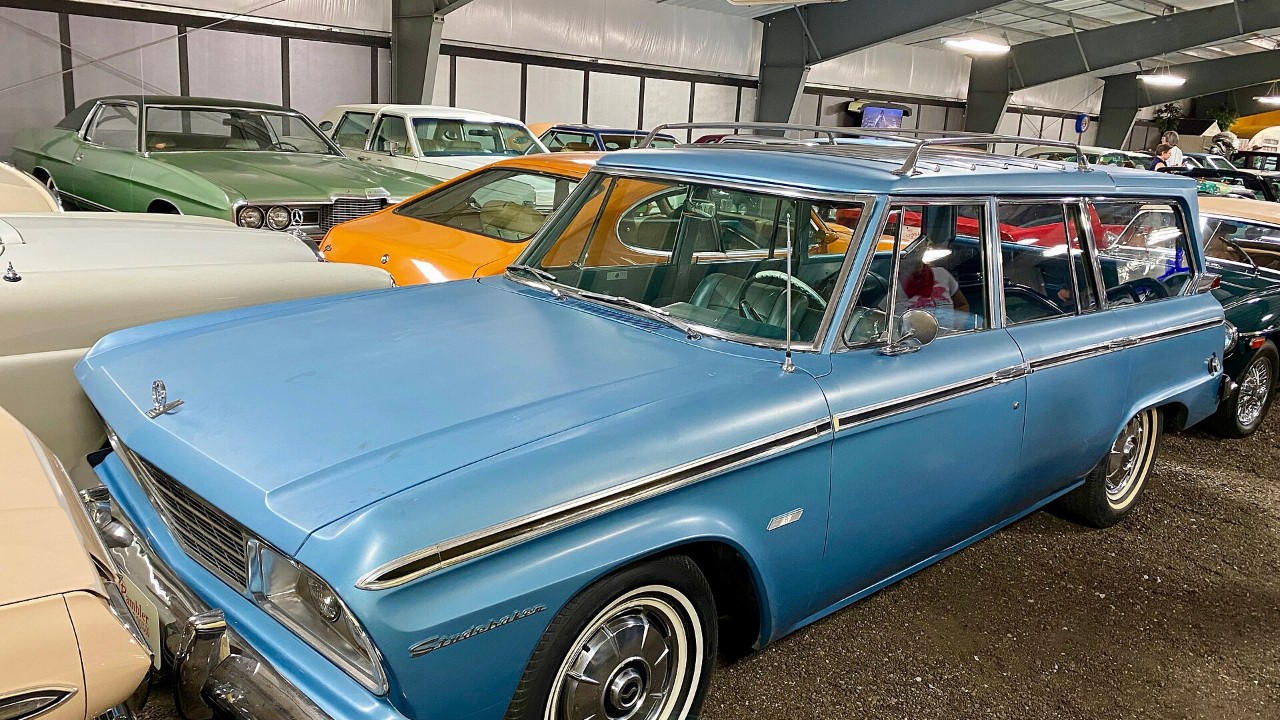
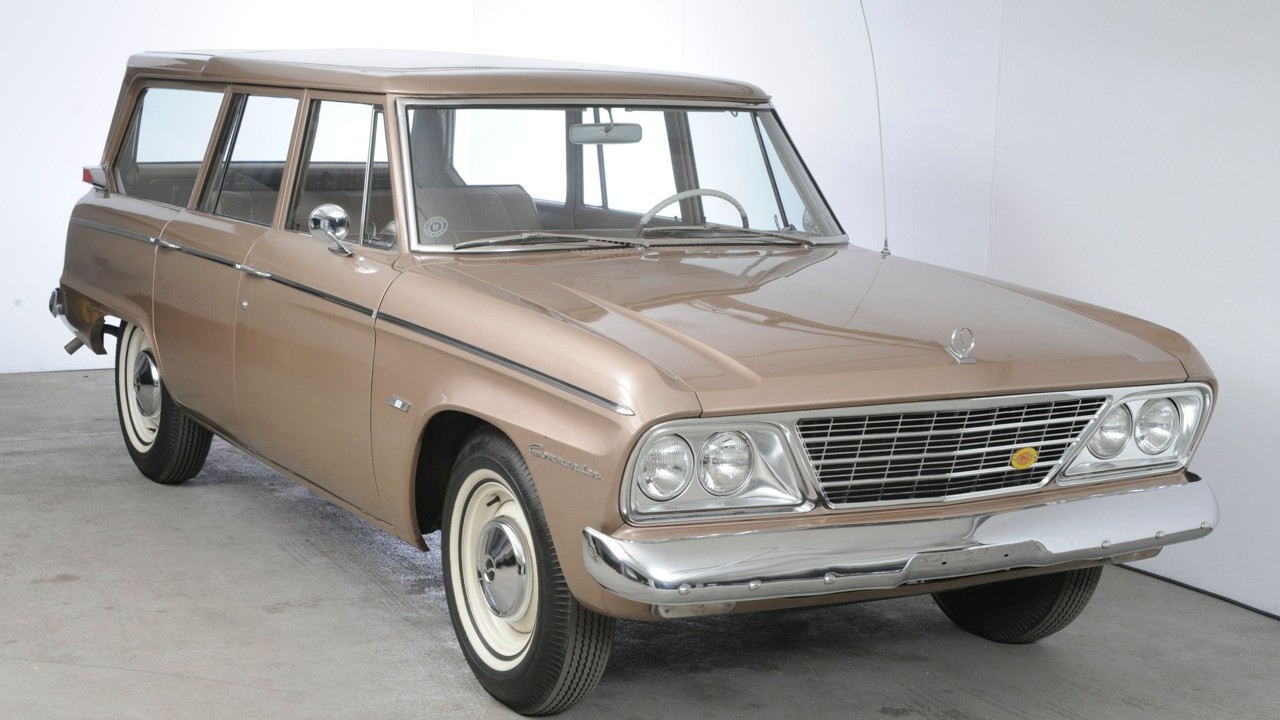
Industrial designer Brooks Stevens gave the Studebaker Wagonaire its trick roof. A panel over the cargo area slid forward, so owners could carry tall items upright. Stevens borrowed the idea from his 1959 Scimitar concept, and he also designed the Jeep Wagoneer.
The 1964 Daytona was the one to have. With the sporty Daytona trim, buyers could order a V8 and disc brakes. Studebaker built 1,563 Daytona Wagonaires that year. However, the roof was hard to seal against rain and snow. According to Mac’s Motor City Garage, the design relied on drain tubes to carry water away from the cabin. Then South Bend closed in mid-1964, and production moved to Hamilton, Ontario.
For us, the Studebaker Wagonaire is the head-turner of this group, because no one expects a 1960s wagon roof to open. It’s also a fine starting point if rare Studebakers are your thing. Buyer’s tip: clear and test those drain tubes before anything else. Decades later, GM tried the sliding-roof idea again on the 2004 GMC Envoy XUV, and dropped it after 2005. In other words, the Wagonaire’s roof was an idea big enough to try twice.
More from Fast Lane Only