By the late 1960s, the American performance market seemed to have settled on a winning formula.
Muscle cars were everywhere. Manufacturers were stuffing increasingly powerful V8 engines into midsize coupes, creating machines that delivered impressive straight-line performance at affordable prices. The Pontiac GTO, Plymouth Road Runner, Dodge Super Bee, and Chevrolet Chevelle SS were capturing headlines and showroom traffic alike.
At the same time, pony cars such as the Ford Mustang and Chevrolet Camaro were attracting younger buyers with sporty styling and endless customization options.
In this crowded marketplace, one type of vehicle seemed to be disappearing.
The traditional American two-seat performance car had largely become the domain of the Chevrolet Corvette.
Most manufacturers had concluded that buyers wanted practical performance. Four seats sold better than two. Families appreciated flexibility. Insurance companies were beginning to scrutinize sports cars. The market appeared to be moving away from dedicated two-seaters.
Then American Motors did something unexpected.
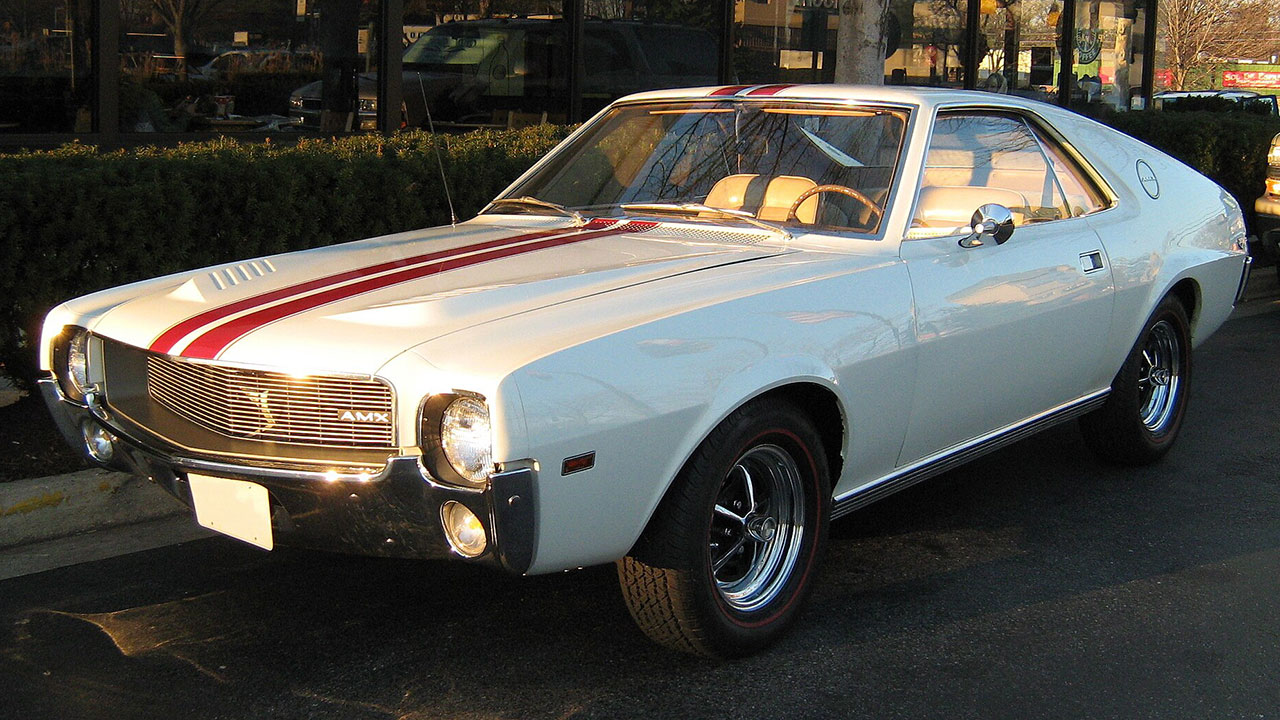
In 1968, AMC introduced the AMX, a short-wheelbase, two-seat performance car unlike anything else being built by a major American manufacturer.
The gamble could have failed.
Instead, the AMX proved there was still room in the market for a car built primarily for driving enthusiasts.
American Motors Needed Attention
During the 1960s, American Motors Corporation occupied a difficult position within the industry.
The company was significantly smaller than General Motors, Ford, and Chrysler. It lacked their engineering budgets, manufacturing scale, and marketing resources. Competing directly against Detroit’s giants often seemed impossible.
AMC needed a different strategy.
Rather than trying to outspend larger competitors, company leaders frequently pursued innovative ideas that could generate attention disproportionate to their size.
Performance became one of those opportunities.
If AMC could build exciting cars that attracted enthusiasts, it might strengthen the brand’s image and bring customers into dealerships.
The AMX emerged from that thinking.
It wasn’t intended to become a high-volume family car.
It was intended to make people notice AMC.
The Car Began as a Concept
The roots of the AMX stretched back to a series of show cars that generated considerable interest.
AMC executives recognized that sporty and performance-oriented vehicles could help reshape public perceptions of the company. The challenge was translating that excitement into a production automobile.
Rather than creating another traditional muscle car, engineers and designers proposed something more ambitious.
The production AMX would be based on the compact Javelin platform but shortened significantly.
The result would be a true two-seat automobile.
This decision immediately distinguished the car from nearly every competitor.
While others focused on practical performance, AMC chose purity.
The AMX would be built primarily for enthusiasts.
Two Seats Made It Unique
One reason the AMX remains so fascinating today is its configuration.
Outside the Corvette, American buyers had very few choices if they wanted a domestic two-seat performance car.
The AMX filled that gap.
By removing the rear seat and shortening the wheelbase, AMC created a vehicle that felt more focused than most muscle cars of the period.
The shorter dimensions contributed to a sporty appearance and emphasized the car’s driver-oriented mission.
Every inch of the AMX suggested performance.
It wasn’t trying to carry a family.
It wasn’t trying to be practical.
It was trying to be fun.
That distinction mattered.
The AMX offered something many enthusiasts felt was missing from the market.
Compact Dimensions Improved the Formula
The AMX’s reduced size delivered benefits beyond appearance.
Compared with many contemporary muscle cars, the AMC was relatively compact and lightweight.
Weight plays a major role in performance.
A lighter vehicle requires less power to accelerate, stop, and change direction. Engineers understood that reducing mass could be just as important as increasing horsepower.
The AMX benefited from that philosophy.
Its smaller footprint gave it a nimble character that helped separate it from larger muscle cars.
While many competitors emphasized brute force, the AMC aimed for a more balanced experience.
The result appealed to drivers who valued agility as much as acceleration.
AMC Offered Serious V8 Power
Despite its compact size, the AMX wasn’t underpowered.
AMC offered several V8 engine options that transformed the little two-seater into a legitimate performance machine.
Buyers could select engines ranging from respectable small-block V8s to increasingly powerful alternatives designed to compete directly with Detroit’s best.
The top choice was AMC’s formidable 390-cubic-inch V8.
Officially rated at 315 horsepower, the engine delivered impressive acceleration and abundant torque.
Combined with the AMX’s relatively low weight, the 390 created a highly competitive package.
Road tests quickly confirmed what enthusiasts suspected.
The AMX was fast.
Very fast.
The Performance Surprised Journalists
Automotive magazines approached the AMX with curiosity.
After all, AMC wasn’t traditionally viewed as a performance powerhouse. Many observers expected the car to be interesting but not necessarily competitive.
The road tests told a different story.
Journalists frequently praised the AMX’s acceleration, handling, and overall driving experience. The car proved capable of running with many better-known muscle cars while offering a distinctly different personality.
Its compact dimensions contributed to a feeling of responsiveness often missing from larger competitors.
The AMX felt eager.
Drivers appreciated that character.
The car’s performance credentials quickly became difficult to dismiss.
It Challenged the Corvette in Spirit
Comparisons to the Corvette were inevitable.
The two cars represented the only domestically produced two-seat performance automobiles available from major American manufacturers.
The AMX wasn’t a direct Corvette competitor in every respect.
The Chevrolet remained more sports-car-oriented, particularly in terms of image and market positioning.
Yet the AMC offered something intriguing.
It provided many of the same emotional benefits at a lower price.
Buyers who wanted a two-seat American performance car suddenly had another option.
For AMC, simply entering that conversation represented a significant achievement.
Racing Helped Build Credibility
Like many performance cars of the era, the AMX benefited from motorsports involvement.
AMC understood that racing success could enhance credibility and attract enthusiasts.
The company participated in various forms of competition, helping demonstrate that the AMX possessed genuine capability rather than merely attractive styling.
These efforts reinforced the car’s performance image.
Buyers appreciated knowing the vehicle had been tested under demanding conditions.
Racing also generated publicity that AMC could never have purchased through advertising alone.
For a smaller manufacturer, every bit of attention mattered.
The AMX delivered plenty of it.
The Market Was Changing
Ironically, the AMX arrived just as broader market forces were beginning to reshape the performance landscape.
Insurance premiums for high-performance vehicles were increasing. Emissions regulations loomed on the horizon. Consumer preferences would soon begin shifting in new directions.
These factors ultimately limited the long-term viability of specialized performance cars.
The AMX’s production run as a true two-seater proved relatively brief.
Later versions evolved, and the market moved on.
Yet the car’s impact remained significant.
It demonstrated that enthusiasm for dedicated performance vehicles still existed.
Buyers Appreciated Its Honesty
One reason the AMX continues to attract admiration is its straightforward nature.
The car didn’t pretend to be anything else.
It wasn’t a luxury coupe disguised as a performance machine.
It wasn’t a family car with a bigger engine.
It was a compact, V8-powered, two-seat American performance automobile.
That honesty appealed to enthusiasts.
The AMX represented a clear statement of purpose.
Every aspect of the design supported the driving experience.
In an era filled with compromise, the AMC felt refreshingly focused.
Collectors Have Rediscovered the AMX
For many years, the AMX lived in the shadow of more famous muscle cars.
Collectors often gravitated toward Mustangs, Camaros, Corvettes, and Mopar legends while overlooking AMC’s contributions to the performance world.
That situation has changed considerably.
Enthusiasts increasingly recognize the AMX as one of the most unique American performance cars of its generation. Its combination of rarity, styling, performance, and historical significance makes it highly desirable among collectors today.
The car’s unconventional story only adds to its appeal.
It wasn’t built by the industry’s largest company.
It was built by the company willing to take a chance.
A Different Kind of Muscle Car
The 1968 AMC AMX succeeded because it rejected conventional wisdom.
At a time when most manufacturers focused on four-seat muscle cars, AMC created a dedicated two-seat performance machine. While competitors chased volume, the company pursued individuality.
The result was a vehicle that stood apart from everything else in the marketplace.
Its compact dimensions, available V8 power, and driver-focused layout gave enthusiasts an experience unavailable elsewhere.
The AMX wasn’t trying to follow trends.
It was trying to create its own path.
The Proof That Two Seats Still Mattered
Looking back, the 1968 AMC AMX represents one of the boldest decisions of the muscle car era.
American Motors could have built another conventional performance coupe and blended into the crowd. Instead, the company created a genuine two-seat performance car at a time when many believed the market no longer wanted one.
The AMX proved otherwise.
It demonstrated that there were still buyers who valued focus over practicality and driving enjoyment over passenger capacity.
More than half a century later, the car remains a reminder that innovation often comes from the companies willing to challenge assumptions.
The 1968 AMX may not have sold in the same numbers as Detroit’s biggest performance stars, but it accomplished something equally important.
It proved that two-seat American performance still had a place.
More from Fast Lane Only