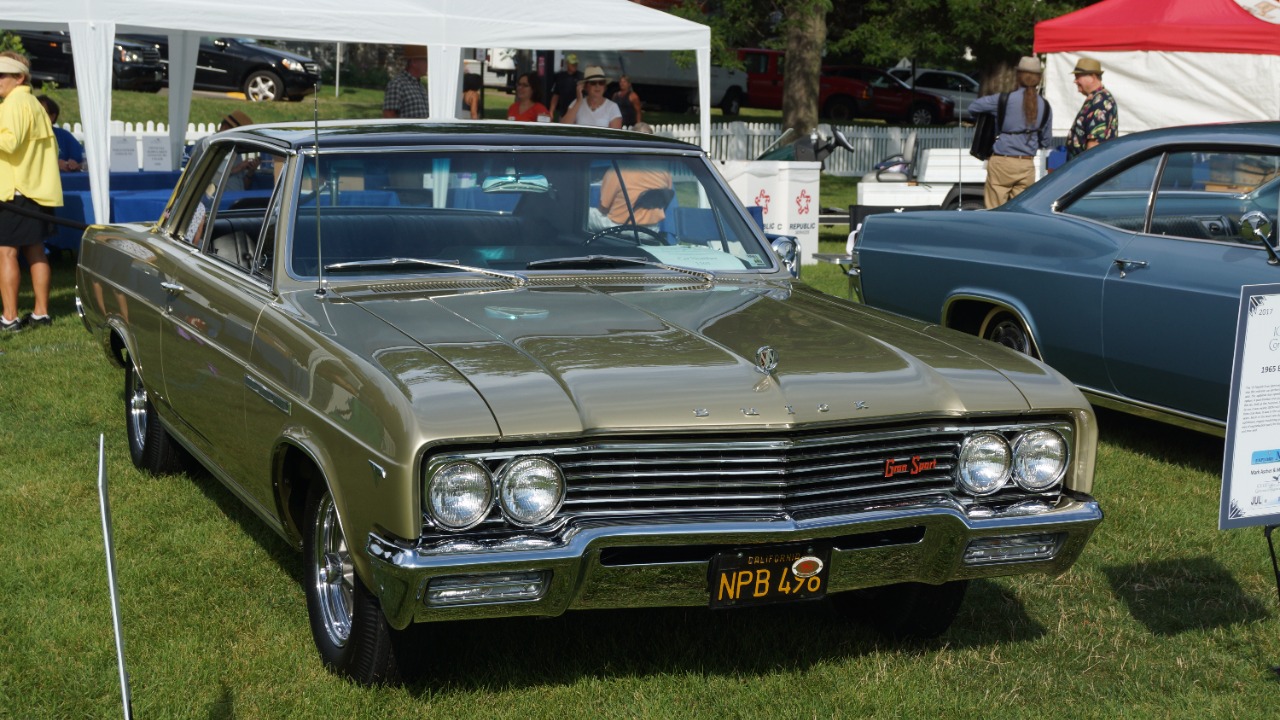
The 1965 Buick Skylark Gran Sport arrived as Detroit’s muscle car race was already heating up, yet it still managed to surprise rivals. With a factory rating of 335 horsepower, Buick’s compact coupe suddenly had the numbers and hardware to run with the era’s most feared street machines. In that single model year, the division long associated with quiet comfort proved it could build a serious performance car without abandoning its polished character.
What happened
By 1965, the intermediate performance formula was well established. Pontiac had lit the fuse with the GTO, Chevrolet fielded the Chevelle SS, Oldsmobile offered the 4-4-2, and each relied on a big-displacement V-8 stuffed into a midsize chassis. Buick’s answer was the Skylark Gran Sport, a package that transformed the brand’s compact Skylark into a genuine muscle car contender.
At the heart of the Gran Sport was its 401 cubic inch nailhead V-8, a torque-rich engine Buick had already proven in full-size models. For marketing and internal policy reasons, Buick labeled the engine as 400 cubic inches in the Skylark GS, but the bore and stroke matched the 401 used elsewhere. The engine carried a factory rating of 325 to 335 horsepower depending on configuration, with the higher figure tied to a higher compression ratio and more aggressive tuning. Regardless of rating, torque output, well over 400 pound-feet, gave the relatively light Skylark chassis the kind of thrust buyers expected from a serious performance package.
Buick did not stop at the engine. The Gran Sport option bundled heavy-duty suspension components, including stiffer springs and shocks, along with larger anti-roll bars to control body motion under hard cornering and acceleration. Power-assisted brakes and upgraded cooling were common selections, since the car’s newfound speed demanded better stopping power and durability. Buyers could choose a 3-speed manual, a 4-speed manual, or Buick’s Super Turbine 300 automatic, and rear axle ratios ranged from highway-friendly to aggressive performance gears that kept the big V-8 in its power band.
Visually, the 1965 Skylark GS walked a fine line between subtlety and muscle. Gran Sport scripts on the fenders, unique badging on the grille and decklid, and modest hood ornamentation signaled the upgrade without resorting to wild stripes or scoops. Dual exhaust outlets and redline tires hinted at its capabilities, but the overall look stayed closer to an upscale personal car than an all-out street racer. That balance of restraint and power would become a Buick performance signature over the next decade.
Inside, the GS leaned into Buick’s reputation for comfort. Bucket seats, a center console with a floor shifter, and a full set of gauges were available, and trim materials were closer to what a buyer might expect in a LeSabre than in a stripped-down drag car. The idea was straightforward: deliver the acceleration and handling of a muscle car without giving up the quiet ride and upscale feel that had built Buick’s customer base.
The Gran Sport package was not limited to a single body style. Buyers could order it on the Skylark hardtop, convertible, and even the pillared coupe, opening the performance experience to a wider range of budgets and tastes. Production numbers remained modest compared with Pontiac’s GTO or Chevrolet’s Chevelle SS, but the Skylark GS carved out a niche among drivers who wanted performance with a more mature image.
Buick’s experiment worked well enough that the Gran Sport idea did not remain a one-year curiosity. The GS name quickly migrated to other models and grew in displacement and power. By 1970, Buick was installing a 455 cubic inch V-8 in its GS series, an engine that enthusiasts now regard as one of the muscle era’s torque champions. A preserved example of a 1970 GS 455, documented with its original 455 engine and performance equipment, illustrates how far the concept evolved from that first 1965 effort, with the later car delivering massive low-end pull and quarter-mile times that rivaled more famous nameplates from Pontiac and Chevrolet, as seen in a detailed profile of a restored 1970 Buick GS.
The continuity from the 1965 Skylark GS to the later GS 455 models shows that Buick did not treat performance as a short-lived marketing stunt. Instead, the division built on the original Gran Sport’s formula, refining suspensions, improving breathing with better induction and exhaust, and steadily increasing displacement as the horsepower race escalated. The 1965 car stands at the beginning of that arc, the first clear statement that Buick intended to compete head-on in the muscle segment.
Why it matters
The 1965 Skylark Gran Sport matters because it redefined what a Buick could be. Before the mid 1960s, the division’s image leaned heavily on quiet, near-luxury transportation for buyers who had moved past youth-oriented brands. Performance existed in the lineup, especially in full-size models with big engines, but it was not the core of Buick’s identity. The Skylark GS changed that perception by putting a high-output V-8 and serious chassis hardware into a smaller, more agile package.
That shift had several consequences. It broadened Buick’s appeal to younger drivers who might have otherwise gravitated toward Pontiac or Chevrolet. A buyer who wanted muscle car performance but also valued a quieter cabin and more refined interior suddenly had a compelling option. The Gran Sport name, with its European flavor, reinforced the idea that this was not just a brute-force drag car but a performance machine with a touch of sophistication.
The Skylark GS also showed that Buick could extract competitive performance from its existing engine family without adopting the high-revving, big-port philosophy favored by some rivals. The 401 nailhead was not a new design in 1965, yet in GS trim it delivered acceleration that matched or exceeded many contemporary 383- and 389-powered intermediates. Its broad torque curve meant strong thrust from low rpm, which suited Buick’s emphasis on effortless power rather than frantic top-end rush. This approach foreshadowed the character of later Buick performance engines, including the 455 V-8 and the turbocharged V-6 units that would arrive in the late 1970s and 1980s.
The Gran Sport program also helped establish a performance sub-brand within Buick that could evolve as regulations and market tastes changed. When insurance pressures and emissions rules began to squeeze traditional muscle cars, Buick already had experience presenting performance as part of a more mature package. That experience later informed cars like the GS 455 Stage 1, which combined brutal torque with relatively understated styling, and eventually the turbocharged Regal models that carried the Grand National and GNX badges.
The 1965 Skylark GS further illustrates a broader pattern in Detroit’s muscle era. Many of the most interesting cars emerged when conservative divisions decided to experiment with performance without abandoning their core values. For Buick, that meant a car that could run the quarter mile in competitive times yet still deliver a comfortable ride and a well-trimmed cabin. The GS did not chase the most radical styling or the highest published horsepower number. Instead, it focused on usable speed and a sense of quality, which helped it age gracefully as a collector car.
From a historical perspective, the Gran Sport’s 335 horsepower rating serves as a benchmark. It placed Buick squarely in the same conversation as Pontiac’s GTO and Oldsmobile’s 4-4-2, which were also rated in the low- to mid-300 horsepower range. That parity mattered in showroom conversations, where buyers compared brochures and bench-raced on paper before ever turning a key. Buick could now point to a concrete figure that matched its rivals, backed by an engine with a reputation for durability and a chassis tuned for serious driving.
The impact reaches into the collector market as well. Enthusiasts who focus on the muscle era increasingly recognize that the story is not just about the headline-grabbing models from Pontiac, Chevrolet, and Dodge. Cars like the 1965 Skylark GS represent an alternative path, one that values torque, subtle styling, and comfort alongside straight-line speed. As interest in these more understated muscle cars grows, the early Gran Sport models have gained attention for their role in shaping Buick’s performance identity.
The 1965 GS also helps explain why later Buick performance cars feel distinct from their competitors. The idea that a muscle-oriented Buick should be quick but not crude, assertive but not flashy, runs through the GS lineage. That philosophy can be traced back to the first Skylark Gran Sport, which proved that a car did not need wild graphics or a stripped interior to be taken seriously by enthusiasts. It only needed the right hardware and a clear statement of intent.
What to watch next
Looking ahead, the 1965 Buick Skylark GS will likely continue to gain visibility among collectors and historians who are reassessing the muscle era beyond its most obvious icons. As more restorations bring these cars back to original specification, the market will have clearer benchmarks for how they perform and feel compared with their period rivals. Detailed documentation of surviving cars, including build sheets and factory options, will help refine understanding of how Buick configured the Gran Sport package in different regions and for different types of buyers.
One area to watch is how the early GS models influence interest in later Buick performance cars. Enthusiasts who discover the 1965 Skylark GS often trace the lineage forward to the 1970 GS 455, the Stage 1 variants, and eventually the turbocharged Regals. That narrative arc, from a 401-powered compact to a 455 big block and then to forced-induction V-6s, gives Buick one of the more coherent performance stories among Detroit brands. As that story becomes more widely told at shows, in clubs, and in online communities, the 1965 car’s status as the starting point of the modern Buick performance era is likely to solidify.
Another trend involves how the Gran Sport concept is interpreted in contemporary Buick products. While current lineups focus on crossovers and sedans with efficiency and technology as primary selling points, the brand still benefits from the halo effect of its historic performance models. Designers and marketers occasionally reference past GS badges in concept vehicles or limited trims, using cues like subtle badging, unique wheels, and performance-oriented suspensions to evoke the spirit of the 1965 Skylark GS without directly replicating it. The degree to which future Buicks lean into that heritage will shape how younger buyers perceive the brand.
There is also growing interest in how muscle-era Buicks can be adapted for modern driving without erasing their character. Owners of 1965 Skylark GS models increasingly explore upgrades such as disc brake conversions, radial tires, and improved cooling systems that make the cars more usable on today’s roads while preserving original engines and major components. The balance between preservation and modernization is a recurring theme in the collector world, and the Gran Sport’s combination of performance and comfort makes it a prime candidate for thoughtful, reversible enhancements.
More From Fast Lane Only: