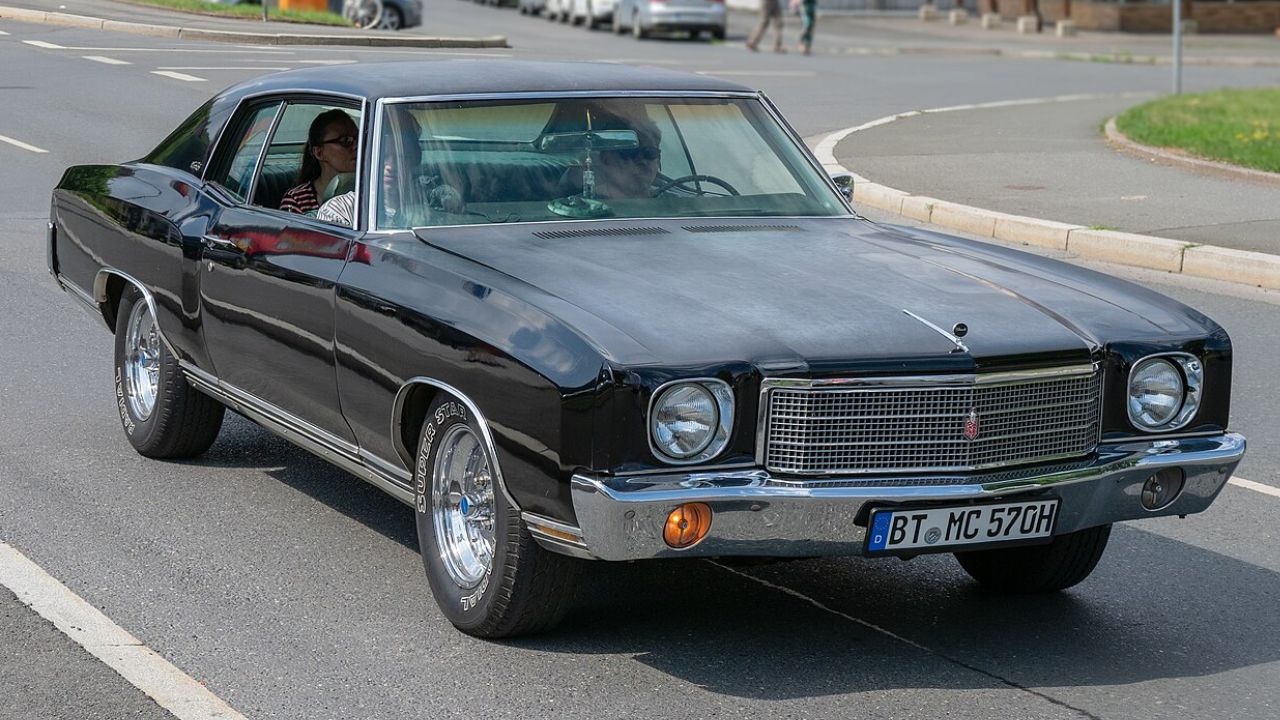
When Chevrolet introduced the Monte Carlo for the 1970 model year, the company wasn’t trying to create the next great muscle car.
It wasn’t trying to launch a revolutionary new segment, either.
Instead, Chevrolet was attempting something that seemed relatively straightforward: build a stylish personal luxury coupe that could attract buyers who wanted more sophistication than a typical family car but didn’t want to pay luxury-car prices.
On paper, the Monte Carlo looked like a niche product.
It combined elements of a midsize car with styling cues borrowed from larger luxury automobiles. It emphasized comfort, appearance, and prestige rather than outright performance. At a time when muscle cars dominated magazine covers and horsepower wars were reaching their peak, the Monte Carlo appeared to be swimming against the current.
Then something unexpected happened.
Buyers loved it.
The Monte Carlo quickly became one of Chevrolet’s biggest success stories of the early 1970s. It exceeded sales expectations, attracted customers from multiple market segments, and established a formula that would remain popular for decades.
Its success revealed something important about the American car market.
While enthusiasts were focused on horsepower, a growing number of buyers wanted style, comfort, and status just as much as speed.
The Monte Carlo arrived at exactly the right moment.
Chevrolet Saw a Growing Opportunity
The Monte Carlo didn’t emerge by accident.
During the late 1960s, American automakers noticed the increasing popularity of personal luxury cars. Buyers were gravitating toward stylish coupes that offered upscale appearances and premium features without the size or cost of traditional luxury automobiles.
One of the most successful examples was the Ford Thunderbird.
Originally introduced as a sporty two-seater, the Thunderbird had evolved into a larger personal luxury coupe and achieved considerable commercial success. Buyers appreciated its blend of comfort, style, and prestige.
General Motors noticed.
Executives recognized that many customers wanted something more distinctive than a standard sedan but weren’t necessarily interested in a full-fledged luxury vehicle.
Chevrolet needed a product that could compete in this expanding market.
The Monte Carlo became the answer.
It Shared Components With Familiar Models
One reason Chevrolet was able to bring the Monte Carlo to market efficiently was its use of existing architecture.
The car rode on GM’s A-body platform, sharing much of its underlying structure with vehicles such as the Chevrolet Chevelle.
This strategy provided significant advantages.
By utilizing proven mechanical components, Chevrolet reduced development costs and improved manufacturing efficiency. At the same time, engineers and designers could focus their efforts on creating a distinctive appearance and character.
The result was a vehicle that felt unique despite sharing its foundations with other GM products.
Buyers saw an elegant coupe.
Chevrolet saw a smart business decision.
Both perspectives proved correct.
The Styling Was a Major Attraction
Perhaps the biggest contributor to the Monte Carlo’s success was its appearance.
The car looked expensive.
A long hood stretched ahead of the driver, creating proportions typically associated with premium automobiles. The short rear deck, formal roofline, and carefully sculpted body panels gave the coupe an upscale presence.
Many buyers immediately noticed the resemblance to far more expensive luxury cars.
The Monte Carlo projected confidence without appearing flashy.
Unlike some muscle cars of the era, it didn’t rely on stripes, scoops, or aggressive graphics to attract attention. Its appeal came from elegance rather than aggression.
That distinction broadened its audience considerably.
The Monte Carlo looked appropriate in virtually any setting.
Buyers Wanted Luxury Without Luxury-Car Prices
One of Chevrolet’s smartest decisions involved pricing.
The company positioned the Monte Carlo as an attainable aspiration.
Buyers could enjoy many of the styling and comfort attributes associated with premium automobiles without stepping into a significantly higher price bracket.
This strategy appealed to a wide range of customers.
Young professionals viewed the Monte Carlo as a reward for success.
Older buyers appreciated its comfortable and refined character.
Families saw it as a stylish alternative to traditional sedans.
Because the car occupied a middle ground between mainstream and luxury segments, it attracted customers from both sides.
That broad appeal became one of its greatest strengths.
The Timing Couldn’t Have Been Better
The Monte Carlo entered the market during a period of transition.
Although the muscle car era remained strong in 1970, signs of change were already emerging. Insurance premiums for high-performance vehicles were rising. Some buyers were becoming less interested in raw horsepower and more interested in comfort, image, and practicality.
The Monte Carlo benefited from these shifting priorities.
It offered enough performance to satisfy most drivers while emphasizing qualities that would become increasingly important during the 1970s.
In many ways, Chevrolet had anticipated where the market was headed.
The company introduced the right car just as consumer tastes began evolving.
That timing proved invaluable.
Performance Was Available If Buyers Wanted It
Despite its luxury-oriented mission, the Monte Carlo wasn’t slow.
Because it shared many components with the Chevelle, buyers could order a variety of V8 engines that delivered respectable performance.
The most famous example was the Monte Carlo SS 454.
Powered by Chevrolet’s massive 454-cubic-inch V8, the SS transformed the elegant coupe into a genuine muscle machine. Officially rated at 360 horsepower, the engine provided impressive acceleration and abundant torque.
The availability of such a package broadened the Monte Carlo’s appeal even further.
Buyers could choose comfort and style, performance and power, or some combination of both.
Few competitors offered that degree of flexibility.
The Interior Matched the Exterior
Chevrolet understood that a personal luxury car needed more than attractive sheet metal.
The cabin had to reinforce the vehicle’s upscale image.
The Monte Carlo delivered.
The interior featured comfortable seating, attractive trim, and thoughtful design elements that made the car feel more expensive than many Chevrolet products. Instruments were easy to read, controls were logically arranged, and overall fit and finish reflected the car’s premium aspirations.
The environment felt refined.
Owners appreciated that quality every time they opened the door.
The cabin helped transform the Monte Carlo from a stylish coupe into a complete luxury-oriented experience.
It Avoided Direct Competition
Another reason the Monte Carlo succeeded was its ability to occupy a relatively unique position within Chevrolet’s lineup.
The Chevelle appealed to mainstream midsize buyers.
The Camaro targeted pony car enthusiasts.
The Corvette served as Chevrolet’s sports car flagship.
The Monte Carlo filled a gap that none of those vehicles addressed.
Rather than competing directly against existing Chevrolet models, it complemented them.
Customers who might not have considered a Camaro or Chevelle suddenly had a compelling new option.
That distinction helped the Monte Carlo establish its own identity almost immediately.
Sales Exceeded Expectations
Chevrolet hoped the Monte Carlo would perform well.
Few anticipated just how successful it would become.
The car generated strong demand almost immediately after its introduction. Buyers responded enthusiastically to its styling, pricing, and overall concept.
Production numbers quickly validated Chevrolet’s strategy.
The Monte Carlo became one of the company’s most successful new products of the era.
Its popularity demonstrated that the personal luxury segment had substantial growth potential.
More importantly, it showed that Chevrolet understood its customers better than many observers realized.
Not everyone wanted a muscle car.
Many wanted something different.
It Helped Define the 1970s
The Monte Carlo’s success wasn’t limited to a single model year.
The car became one of the defining personal luxury coupes of the 1970s and remained an important part of Chevrolet’s lineup for decades.
Its influence extended beyond Chevrolet as well.
Other manufacturers increasingly embraced the personal luxury formula, creating vehicles that emphasized style, comfort, and prestige rather than outright performance.
The Monte Carlo helped validate that approach.
It demonstrated that buyers were willing to prioritize elegance and refinement without abandoning sporty proportions.
That lesson shaped the industry for years.
Collectors Have Gained New Appreciation
For many years, the Monte Carlo lived in the shadow of more famous performance cars.
Collectors focused on Camaros, Chevelles, and Corvettes while overlooking Chevrolet’s personal luxury coupe.
That attitude has gradually changed.
Enthusiasts increasingly appreciate the Monte Carlo’s unique role in automotive history. Early examples, particularly SS 454 models, have become especially desirable.
Collectors now recognize the car as an important milestone rather than merely a stylish alternative to Chevrolet’s muscle machines.
Its significance extends beyond horsepower figures.
The Monte Carlo helped define an entirely different kind of success.
The Right Car at the Right Time
The 1970 Chevrolet Monte Carlo succeeded because it understood something many competitors had not yet fully recognized.
The American car market was changing.
While muscle cars continued attracting headlines, increasing numbers of buyers wanted style, comfort, prestige, and practicality wrapped into a single package.
The Monte Carlo delivered exactly that.
Its elegant design, accessible pricing, comfortable interior, and available performance options created a combination that appealed to a remarkably broad audience.
Chevrolet didn’t set out to create a revolutionary automobile.
It simply set out to build a desirable one.
An Unexpected Winner
Looking back, the Monte Carlo’s success seems obvious.
The styling was attractive, the pricing was smart, and the market was ready.
But in 1970, none of that was guaranteed.
The car entered a competitive environment dominated by muscle cars and established luxury coupes. It could easily have become a niche product.
Instead, it became one of Chevrolet’s biggest success stories.
The 1970 Monte Carlo proved that buyers didn’t always want the fastest car in the showroom.
Sometimes they wanted the one that made them feel successful every time they looked at it.
And that simple insight helped turn the Monte Carlo into an unexpected hit.
More from Fast Lane Only