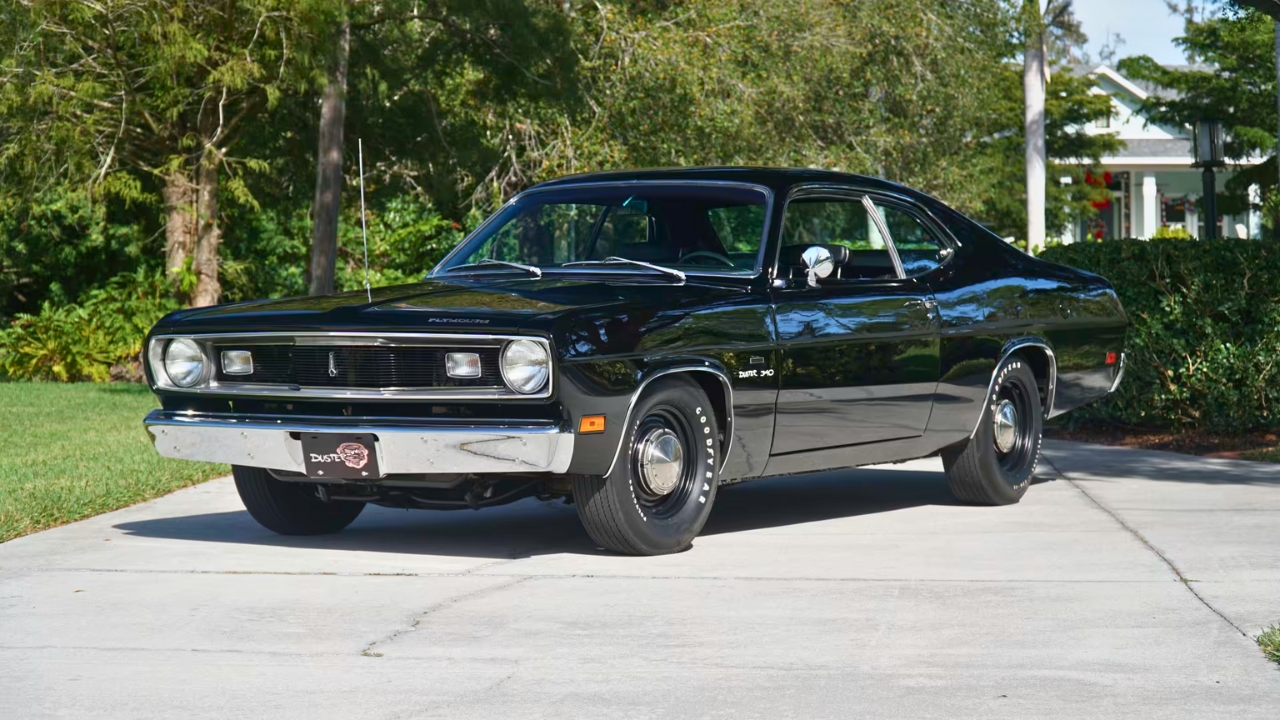
When Plymouth introduced the Duster for the 1970 model year, most buyers viewed it as a practical addition to the company’s compact-car lineup.
The Duster was based on the familiar Valiant platform, a vehicle known more for affordability and dependability than tire-smoking performance. It offered attractive styling, reasonable pricing, and enough practicality to appeal to a wide range of customers.
Nothing about that formula suggested a future muscle car legend.
Then Plymouth installed a high-performance 340-cubic-inch V8 under the hood.
The result was the Duster 340, a compact performance machine that quickly earned a reputation for delivering far more speed than many people expected. It combined a relatively lightweight body with one of Chrysler’s most respected small-block engines, creating a package capable of challenging larger and more expensive muscle cars.
At a time when Detroit’s horsepower wars were approaching their peak, the Duster 340 proved that impressive performance didn’t always require a massive big-block engine or a premium price tag.
In many ways, it became one of the smartest performance bargains of the muscle car era.
Plymouth Needed a New Compact Coupe
The story begins with a practical problem.
By the late 1960s, Plymouth’s compact lineup relied heavily on the Valiant. While the Valiant sold well, the company recognized an opportunity to attract younger buyers looking for something sportier.
The answer was the Duster.
Introduced as a fastback coupe variant of the Valiant, the Duster featured unique sheet metal from the windshield rearward. The sweeping roofline gave the car a more youthful appearance while helping Plymouth compete with increasingly popular sporty compact cars.
Initially, the Duster wasn’t designed solely as a performance vehicle.
It was intended to broaden the appeal of Plymouth’s compact offerings.
Yet its dimensions made it an ideal candidate for something more exciting.
The Compact Size Became a Major Advantage
One of the Duster’s greatest strengths was its relatively small size.
During the muscle car era, manufacturers often focused on increasing engine displacement. Cars became more powerful, but they also frequently became heavier.
The Duster approached performance from a different angle.
Because it started as a compact platform, it weighed significantly less than many midsize muscle cars. That weight advantage created opportunities.
A lighter vehicle requires less power to achieve strong acceleration.
It also tends to feel more responsive and agile.
Plymouth’s engineers understood this relationship.
The challenge was finding the right engine.
The 340 V8 Was Perfect for the Job
Rather than installing one of Chrysler’s larger big-block engines, Plymouth selected the company’s highly regarded 340-cubic-inch small-block V8.
This decision proved crucial.
The 340 had already developed a reputation as one of the most effective performance engines in Chrysler’s lineup. Officially rated at 275 horsepower for 1970, the engine was widely respected for its willingness to rev and its impressive real-world performance.
Many enthusiasts believed the published horsepower figures understated the engine’s true capability.
Whether or not that was the case, road tests consistently demonstrated that the 340 delivered strong acceleration.
The engine’s characteristics perfectly matched the Duster’s lightweight chassis.
Together, they created a remarkably effective package.
Performance Surprised the Automotive Press
When journalists began testing the Duster 340, many came away impressed.
The car’s acceleration figures frequently compared favorably with larger and more expensive muscle cars. Quarter-mile times often landed firmly within serious performance territory.
What surprised many reviewers was how easily the Duster achieved those results.
The combination of moderate weight and a powerful small-block engine created a car that felt eager and responsive.
Drivers didn’t need massive displacement to experience excitement.
The Duster proved that careful engineering could produce impressive results without relying on sheer cubic inches.
Its performance credentials quickly became difficult to ignore.
The Duster Looked Fast, Too
Performance wasn’t the only part of the formula.
Plymouth’s designers ensured the Duster 340 looked the part as well.
Special graphics, performance-oriented trim, and sporty styling details helped distinguish the car from ordinary Dusters.
The fastback roofline gave the vehicle a sleek appearance that suggested motion even when parked.
Unlike some muscle cars that relied on excessive ornamentation, the Duster’s styling remained relatively clean.
The design balanced youthful energy with simplicity.
That combination appealed to buyers seeking a performance car that didn’t appear overly extravagant.
The Duster looked confident without trying too hard.
Handling Benefited From the Lightweight Platform
Although straight-line performance dominated muscle car marketing, the Duster’s relatively low weight also benefited handling.
Compared with some larger muscle cars, the Duster felt more nimble.
Drivers appreciated its willingness to change direction and its overall responsiveness.
The car wasn’t a sports car in the European sense, but it offered a balanced driving experience that many enthusiasts enjoyed.
Its compact dimensions made it easy to maneuver while still delivering the V8 power buyers expected from a performance machine.
The Duster 340 succeeded because it offered more than acceleration alone.
It felt lively.
That quality helped distinguish it from some heavier competitors.
It Cost Less Than Many Rivals
One of the Duster 340’s most important advantages involved price.
The car delivered impressive performance without requiring buyers to spend as much money as they might on larger muscle cars.
This affordability expanded its appeal considerably.
Young enthusiasts, first-time performance-car buyers, and budget-conscious consumers all found the Duster attractive.
Plymouth had created a vehicle that offered substantial performance value.
In many respects, it represented the democratization of muscle-car excitement.
You didn’t need a premium budget to have fun.
The Duster 340 made sure of that.
Insurance Was Becoming a Factor
The timing of the Duster’s arrival proved particularly interesting.
By 1970, insurance companies had begun paying closer attention to high-performance automobiles. Premiums for some muscle cars were increasing rapidly, especially for younger drivers.
Vehicles equipped with enormous big-block engines often attracted the highest rates.
The Duster’s smaller displacement occasionally worked in its favor.
Although it remained a serious performance car, it didn’t always draw the same assumptions associated with the largest-engine muscle machines.
For some buyers, this made ownership slightly more practical.
That practicality enhanced the car’s appeal even further.
It Competed With Bigger Names
The Duster 340 entered a market crowded with established performance legends.
Cars like the Chevrolet Chevelle SS, Pontiac GTO, and Plymouth Road Runner dominated magazine covers and advertising campaigns.
The Duster lacked the prestige of some rivals.
Yet on the road, it frequently proved more competitive than many expected.
Its power-to-weight ratio allowed it to challenge vehicles that appeared far more intimidating on paper.
Enthusiasts quickly learned not to underestimate the little Plymouth.
Doing so often led to disappointment.
Buyers Appreciated Its Simplicity
Part of the Duster 340’s enduring appeal comes from its straightforward nature.
The formula wasn’t complicated.
Take a lightweight compact coupe.
Install a strong V8 engine.
Add a few performance upgrades.
Keep the price reasonable.
The result was a car that delivered exactly what enthusiasts wanted.
There was no unnecessary complexity.
The Duster focused on providing an enjoyable driving experience.
That honesty resonated with buyers then and continues to resonate with collectors today.
Collectors Have Rediscovered Its Value
For many years, the Duster 340 lived in the shadow of more famous muscle cars.
Collectors often focused on Hemi-powered Mopars, Six-Pack models, and other headline-grabbing vehicles.
Over time, however, appreciation for the Duster increased.
Enthusiasts began recognizing how effective the package truly was. The combination of strong performance, relative rarity, and historical significance helped elevate the car’s status.
Today, well-preserved Duster 340s are highly desirable among Mopar collectors.
The market has finally caught up with what owners knew all along.
The Smart Muscle Car
Looking back, the 1970 Plymouth Duster 340 succeeded because it approached performance intelligently.
Rather than relying solely on maximum displacement, Plymouth leveraged a lightweight platform and one of Chrysler’s best small-block engines to create a balanced and effective performance machine.
The formula worked brilliantly.
The Duster delivered acceleration, handling, affordability, and style in a package that exceeded expectations.
It offered more performance than many buyers anticipated—and often more than competitors wanted to admit.
The Compact That Punched Above Its Weight
The 1970 Plymouth Duster 340 remains one of the most impressive performance bargains of the muscle car era.
What began as a sporty compact coupe evolved into a genuine performance contender capable of challenging larger and more expensive rivals.
Its success came from balance rather than excess.
The lightweight body, powerful 340 V8, attractive styling, and accessible pricing created a combination that appealed to a wide range of enthusiasts.
More than fifty years later, the Duster 340 stands as proof that muscle car greatness wasn’t always measured by engine size alone.
Sometimes the smartest package delivered the biggest surprise.
More from Fast Lane Only