The Chevrolet Corvette ZR1 has always been the car that gets bragging rights. It sits at the top of the lineup, wearing the biggest engine and the loudest numbers Chevrolet can attach to a factory Corvette. When a ZR1 lines up against anything, the assumption is usually simple: the ZR1 wins.
That assumption ran into a problem on a quarter-mile drag strip in British Columbia. A C7-generation Corvette ZR1, packing a supercharged V8 built to intimidate, lined up next to a C8 Corvette E-Ray, a car that trades outright horsepower for a hybrid all-wheel-drive system. On paper, the ZR1 looked like the clear favorite.
It did not turn out that way. The E-Ray crossed the finish line first, and the gap was not close. The result says less about one bad run and more about how much the Corvette has changed as a platform, and why raw horsepower is not always the number that decides a drag race.
Two Very Different Corvettes
The C7 ZR1 represents the final, most extreme version of the old front-engine Corvette formula. It uses a supercharged 6.2-liter LT5 V8 that sends 755 horsepower and 715 lb-ft of torque through the rear wheels only. That combination made the ZR1 the fastest and most powerful Corvette General Motors had built up to that point, and it earned a reputation as a car that could put down brutal straight-line numbers when the tires hooked up.
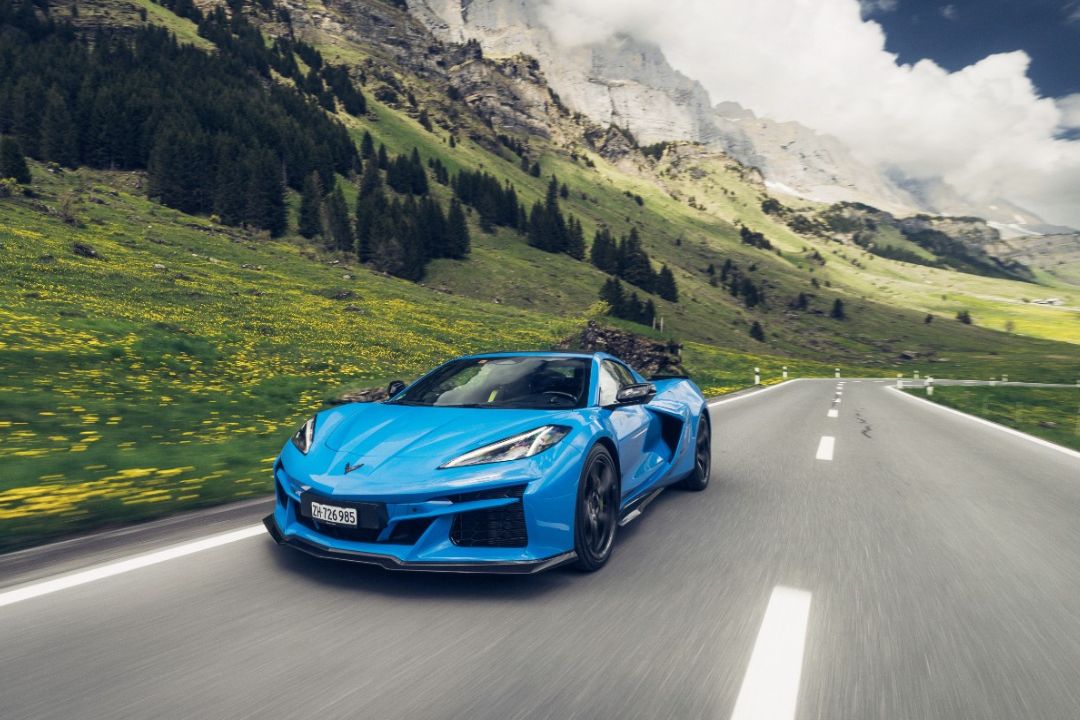
The C8 E-Ray takes a completely different approach. It pairs a naturally aspirated 6.2-liter V8 with a front-axle electric motor, giving the car all-wheel drive and a combined output of 655 horsepower. That is 100 horsepower less than the ZR1 sends to the pavement, and the E-Ray also uses a mid-engine layout instead of the ZR1’s front-engine design. Chevrolet built the E-Ray around traction and drivability rather than chasing the highest horsepower figure in the lineup.
That difference in philosophy is exactly what made this matchup worth watching.
The Numbers From the Track
The two Corvettes staged at a prepped quarter-mile strip and launched together off an electronic Christmas tree. When the light turned green, the E-Ray left the line cleanly, its electric front motor delivering instant torque while the all-wheel-drive system kept both ends of the car planted. The ZR1 dealt with some rear tire spin as it tried to put its 755 horsepower down through the rear wheels alone.
That early advantage held up for the entire run. The E-Ray finished the quarter mile in 10.60 seconds at a trap speed of roughly 129 mph. The ZR1 crossed the line behind it at 11.02 seconds and about 120 mph. Both cars completed clean passes with no mechanical issues, which means the result came down entirely to how each car put its power to the ground.
A 0.42-second gap may not sound enormous, but in drag racing terms, it is decisive. The E-Ray had built a multi-car-length lead in the first several feet, and the ZR1 never had enough track left to close it back up.
Why the E-Ray Had the Edge
The story here is not that the ZR1 is a weaker car. It has more horsepower and more torque than the E-Ray by a wide margin. The story is that horsepower alone does not win a drag race. What wins is how effectively a car can put that power down at the moment the light turns green, and that is where the E-Ray’s hybrid all-wheel-drive system took over.
The ZR1’s supercharged V8 has to send all of its power through two rear tires, which makes wheel spin a real risk on a hard launch. The E-Ray splits that job across all four tires and adds an electric motor that produces its full torque instantly, with no need to build boost or wait for the engine to spool up. That combination let the E-Ray leave the line harder and hold its lead through the rest of the run, even while carrying 100 fewer horsepower than the car behind it.
It is a reminder that on a drag strip, launch traction can matter just as much as the number on the spec sheet.
What This Race Says About the Corvette’s Direction
This result lands at an interesting point in the Corvette’s history. The C7 ZR1 was the peak of a formula Chevrolet had refined for decades: big front-mounted V8, forced induction, and rear-wheel drive doing all the work. The C8 generation moved the engine behind the driver and, with the E-Ray, added electric assistance and all-wheel drive to the mix for the first time.
Seeing a lower-horsepower hybrid Corvette beat one of the most powerful non-hybrid Corvettes ever built is not just a fun result. It shows how much ground the E-Ray’s approach can make up through traction alone, and it hints at how competitive future all-wheel-drive Corvettes could be against cars that still rely on raw power sent through two tires. The ZR1 remains one of the fastest Corvettes Chevrolet has ever sold. On this particular day, though, the smarter launch beat the bigger engine.
More from Fast Lane Only: