The Jaguar XJS never had an easy job. It arrived as the replacement for the E-Type, a car so beloved that anything following it was bound to feel like a letdown. For years, the XJS was seen more as a comfortable grand tourer than a car with real teeth.
That changed when Tom Walkinshaw Racing turned the XJS into a genuine touring car weapon, winning the European Touring Car Championship in 1984. TWR later built race Jaguars that won outright at Le Mans in 1988 and 1990, cementing the name as part of the brand’s biggest motorsport moments.
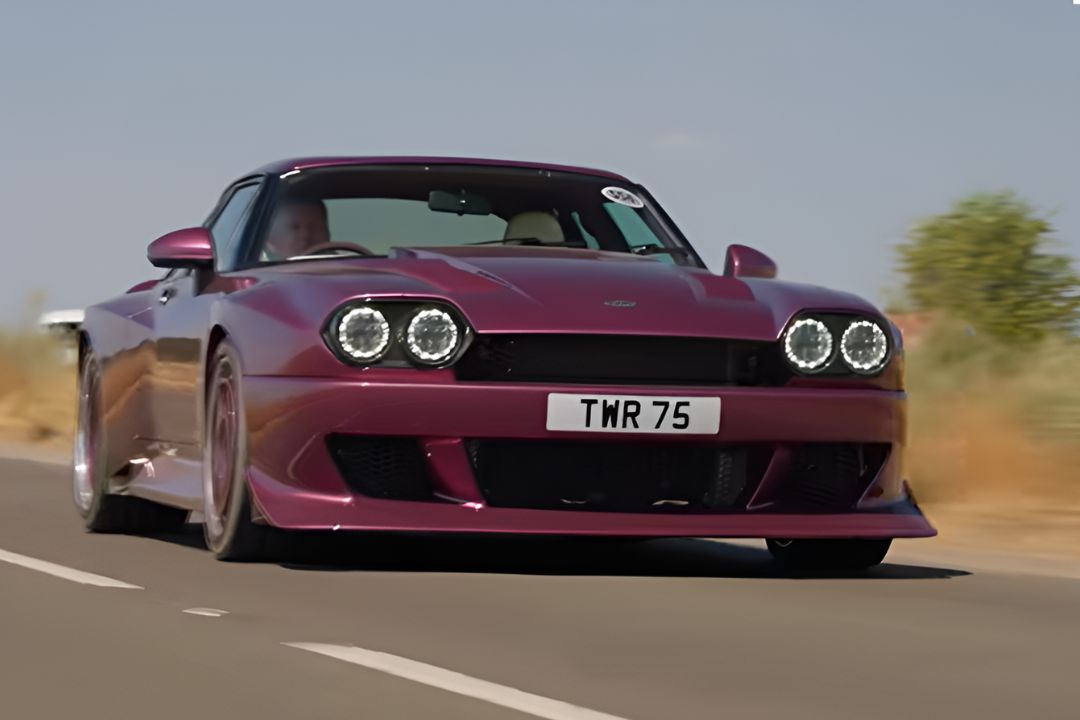
Now TWR is back, with a modern reinterpretation of the car that started it all. The result is the Supercat, a supercharged V12 restomod built on the XJS platform, and racing driver Tiff Needell recently got behind the wheel to see if it lives up to the name.
A Familiar Chassis, Almost Entirely Reworked
The Supercat starts life as a donor Jaguar XJS, but little of the original car survives. The chassis remains, along with a few smaller parts, while the bodywork is replaced with a fully reworked carbon fiber design shaped around aerodynamics rather than just styling.
Under the hood sits a supercharged 5.6 liter V12 producing 660 horsepower and 730 Newton meters of torque, sent through a six speed manual gearbox to the rear wheels. TWR chose a supercharger over a turbocharger specifically for smoother, more progressive power delivery.
Only 88 examples will be built, mirroring TWR’s 1988 Le Mans win. Pricing lands around £395,000 for the build itself, with the total closer to half a million pounds once a donor XJS and VAT are added.
The Man Behind the Revival
The Supercat exists because of Fergus Walkinshaw, one of three sons of TWR founder Tom Walkinshaw, who passed away in 2010. Fergus relaunched the company with business partner John Kane, and the team settled on the XJS as their starting point because it offered the clearest link back to TWR’s most famous racing era without immediately attempting something as ambitious as a Le Mans tribute.
Choosing a supercharged V12 was a deliberate choice. Rather than chasing big displacement or twin turbos, TWR wanted an engine that stayed smooth and usable, since the Supercat was designed as a genuine grand tourer that owners could drive long distances without constant stops.
Behind the Wheel
Tiff Needell’s connection to TWR runs deep. He raced against TWR-prepared cars during his career and competed in TWR machinery himself, including the Jaguar XJR-15 in the Jaguar Sport Intercontinental Challenge. That history gave him a useful frame of reference for the Supercat.
Needell found the car offers two personalities. Driven relaxed, it behaves like a proper grand tourer, with comfortable seats, good visibility, and a dashboard layout that echoes the original XJS. Pushed harder, with a couple of downshifts, the character shifts completely, and the supercharged V12 responds with a steady, escalating pull rather than a sudden hit of boost. Switching into track mode sharpened the throttle response further and introduced pops and crackles on lift off, and with that much torque arriving through a manual gearbox and rear wheels alone, Needell admitted the car was tempting enough to get him into serious trouble on the road.
What Makes It Different
Modern hypercars increasingly lean on hybrid systems and layers of electronic assistance. The Supercat goes the other way, relying on a supercharged V12, a manual gearbox, and driver input over computer intervention, even though it keeps some electronic aids as a safety net.
That analog character carries through in how TWR talks about the car. Despite the extensive rework, the company still calls the Supercat a restomod rather than an entirely new model. It’s a Jaguar XJS underneath, just pushed further than Jaguar or TWR ever pushed it the first time.
More from Fast Lane Only: