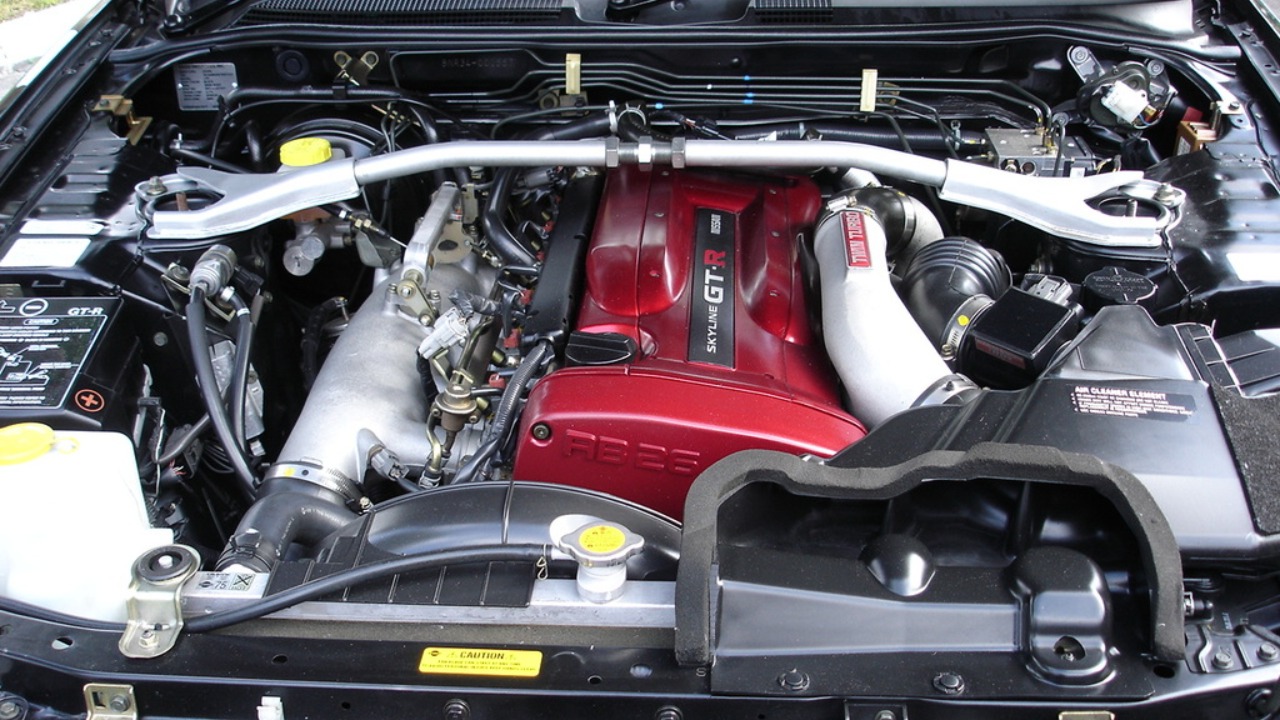
The 1990s were a high watermark for Japanese car culture, a decade when video games, street racing manga, and a flood of export coupes turned a once‑niche scene into global obsession. At the center of that story sat a family of straight‑six engines whose mix of strength and tunability helped define how the world remembers that era. The RB series, and especially the turbocharged RB26DETT, became the mechanical soundtrack of bubble‑era Japan and the blueprint for a generation of enthusiasts who grew up dreaming in boost pressure and boost gauges.
Three decades later, those engines are no longer just hardware. They serve as shorthand for a specific moment when Japan’s carmakers chased innovation, motorsport glory, and cultural influence with unusual freedom, leaving a legacy that still shapes how performance cars are built, tuned, and collected.
How a straight‑six from Yokohama became a 1990s icon
Nissan’s RB straight‑six arrived in the late 1980s, but it was the 1990s that turned it into legend. The company installed RB variants across a wide spread of models, from sedans to coupes, yet it was the Skyline GT‑R that crystallized the engine’s reputation. The R32, R33, and R34 generations paired the 2.6‑liter twin‑turbo RB26DETT with all‑wheel drive and advanced electronics, creating a car that could embarrass contemporary European exotics while still looking like a restrained Japanese coupe.
That mix of understatement and outrageous performance helped several iconic Nissan models define the decade. The Skyline GT‑R sat alongside cars like the Silvia and 300ZX as proof that Japan could build complex, high‑output engines that tolerated hard use and aggressive tuning. The RB’s iron block, strong internals, and conservative factory power ratings gave tuners room to chase big numbers without immediately sacrificing reliability.
What made the RB series special was not only its top‑end heroics. Nissan used naturally aspirated and single‑turbo versions in more ordinary Skylines and Laurels, which meant the same basic architecture that powered touring car championships also carried commuters through Tokyo traffic. That shared DNA turned scrapyards into treasure troves for grassroots racers, who could source an RB and, with the right turbo and fuel system, build a track car that borrowed engineering from Japan’s flagship performance halo.
On the street and in motorsport, the RB26DETT quickly built a record. Group A touring car entries dominated domestic series, and the Skyline GT‑R gained a reputation in overseas racing where regulations allowed it to run. The engine’s ability to handle extended high‑load use without catastrophic failure gave teams confidence to push boost and revs, reinforcing its image as an overbuilt unit that invited experimentation.
Meanwhile, the RB shared the stage with other Japanese engines that turned the 1990s into a golden age. Rotary power in Mazda’s RX‑7, Toyota’s 2JZ‑GTE in the Supra, and Honda’s high‑revving VTEC units in the NSX and Integra Type R all contributed to a wave of unforgettable JDM sports. Within that group, the RB’s blend of turbocharged torque and smooth six‑cylinder character gave it a distinct identity that enthusiasts could recognize by sound alone.
Why that 1990s powerplant still shapes car culture
The RB series matters today because it sits at the intersection of engineering, regulation, and pop culture. During the 1990s, Japan’s “gentlemen’s agreement” informally capped advertised horsepower, so manufacturers focused on drivability, response, and tuning headroom rather than headline numbers. The RB26DETT was officially rated within that limit, yet owners quickly discovered that simple modifications unlocked far more power. That gap between brochure and reality turned the engine into a symbol of hidden potential.
Media amplified that mystique. Video games and anime framed the Skyline GT‑R as an almost mythical machine, and the RB’s rising‑boost soundtrack became part of the era’s shared memory. When car lists today catalog the most memorable 1990s, the Skyline and its RB engine sit alongside European and American icons, proof that Japanese engineering had fully arrived in the global enthusiast conversation.
That legacy has real economic consequences. As import rules in markets like the United States have gradually opened to 1990s Japanese models, demand for RB‑powered cars has surged. Auction prices for clean R32, R33, and R34 Skylines have climbed sharply, driven by a mix of nostalgia, limited supply, and the engine’s tuning reputation. Collectors are not only buying a chassis, they are buying access to a specific mechanical experience that modern turbocharged engines, with their filtered exhausts and strict emissions controls, rarely replicate.
The tuning community keeps that experience alive. Specialist shops still build RB engines with modern turbos, standalone ECUs, and updated fueling, often extracting outputs that would have been unthinkable when the cars were new. Many builders, however, aim to preserve the period character, keeping twin‑turbo layouts or factory‑style intake plumbing so the cars feel like time capsules rather than restomods. The engine’s architecture gives them the flexibility to chase either authenticity or outright performance.
At the same time, the RB’s story highlights how much the industry has changed. Modern performance cars rely heavily on downsized engines, hybrid assistance, and strict electronic oversight. By contrast, the RB26DETT represents a more analog philosophy, where a relatively simple mechanical package could be reinterpreted endlessly by owners. That contrast helps explain why younger enthusiasts, who never experienced the 1990s firsthand, still gravitate toward RB builds on social media and at track days.
From heritage piece to future blueprint
The RB engine family is no longer in mass production, and Nissan’s current performance lineup uses very different powertrains. Yet the influence of that 1990s straight‑six shows up in how manufacturers and tuners approach heritage and innovation today.
On the manufacturer side, carmakers increasingly treat their 1990s performance models as brand assets. Limited‑run reissues of classic colors, retro‑inspired styling cues, and official heritage parts programs acknowledge that engines like the RB carry emotional weight. While specific corporate plans for RB components are not fully documented here, the broader trend is clear: companies see value in keeping older performance icons on the road, whether through reproduction parts or technical support. Unverified based on available sources.
For tuners and engineers, the RB’s durability and mod‑friendliness provide a template for how to design enthusiast‑focused powertrains in a stricter regulatory environment. Some modern engines borrow the idea of leaving headroom in internals and cooling systems so that performance variants and aftermarket upgrades can safely push beyond stock output. The lesson from the 1990s is that an engine can meet factory needs while still inviting a second life in private hands.
There is also a growing conversation about how to preserve engines like the RB in an era of electrification. Some builders experiment with hybrid conversions that keep the straight‑six but add electric assistance for low‑speed torque and emissions benefits. Others argue that the RB’s value lies precisely in its unassisted character, and focus instead on synthetic fuels or careful maintenance to extend its lifespan. Both approaches treat the engine as cultural heritage that deserves thoughtful stewardship rather than casual use.
Looking ahead, the RB’s most enduring impact may be educational. Young mechanics and engineers still study its design, learning how casting choices, oiling strategies, and turbo sizing affected both reliability and response. As more cars transition to electric powertrains, that knowledge risks fading unless it is actively passed down. Clubs, forums, and specialist workshops effectively function as informal archives, documenting rebuild techniques and failure modes so future owners can keep these engines running.
The story of the RB also challenges a simple narrative that progress always means replacement. Electric performance cars deliver acceleration that would have stunned 1990s engineers, yet the emotional connection many drivers feel to a spooling turbo straight‑six suggests that different technologies can coexist. Enthusiasts increasingly talk about mixed garages, where an RB‑powered coupe shares space with an electric daily driver, each used where it shines.
More from Fast Lane Only
- Unboxing the WWII Jeep in a Crate
- 15 rare Chevys collectors are quietly buying
- 10 underrated V8s still worth hunting down
- Police notice this before you even roll window down
*Research for this article included AI assistance, with all final content reviewed by human editors