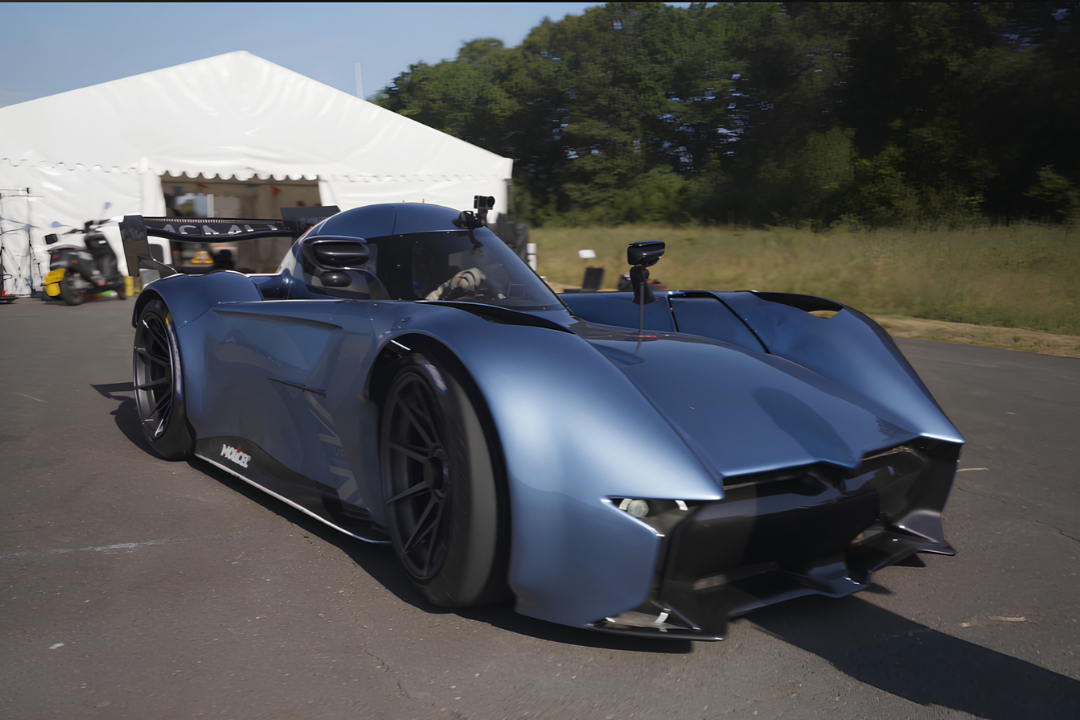
Some engineering claims sound like marketing until you see the math. A car that can drive upside down is exactly that kind of claim, the sort of clip that gets dismissed as fake the moment it hits social media. When footage of the McMurtry Spéirling doing precisely that started circulating, plenty of viewers assumed it had to be staged.
It wasn’t. The Spéirling is a real car built by a small British startup, and the same system that lets it hang upside down on a platform is the reason it can out-corner a Formula 1 car on certain tracks despite being far lighter and smaller than one. Understanding how gets you into one of the more elegant solutions in modern motorsport engineering, and it starts with a problem every racing car has struggled with for fifty years: how do you get grip at low speed, not just high speed.
Wings work great, until you slow down
Every fast cornering car depends on downforce, the force that presses tires harder into the road so they can grip better under braking, cornering, and acceleration. For decades the standard solution has been wings, shaped to use oncoming air to push the car down. The problem is that wings only work in proportion to speed, and that relationship isn’t linear. Downforce scales with the square of speed, so cutting your speed in half doesn’t cut your downforce in half, it cuts it to a quarter.
That’s why Formula 1 cars, capable of roughly 4,000 kilograms of downforce at 210 mph, feel comparatively grip-starved in slow corners. The wings simply aren’t moving enough air to do their job at those speeds. McMurtry’s founder, Sir David McMurtry, a former Rolls-Royce engineer who worked on Concorde’s engines, proposed a solution so simple it sounded almost like a joke: stick a fan under the car and suck it down instead of relying on airflow over the top.
There’s no such thing as suction, and that’s the whole point
The actual physics involved isn’t suction in the way people usually think about it. Removing air from underneath the car doesn’t pull the car down. It creates an imbalance, and the atmosphere above the car, already pressing down with enormous force everywhere, pushes the car into the resulting low-pressure zone. Two electric fans at the back of the Spéirling do exactly this, pulling air out from under the floor so the atmosphere does the rest of the work.
The result is a genuinely strange number: roughly 2,000 kilograms of downforce, generated at any speed at all, including a dead stop. A car that weighs under a ton can have twice its own weight in downward force pressing it to the ground before it’s even moving. That’s the entire trick behind the upside-down demonstration. On a platform, held there briefly, the only thing keeping the car pinned to an inverted surface was atmospheric pressure doing the same job it does right-side up.
The part every previous attempt at this got wrong
Fan-generated downforce isn’t a new idea. The Chaparral 2J tried it in 1970, and the Brabham F1 car did in 1978, winning its only race before Formula 1 banned fan cars entirely. The problem in both cases, and in every ground-effect approach that followed, was sealing. Generating this kind of downforce requires a sealed low-pressure area under the car, and on a real racetrack, with bumps, curbs, and a ride height that shifts constantly under braking and cornering, keeping that seal intact proved essentially impossible. When the seal broke, the downforce didn’t fade gradually. It vanished immediately, which made every previous attempt at this technology dangerous enough to eventually get banned.
McMurtry’s answer was to stop trying to seal the whole floor and instead seal a much narrower strip down the center of the car, running the width of roughly the driver’s own body rather than the full car. A skirt, developed over eight years using materials the company has kept private beyond patent filings referencing toughened ceramics and Kevlar weave, rides directly against the track surface. Critically, that skirt isn’t fixed rigidly to the car’s chassis. It moves independently, so when the car rolls, dives under braking, or hops a curb, the seal stays put even as the body around it shifts.
Why the car still has a wing at all
If two tons of downforce comes from the fans alone, a rear wing seems redundant. The reason it’s there comes down to where the downforce acts rather than how much of it there is. The Spéirling has an unusually short wheelbase, shorter than a classic Mini, which makes it extremely agile at low speed but can make the rear end feel less planted as speed builds in fast corners. Adding a wing at the back shifts the car’s center of pressure rearward, and because wing downforce increases with speed, it gives the rear more support exactly when the car is going fastest and needs it most, without demanding a wing anywhere near the size an F1 car needs.
That distinction matters because F1’s wings come with a real cost: drag. A significant portion of a Formula 1 car’s power is spent simply pushing its own aerodynamic devices through the air at speed. Because the Spéirling gets most of its grip from the fans rather than from wings punching through the air, it can stay small and light while still cornering at levels that rival or exceed a car with vastly more horsepower.
What driving it actually feels like
The car’s 0-60 time of 1.4 seconds is the number that gets attention, but according to the driver who tested it, that’s not actually the most striking part of the experience. What stands out is how the grip behaves through corners. In an F1 car, braking grip fades constantly as speed drops, forcing the driver to ease off the brake pedal progressively to match the disappearing downforce. In the Spéirling, the downforce stays constant regardless of speed, so the driver can stay hard on the brakes the entire way down without chasing a moving target.
That consistency reportedly makes the car far less intimidating to drive at its limit than its numbers would suggest, according to both the professional driver who tested it and an early customer who isn’t a racing driver by trade. The car apparently behaves the same way at low speed as it does at high speed, removing the usual problem where amateur drivers in extreme performance cars can’t safely get anywhere near the car’s actual limits.
Faster than F1, but only sometimes
The honest answer to whether the Spéirling beats a Formula 1 car isn’t a simple yes. On tracks dominated by slower corners, hairpins, chicanes, and tight sections up to around 120 mph, the Spéirling reportedly matches or beats current F1 machinery based on simulation and track data referenced by the team. On high-speed circuits with long, fast corners, straight-line aerodynamics and raw power still favor Formula 1. The Spéirling’s advantage lives specifically in the low-speed regime that wings have always struggled to serve, which happens to be exactly the problem the fans were built to solve in the first place.
Sir David McMurtry died in December 2024, but he was reportedly present at Goodwood to see the car take a historic hillclimb record, a fitting bookend for a project built on an idea simple enough to sound like a joke and successful enough to outrun cars with vastly more power.
More from Fast Lane Only
- Unboxing the WWII Jeep in a Crate
- 15 rare Chevys collectors are quietly buying
- 10 underrated V8s still worth hunting down
- Police notice this before you even roll window down
*Research for this article included AI assistance, with all final content reviewed by human editors.