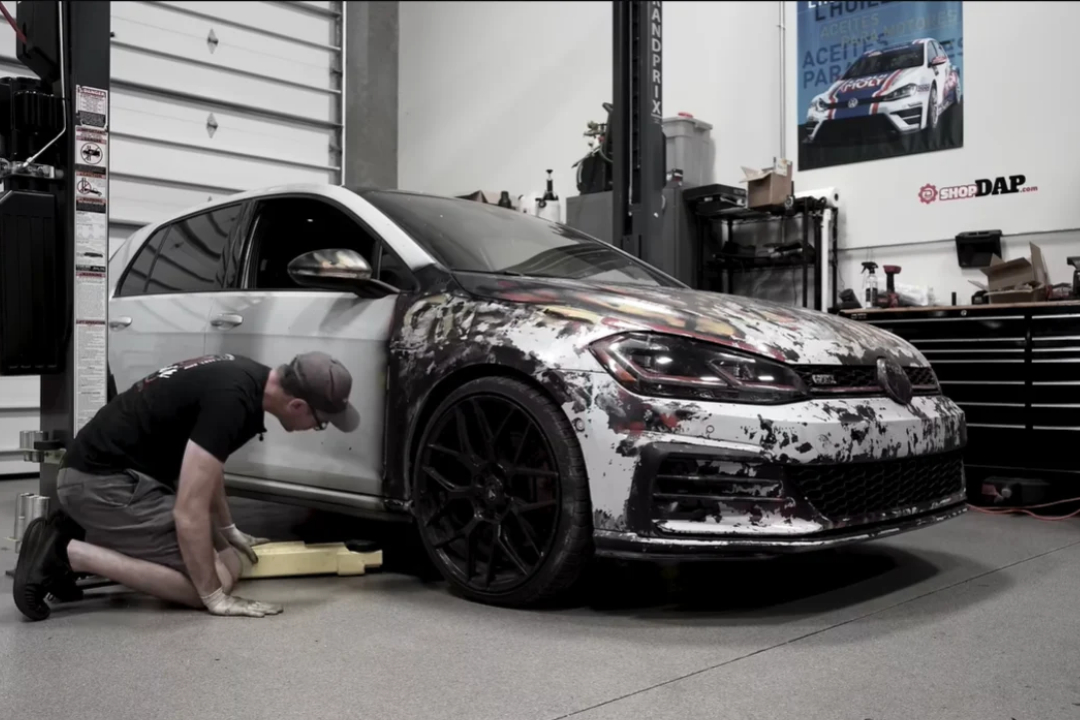
Some cars announce their problems the moment they roll into a shop. A Volkswagen Golf GTI showed up recently looking less like a hot hatch and more like a crime scene, its front end coated in hastily applied black spray paint, flame graphics running down the sides, and a front subframe crusted white with what turned out to be months, possibly years, of leaking coolant.
The car had started life as something genuinely desirable. This was a Mk7.5 GTI with the Dynamic Chassis Control adaptive suspension package, a factory option that pushed the car’s original price close to $40,000 and separated it from the base trim most people picture when they hear “GTI.” A buyer named Addison had picked it up off Facebook Marketplace for $3,000, planning to either use it as a parts donor for his own blown GTI or nurse it back into a driver.
What the shop found once they got it on a lift went well past cosmetic damage, and the story behind how the car got that way turned out to be almost as unsettling as the mechanical problems themselves.
A paint job with an unusual origin story
The spray paint alone would have been a project. Matte black covered the front bumper, hood, grille, VW emblem, and headlights, the last of which run roughly $1,700 each to replace and were now coated in overspray. Addison had already burned through three cans of brake cleaner trying to strip it off, revealing patches of the original factory paint still intact underneath, which led him to say on camera that the car might still be salvageable cosmetically.
The explanation for the paint job came from the previous owner, who told Addison he’d simply gotten bored one day and grabbed some rattle cans. That story became harder to take at face value once Addison found two used doses of Narcan in the back of the car at the time of purchase, a detail that shifted the conversation from a strange DIY choice to something with a more concerning explanation behind it.
A subframe that told its own story
The cosmetic damage turned out to be the least of the car’s problems. Once the shop got underneath it, they found the black steel front subframe coated entirely white, the visible result of coolant that had been leaking and spraying across the underside of the car at highway speed for an extended period. Bright green residue throughout the engine bay confirmed the wrong coolant type had been used for a long stretch before that.
The oil filler cap showed milky residue, a warning sign that oil and coolant were mixing somewhere in the engine, typically the result of a blown head gasket, a cracked block or head, or a failed gasket in the accessory bracket where the oil cooler and water pump meet. Whatever the source, the underlying question was serious: an engine run hot enough for long enough can suffer real internal damage, not just a fluid leak that needs patching.
Small details that added up to a bigger pattern
Beyond the headline issues, the inspection turned up one strange discovery after another. One front wheel carried five separate rows of stacked wheel weights around its outer barrel, an amount so far beyond normal balancing practice that the mechanic compared it to a tire shop employee’s fever dream. Both front fender liners were missing entirely, pinch welds and floor pans were visibly bent from repeated improper jacking, and the spare tire in the trunk had been shredded down to its metal cord, consistent with driving on it while flat.
The previous owner’s DIY water pump replacement added its own red flag. Of the roughly six bolts meant to secure it, three had backed out entirely, the kind of detail that raises real questions about what else on the car had been touched without being finished properly.
The one piece of good news
Amid all of it, a cylinder compression test came back healthy, with readings of 160, 160, 160, and 170 PSI across the four cylinders, solidly within normal range and a sign that the engine’s core mechanical health had survived the overheating better than the milky oil suggested it might have. It was a rare moment of relief in an inspection that had mostly turned up bad news.
That relief was tempered by what the compression test couldn’t rule out. A live coolant leak was traced to a fitting at the upper radiator hose connection, but fixing that wouldn’t necessarily resolve why oil and coolant were mixing in the first place. The shop’s read was that a genuinely blown head gasket, or worse, a hairline crack in the block or head from sustained overheating, remained a real possibility that only further teardown could confirm.
What happened after the car left the shop
Addison’s own updates after leaving didn’t bring better news. He’d been running water in place of coolant temporarily, fixed the leak the shop identified, and the car still overheated afterward. He felt strongly the previous owner had used stop-leak additive that was now clogging the system, a plausible contributor to overheating on its own, but the shop was clear that a blockage alone wouldn’t explain oil and coolant mixing, which points back toward the head gasket or block regardless.
The shop’s honest assessment left Addison with an unenviable choice. Pulling the engine for machine shop diagnosis is thorough but expensive, and a cracked block can be genuinely difficult to find even under close inspection. A cheaper first step would be replacing the head gasket and seeing whether the overheating stops, though that’s a gamble rather than a guaranteed fix. Either way, the shop was clear that swapping this engine into another car before resolving the root cause would just carry an unknown problem into a second vehicle. The mechanic’s own read was that by the time Addison parted out the interior, transmission, and a few other components, he’d probably make his money back on the car regardless of what happens with the engine.
More from Fast Lane Only
- Unboxing the WWII Jeep in a Crate
- 15 rare Chevys collectors are quietly buying
- 10 underrated V8s still worth hunting down
- Police notice this before you even roll window down
*Research for this article included AI assistance, with all final content reviewed by human editors.