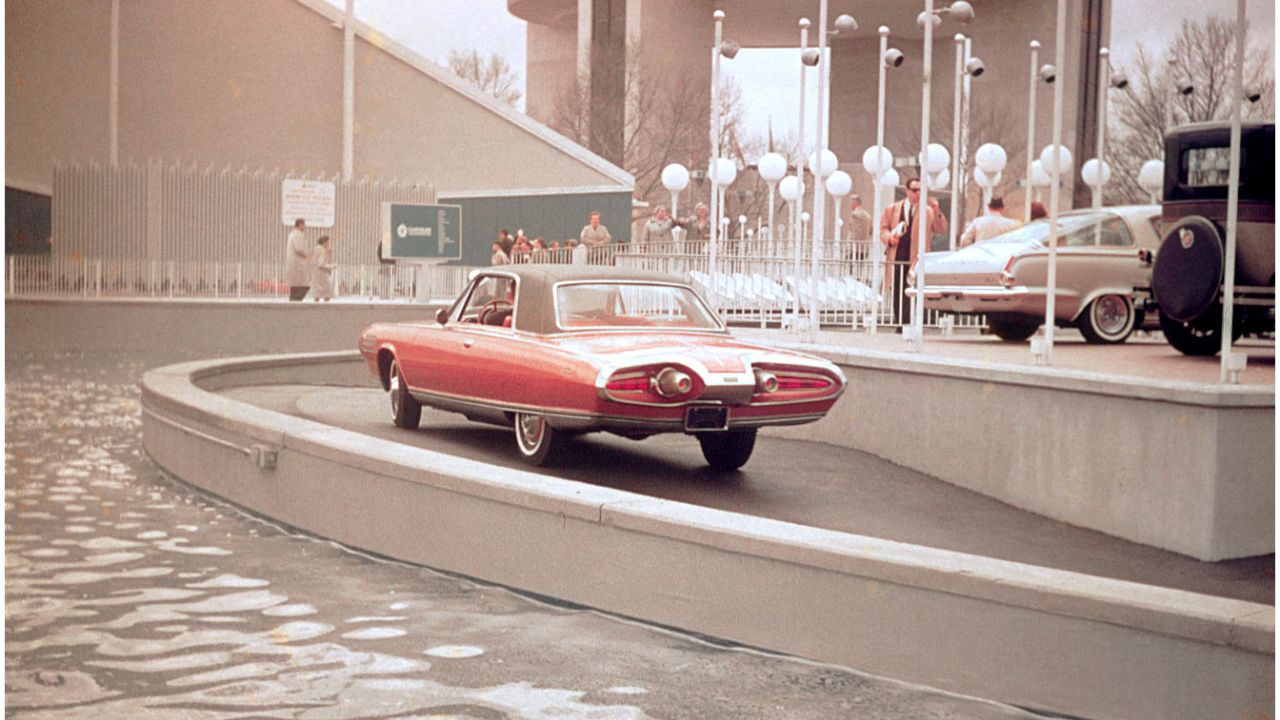
The 1964 Chrysler Turbine Car looked like it belonged in the future. Powered by a gas turbine engine instead of a conventional piston engine, it promised smooth operation, fewer moving parts, and the ability to run on a surprising variety of fuels. Despite generating enormous public excitement, the revolutionary concept never reached mass production, leaving one of the automotive industry’s most fascinating “what if” stories.
Chrysler Believed Turbines Could Change the Automobile
During the 1950s and early 1960s, Chrysler invested heavily in turbine engine research, believing the technology could eventually replace traditional internal combustion engines. Unlike piston engines with hundreds of moving parts, a gas turbine relied on a rotating compressor and turbine wheel, resulting in a much simpler mechanical design.
Engineers believed this simplicity could improve long-term reliability while reducing routine maintenance. Turbine engines also produced remarkably smooth power with very little vibration, creating a refined driving experience unlike that of conventional automobiles.
Perhaps most impressively, the engine could operate on a wide variety of fuels, including diesel, kerosene, jet fuel, and even certain vegetable-based oils. This flexibility attracted considerable attention during an era of rapid technological innovation.
The Turbine Car became Chrysler’s most ambitious attempt to prove that an entirely different type of engine could power everyday transportation.
A Public Test Program Produced Valuable Lessons
Rather than keeping the project confined to engineering laboratories, Chrysler launched one of the most unusual automotive experiments ever conducted. Beginning in 1963, the company loaned approximately 50 hand-built Turbine Cars to carefully selected American families for extended real-world evaluation.
Participants drove the cars during daily commutes, vacations, and ordinary errands while providing engineers with detailed feedback about performance and reliability. The program generated millions of miles of real-world experience, giving Chrysler valuable information that laboratory testing alone could never provide.
Many drivers praised the engine’s smooth acceleration, quiet operation at cruising speeds, and ability to start reliably in a wide range of weather conditions. The futuristic styling of the bronze-colored coupes also attracted widespread public curiosity wherever they traveled.
The experiment successfully demonstrated that ordinary drivers could comfortably operate a turbine-powered automobile.
Practical Challenges Outweighed the Advantages
Although the Turbine Car performed well in many respects, several important limitations prevented it from replacing piston engines. One of the biggest drawbacks was fuel economy, particularly in city driving. Turbine engines operated most efficiently at steady speeds but consumed significantly more fuel during frequent acceleration and stop-and-go traffic.
Throttle response also differed from that of conventional engines. Because the turbine needed time to build rotational speed, acceleration from a standstill was not as immediate as drivers expected from piston-powered cars.
Manufacturing costs presented another major obstacle. The engine required heat-resistant materials and highly precise manufacturing techniques that made production considerably more expensive than traditional automotive engines. At a time when buyers expected affordable family cars, those costs proved difficult to justify.
Growing emissions regulations also complicated the turbine’s future. Although the engine offered certain environmental advantages, meeting increasingly strict pollution standards would have required further expensive development.
An Innovative Idea That Still Influences Engineers
By the late 1960s, Chrysler concluded that conventional piston engines offered a more practical path for mass-market automobiles. The company ended development of passenger-car turbine programs, and most of the experimental vehicles were destroyed after testing concluded, making surviving examples exceptionally rare today.
Even though the Turbine Car never entered full production, the project demonstrated Chrysler’s willingness to challenge established engineering principles. Lessons learned from advanced materials, combustion systems, and manufacturing techniques influenced later automotive research, even if turbine power itself did not become commonplace.
Today, the few surviving Chrysler Turbine Cars remain among the most celebrated concept vehicles in automotive history. They represent a period when manufacturers were willing to pursue bold technological experiments in search of the next breakthrough.
Looking back, the 1964 Chrysler Turbine Car failed to replace piston engines not because the idea lacked promise, but because practical realities ultimately outweighed its remarkable innovations. It remains one of the automotive world’s most ambitious engineering experiments—and one of its most intriguing missed opportunities.
More from Fast Lane Only
- Unboxing the WWII Jeep in a Crate
- 15 rare Chevys collectors are quietly buying
- 10 underrated V8s still worth hunting down
- Police notice this before you even roll window down
*Research for this article included AI assistance, with all final content reviewed by human editors