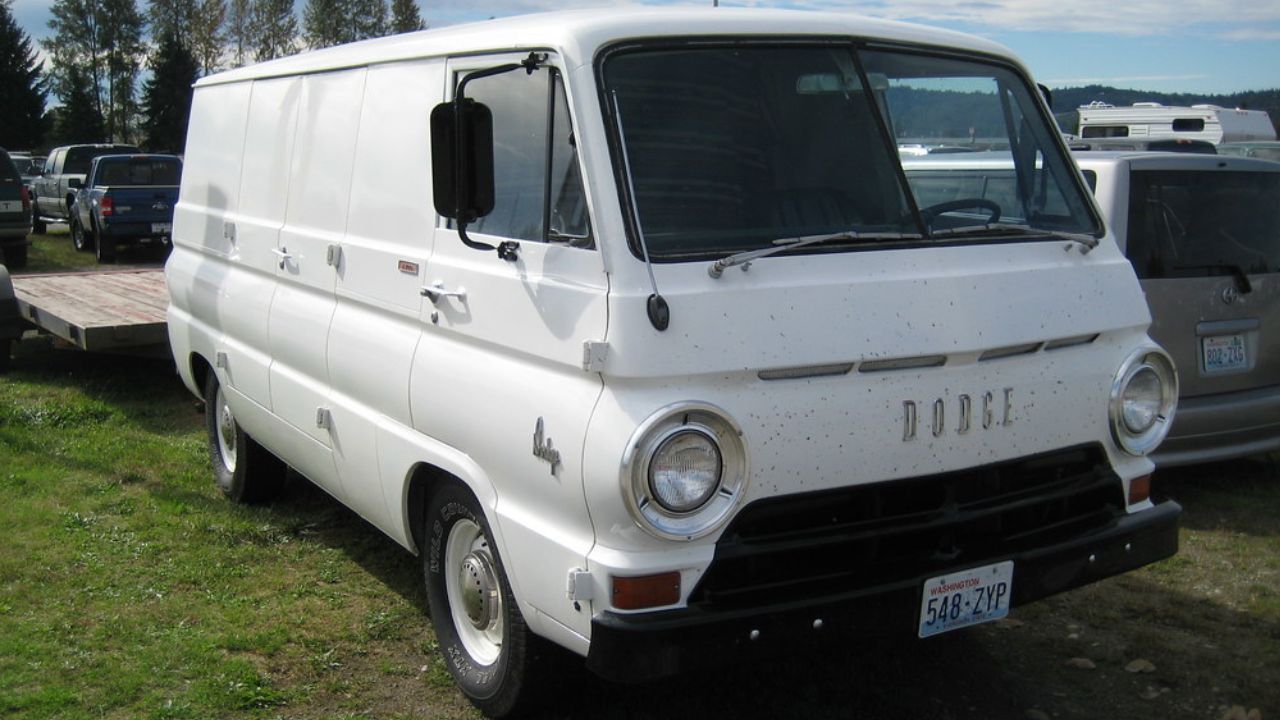
The Dodge A100 is often remembered for its distinctive forward-control styling and compact size, but its greatest contribution came in the commercial world. Introduced in the mid-1960s, the A100 became far more than a delivery van or pickup. Its adaptable design made it a popular platform for specialized work vehicles, serving businesses, municipalities, and service industries in ways that are often overlooked today.
A Compact Design That Maximized Working Space
The Dodge A100’s most distinctive feature was its forward-control layout, with the driver positioned above and slightly ahead of the front axle. By placing the engine between the front seats, Dodge eliminated the long hood found on conventional trucks and vans, freeing up valuable cargo space.
This efficient design allowed businesses to carry more equipment without increasing the vehicle’s overall length. In crowded urban areas, the A100’s compact footprint made it easier to park, maneuver through narrow streets, and access loading docks that larger commercial trucks struggled to reach.
The low cargo floor also simplified loading and unloading heavy tools, supplies, and merchandise. Workers spent less time lifting equipment, improving efficiency during busy workdays.
For companies making frequent stops, the A100 offered an ideal balance of practicality and maneuverability.
Businesses Adapted It for Countless Specialized Jobs
One reason the Dodge A100 became so versatile was its ability to accept numerous custom conversions. Equipment manufacturers transformed standard vans into service vehicles equipped with shelving, tool cabinets, electrical systems, and workbenches tailored to specific industries.
Electricians, plumbers, HVAC technicians, and appliance repair companies appreciated the organized storage space that kept tools secure while maximizing interior capacity. Mobile workshops became increasingly common, allowing technicians to perform repairs directly from the vehicle.
Some A100s were converted into bakery delivery vans, florist vehicles, and refrigerated transport units. Others served as maintenance trucks for factories, schools, and utility companies that required dependable transportation for both workers and equipment.
Its flexible interior made the A100 suitable for nearly any profession requiring a compact commercial vehicle.
Municipal Agencies Found It Surprisingly Useful
The A100 also earned a place in government and public-service fleets. Cities used the vans for parks and recreation departments, street maintenance, and public works operations where compact dimensions were especially valuable.
Telephone companies, electric utilities, and gas providers frequently equipped A100s with specialized storage systems for replacement parts, testing equipment, and service tools. Their small size allowed crews to reach residential neighborhoods and confined work areas more easily than larger trucks.
Some emergency organizations adapted the platform into communications vehicles, light rescue units, and support vans carrying medical supplies or disaster-response equipment. Although they lacked the capacity of larger emergency vehicles, they proved highly effective for specialized support roles.
These practical applications demonstrated that the A100 could perform far beyond ordinary cargo delivery.
A Legacy That Extended Beyond Delivery Vans
Production of the Dodge A100 lasted only a few years before newer van designs replaced it, yet its influence continued through the commercial vehicle market. It showed that a compact forward-control platform could successfully serve industries requiring efficiency, flexibility, and dependable operation.
Today, surviving A100s are popular among collectors, especially restored commercial examples that preserve their original working equipment and graphics. Former service vans, utility vehicles, and specialty conversions provide a fascinating glimpse into an era when businesses customized vehicles to meet highly specific needs.
The A100 also helped pave the way for later compact commercial vans by demonstrating the value of maximizing interior space without dramatically increasing vehicle size. Its innovative layout influenced how manufacturers approached commercial vehicle design for years afterward.
Looking back, the Dodge A100’s forgotten role in specialized commercial work was built on practicality rather than publicity. Whether serving repair technicians, utility crews, municipal workers, or small businesses, it quietly became one of the most adaptable commercial vehicles of its generation, proving that thoughtful engineering could support countless professions beyond simple cargo hauling.
More from Fast Lane Only
- Unboxing the WWII Jeep in a Crate
- 15 rare Chevys collectors are quietly buying
- 10 underrated V8s still worth hunting down
- Police notice this before you even roll window down
*Research for this article included AI assistance, with all final content reviewed by human editors