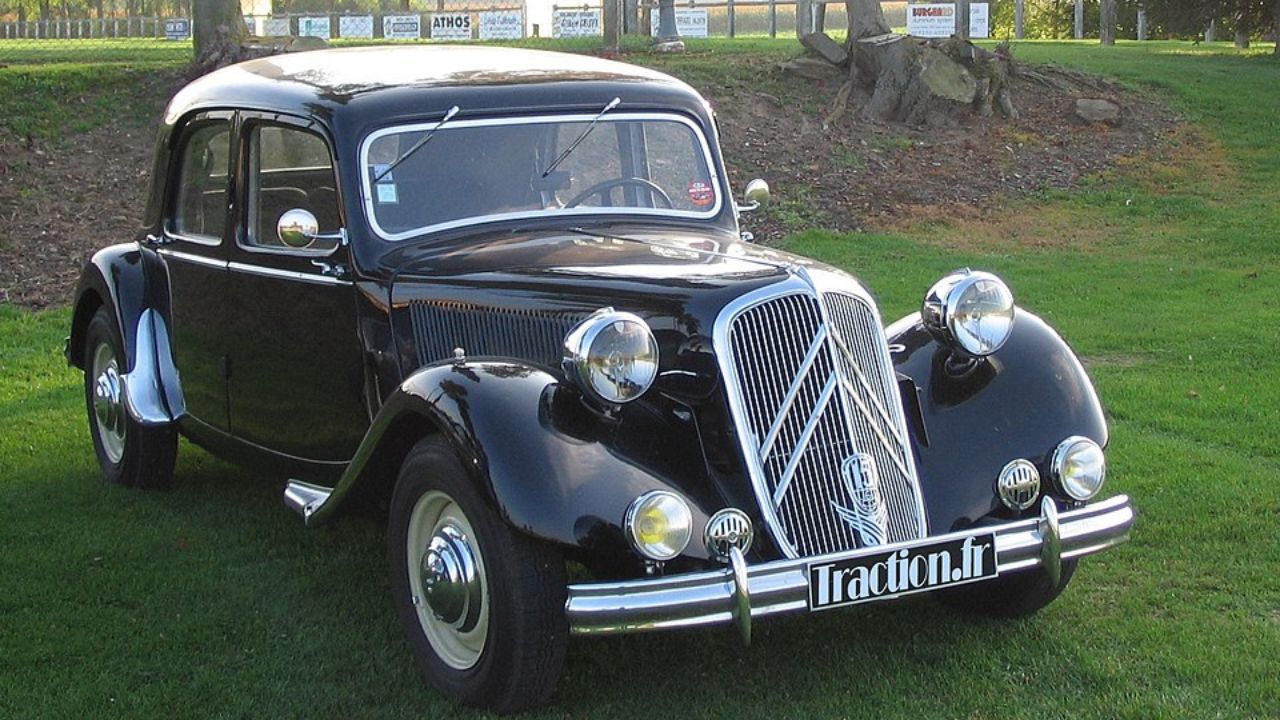
The Citroën Traction Avant arrived in 1934 as a family car that read like a concept sketch. While rivals still sat on separate frames with rear‑wheel drive and cart springs, this low, smooth saloon hid a welded monocoque, front‑wheel drive and torsion bars. The engineering was so radical that it nearly destroyed Citroën financially, yet it also set the pattern for mainstream cars for decades.
What first looked like a stylish French oddity turned out to be a blueprint. From structural layout to suspension and driving dynamics, the Traction Avant anticipated the modern hatchback more clearly than many cars built half a century later.
How the Traction Avant rewrote the car’s basic architecture
At the heart of the Traction Avant was a structural decision that separated it from its contemporaries. Instead of a ladder chassis with a bolted body, Citroën used an all‑steel monocoque shell. The body itself carried the loads, which allowed the car to sit much lower, save weight and feel stiffer on the road. Period rivals that still relied on separate frames simply could not match that combination of rigidity and packaging efficiency.
This new structure was not a styling trick. It enabled a flat floor, a lower roofline and a wider cabin, so occupants sat between the wheels rather than on top of them. That stance also improved handling, since the center of gravity dropped compared with tall, frame‑based saloons of the early 1930s. Modern testers who have driven well‑preserved examples describe how the car still feels unusually planted and precise for its age, a point echoed in contemporary impressions of the Traction Avant.
The second structural revolution sat at the front axle. By driving the front wheels, Citroën could move the engine and gearbox ahead of the passengers and free up rear space. The layout reduced the need for a bulky transmission tunnel and improved traction on wet or loose surfaces, since the driven wheels also carried the engine’s weight. Front‑wheel drive was not an absolute first in the world, but the Traction Avant was one of the earliest mass‑produced family cars to commit to it as a core design principle rather than an experiment.
Bringing these ideas together demanded new production methods. Large pressed panels had to be welded into a rigid shell with tight tolerances, at a time when many factories still relied on more artisanal body construction. The investment in tooling and training was enormous, which helps explain why so few rivals attempted anything similar in that decade.
Suspension, steering and brakes that anticipated the modern feel
The structural innovations only mattered because Citroën paired them with equally advanced running gear. Instead of leaf springs, the Traction Avant used independent front suspension with torsion bars. Each front wheel could move vertically without dragging the other with it, which improved grip and comfort on rough roads. Combined with the low body, this gave the car a level stance through corners that surprised drivers used to wallowing saloons.
At the rear, the car again used torsion bars and a layout that prioritized stability and ride quality. Hydraulic brakes on all four wheels, still far from universal at the time, delivered more consistent stopping power than mechanical systems. The steering, helped by the weight distribution of the front‑drive layout, felt lighter and more accurate than many rivals. Period road tests often remarked on the way the Traction Avant could be placed on the road with a precision that drivers did not expect from a family car.
The result was a driving experience that many later enthusiasts would describe as eerily modern. The car cornered flat, tracked straight at speed and could be driven briskly on twisting roads without the drama associated with tall, softly sprung contemporaries. In that sense, the unusual engineering was not abstract theory. It translated directly into how owners used the car every day.
What changed in car design because of Citroën’s 1934 gamble
Citroën did not invent every idea in the Traction Avant, but the company was among the first to package so many advanced concepts into a single mass‑market model. Over its production life, the car demonstrated that front‑wheel drive, monocoque construction and independent suspension were not fragile novelties. They could survive poor roads, indifferent maintenance and long distances in ordinary hands.
That proof of concept mattered. In the years that followed, other manufacturers gradually adopted similar architectures. By the second half of the twentieth century, unibody shells and front‑wheel drive had become the default for compact and mid‑size cars. The Traction Avant showed that a low, integrated body could be both stylish and practical, which encouraged designers to move away from separate fenders and upright grilles toward more cohesive forms.
The car’s influence can be seen most clearly inside Citroën’s own range. The later DS, often celebrated for its hydraulics and aerodynamics, built on the structural and layout lessons learned from the Traction Avant. The company’s decision to celebrate eighty years of the model with a detailed retrospective of its engineering and styling underlines how central it remains to Citroën’s identity.
Beyond the brand, the Traction Avant helped normalize the idea that a family car could prioritize roadholding and active safety rather than simply durability. Its low stance, strong brakes and predictable handling were early steps toward the modern notion of passive and active safety as selling points.
Why this 1930s engineering experiment still matters
For current designers and engineers, the Traction Avant offers a case study in how to use a bold technical package to create a new market position. Citroën did not just add a feature or two. The company rethought the entire layout of a family car, then committed to it in volume production. That level of risk is rare, yet it is often what moves the industry forward.
The car also illustrates the tension between innovation and financial stability. The investment in tooling for the monocoque body and front‑drive hardware strained Citroën’s resources. The company faced serious financial trouble soon after launch, even as the car’s engineering drew praise. Modern manufacturers weighing electric platforms, new battery chemistries or advanced driver assistance systems confront similar trade‑offs between ambition and cost.
From a cultural perspective, the Traction Avant shows how engineering can shape a car’s image for generations. Its low, almost gangster‑like silhouette, made possible by the structural layout, created a visual identity that still resonates with enthusiasts. That image was not a marketing afterthought. It flowed directly from the decision to put the bodywork in charge of carrying loads and to drive the front wheels.
For owners and restorers, the car’s unusual construction presents both challenges and rewards. Repairing a monocoque that has suffered corrosion requires different skills from patching a separate frame, and sourcing correct suspension and steering parts can be complex. At the same time, a well‑sorted Traction Avant offers a driving experience that bridges eras, with prewar charm and unexpectedly modern responses.
What comes next for understanding and preserving the Traction Avant
As the Traction Avant ages into deeper classic status, its future lies in preservation, documentation and reinterpretation. Specialist clubs and archives are cataloguing factory drawings, period photographs and engineering notes to ensure that the story of its design remains accessible. That work helps restorers return cars to original specification and gives historians a clearer view of how such a radical project came together inside Citroën.
On the road, surviving examples are likely to become more visible at major historic events and museum collections. Curators increasingly use the Traction Avant to explain the transition from coachbuilt bodies to integrated shells, and from rear‑wheel drive to front‑wheel drive in everyday cars. As electric platforms make flat floors and flexible packaging normal again, the parallels with the 1934 Citroën grow more obvious.
More from Fast Lane Only
- Unboxing the WWII Jeep in a Crate
- 15 rare Chevys collectors are quietly buying
- 10 underrated V8s still worth hunting down
- Police notice this before you even roll window down
*Research for this article included AI assistance, with all final content reviewed by human editors