The Pontiac Can Am is one of those muscle-era curiosities that existed for a single model year yet still commands serious attention in today’s collector market. Built off the LeMans platform and dressed with Trans Am attitude, it was produced in small numbers and disappeared almost as quickly as it arrived, a combination that now shapes both its mystique and its price.
Understanding exactly when Pontiac built the Can Am, how many were made, and what they trade for today helps explain why this short-lived option package has become a benchmark for 1970s performance cars. I will walk through the production story, the rarity, and the latest value data so buyers and sellers can gauge where this niche Pontiac fits in the broader classic-car landscape.
How long Pontiac built the Can Am
The Pontiac Can Am was not a multi-year nameplate but a one-shot experiment tied specifically to the 1977 model year. Rather than a standalone model, it was a special version of the fourth-generation Pontiac LeMans, created to inject some performance credibility into the lineup at a time when emissions rules and fuel concerns were reshaping American muscle. Market data that groups the Pontiac Can Am strictly as “1977 to 1977” confirms that the car’s official production window was confined to that single year, with no factory Can Am offered before or after that run.
That tight timeframe matters because it separates the Can Am from other Pontiac performance badges that evolved over several years. While the Pontiac Firebird Trans Am, for example, carried on through multiple model years and trim variations, the Can Am’s identity is locked to 1977 LeMans underpinnings and a specific combination of graphics, shaker scoop and drivetrain. Contemporary coverage of the car’s history describes it as a limited production run of the LeMans, and current valuation tools list only the 1977 Pontiac LeMans Can Am when breaking out prices, reinforcing that collectors are dealing with a one-year-only package rather than a broader series.
Production numbers and why the Can Am is rare
Rarity is central to the Can Am story, and the production figures help explain why the car still flies under the radar for many enthusiasts. Owners and historians often point out that the car is “underappreciated just because 80% of people have no idea it was ever a production car,” a sentiment that underscores how quickly it came and went. In the same discussion, they cite that the “77 Can Am, only 1,377 made,” a figure echoed elsewhere as “1,377 units” built before production ended early due to supply issues. That combination of a single model year and roughly 1,377 examples gives the Can Am a level of scarcity that many better-known muscle cars cannot match.
Context from broader Pontiac production in the mid 1970s shows just how small that number is. Reporting on the brand’s lineup notes that the Grand Prix was on track for “almost 290,000 units” delivered in a strong year, while the LeMans itself was being prepared for a redesign. Against that backdrop, a run of about 1,377 Can Ams looks more like a limited experiment than a mainstream product. Later commentary on the car’s legacy describes it as one of the last true muscle offerings of its era, with its short production and distinctive appearance contributing to a cult following that has only grown as surviving cars age and parts become harder to source.
What defines a 1977 Pontiac Can Am
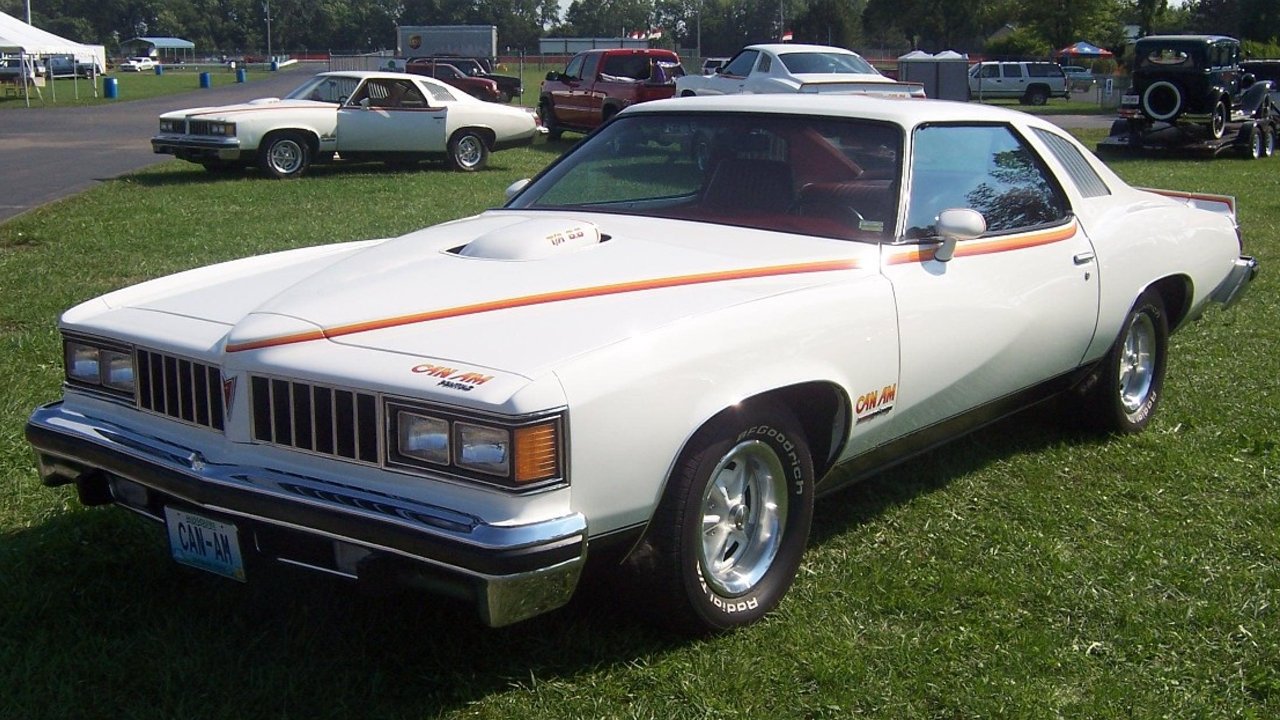
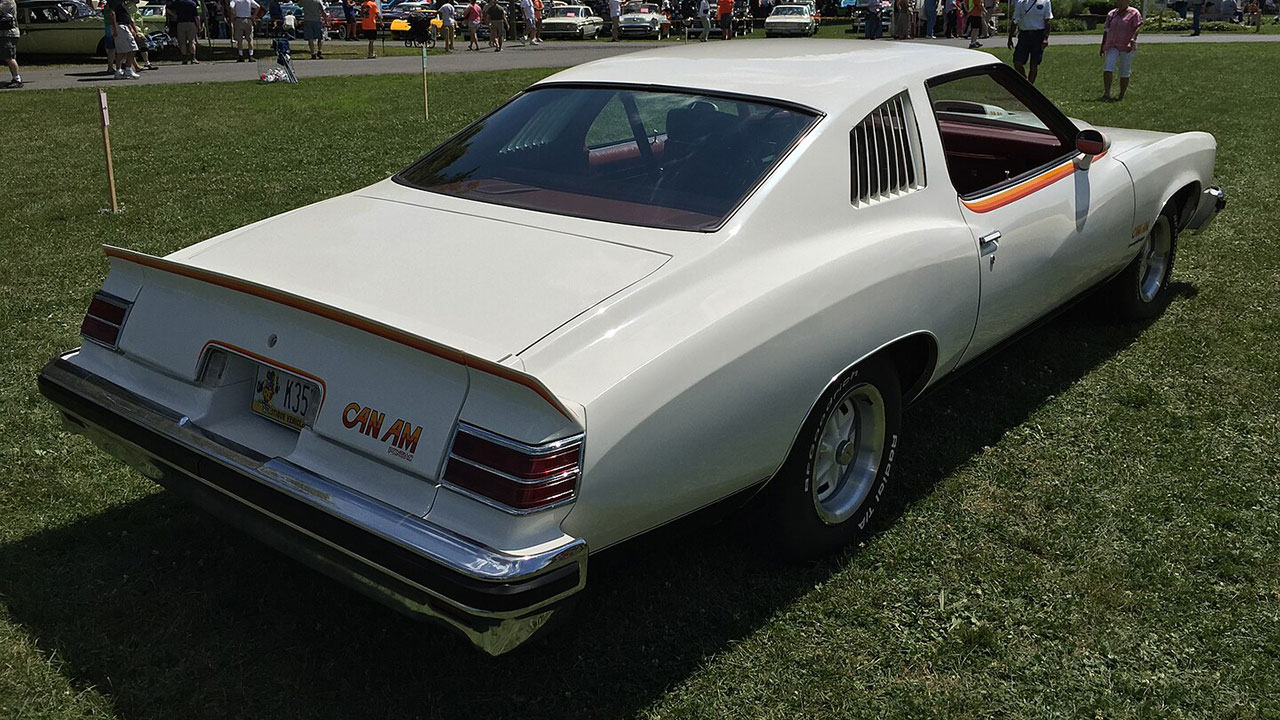
To understand current prices, it helps to be clear about what buyers mean when they talk about a Pontiac Can Am. The car is formally cataloged as a 1977 Pontiac LeMans Can Am, and valuation tools treat it as a specific configuration within the LeMans family rather than a separate model line. Period-style descriptions highlight its Cameo White paint, bold orange, red and yellow graphics, a Trans Am shaker scoop protruding through the hood, a ducktail rear spoiler and color-matched Rallye II wheels. Under the skin, it carried a “real” Pontiac 400 V8 rated at 200 horsepower, a meaningful figure in the late 1970s context.
Driving impressions from enthusiasts emphasize that the Can Am was more than just a decal package. Reports on “Braking and Ride” describe power assisted brakes that provided decent stopping power and a suspension tuned for a balance between comfort and control, characteristics that made the car usable on both city streets and highways. Modern video features that revisit surviving examples frame the Can Am as a “very rare Pontiac” and walk through its unique mix of LeMans practicality and Trans Am-inspired performance cues. All of this reinforces that when collectors pay a premium for a Can Am, they are buying a specific 1977 recipe of styling, drivetrain and equipment rather than a loosely defined trim name.
Current value benchmarks for the Pontiac Can Am
On the pricing front, the Pontiac Can Am has matured into a recognized niche within the classic-car market, with dedicated benchmarks tracking its performance. A focused market overview lists the Pontiac Can Am as a 1977-only entry and assigns it a specific average transaction figure, noting that the “average” price for a Pontiac Can Am is “$37,703.” That number comes from The CLASSIC, COM, Market Benchmark, often abbreviated as the CMB, which aggregates recent sales to produce a representative value for vehicles in this segment. The benchmark is not a fixed price tag for every car, but it does give buyers and sellers a data-driven starting point.
More granular guidance comes from valuation tools that break the car out as the 1977 Pontiac LeMans Can Am and answer “Common Questions” such as “How much is a 1977 Pontiac LeMans Can Am worth?” Those tools stress that value “can vary greatly” depending on condition, originality, mileage and documentation, and they track both private and auction sales to stay current. Industry voices encourage enthusiasts to “visit” these valuation resources for the most detailed and up to date information, pointing out that they include historical charts, condition ranges and recent sale examples. For anyone actively shopping, the combination of a CMB average and condition-based value tiers offers a clearer picture than anecdotal asking prices alone.
How Can Am prices compare with other 1970s Pontiacs
To put the Can Am’s roughly $37,703 benchmark in perspective, it helps to compare it with other 1970s Pontiacs that share similar DNA. Coverage of the 1977 Pontiac Firebird Trans Am notes that a “Trans Am In Good Condition Costs Less Than $25,000,” with used market data showing typical prices under that $25,000 mark for solid driver-quality cars. That means the average Pontiac Can Am currently trades at a noticeable premium over a comparable 1977 Pontiac Firebird Trans Am, despite the Firebird’s higher profile in popular culture. The gap reflects the Can Am’s rarity and its appeal to collectors who prioritize low production numbers and period-correct details.
Market analysts also point out that the classic car world increasingly relies on structured “analysis” and digital tools to understand pricing trends. Guidance for sellers highlights how the classic car market “benefits tremendously from data-driven decision-making” and urges them to “Utilize” platforms like “Hager” style valuation and market analysis tools to inform pricing strategies and inventory decisions. In that context, the Pontiac Can Am’s dedicated CMB figure and its separate listing in valuation databases signal that it has enough transaction volume and collector interest to justify its own category, rather than being lumped in with ordinary LeMans coupes.
What drives demand for the Can Am today
Beyond raw numbers, demand for the Pontiac Can Am is shaped by its story and by how enthusiasts perceive late 1970s performance cars. Commenters who call it “one of the most unique and rare muscle cars of the late” period emphasize that it represents a bridge between the high-horsepower glory days and the more restrained, emissions-conscious era that followed. The fact that only about “1,377 units” were produced, and that production ended early due to supply constraints, adds a sense of what might have been if the package had continued. Modern social posts that describe its “limited production and distinctive features” note that this combination has made the 1977 Pontiac Can Am “a sought” after collectible.
Ongoing interest is also visible in enthusiast projects and media. A recent video feature titled around a “Pontiac Can Am Revival” walks viewers through the process of bringing a long-dormant example back to life, underscoring how owners are willing to invest time and money into preserving these cars. Community groups dedicated to the model share details on production numbers, restoration tips and period-correct parts, reinforcing the idea that the Can Am has moved from obscure option package to recognized classic. When a car inspires that level of engagement, it tends to support values over the long term, especially when the supply of original cars is fixed and relatively small.
How buyers and sellers can approach the Can Am market
For anyone considering a Pontiac Can Am today, the key is to combine the car’s historical context with current data. On the history side, it is clear that the Can Am was a 1977-only package built in roughly 1,377 examples, positioned as a performance-oriented LeMans with distinctive styling and a 200 horsepower Pontiac 400. On the data side, The CLASSIC, COM, Market Benchmark pegs the average price at $37,703, while detailed valuation tools for the 1977 Pontiac LeMans Can Am show how that figure spreads across different condition levels. Together, those pieces help frame realistic expectations before stepping into negotiations.
Buyers and sellers who want to go deeper can lean on the same kind of structured “analysis” that broader classic car marketing advice recommends. That means tracking recent auction results for the Pontiac Can Am, comparing them with private sale listings, and watching how the CMB and other benchmarks move over time. It also means paying close attention to originality, documentation and mechanical health, since those factors can swing a Can Am’s value far above or below the average. In a market where 80% of people may still not recognize the car at first glance, the informed minority that does understand its story and its numbers is in the best position to make smart deals.