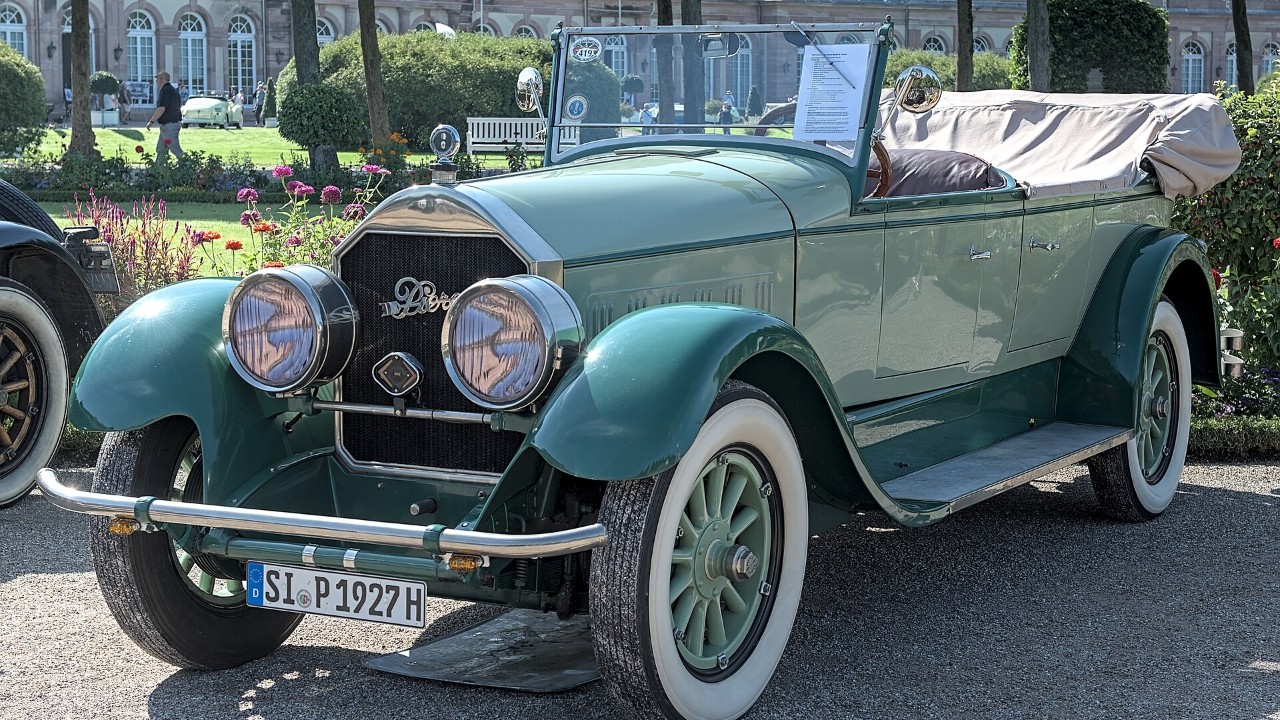
The 1956 Packard Caribbean arrived as a last, lavish attempt to prove that Packard Motor Car Company of Detroit still belonged at the top of the American luxury market. Packed with technology, drenched in chrome and color, and priced to signal exclusivity, it was meant to steady a brand that had once defined prestige but was now fighting for survival. Instead, the Caribbean became a rolling epitaph for a luxury empire that could not outrun its own structural problems.
From halo car to last stand
Packard had already turned to the Caribbean nameplate once before as a statement of intent. Earlier in the decade, the company created the semi-custom 1953 Caribbean to re-declare its leadership in luxury at a time when Packard was lagging in style and engineering, using a limited-production convertible to show that it could still build a glamorous flagship that rivaled anything from Detroit. By the middle of the 1950s, that strategy evolved, and beginning in 1954, the Caribbean was elevated to senior Packard status and was related to the Packard Pacific hardtop, which positioned it firmly at the top of the company’s hierarchy of Senior Packards.
By 1956, the Packard Caribbean was a full-sized luxury car that was made by the Packard Motor Car Company of Detroit, and it carried the burden of representing the entire brand’s future. The car sat alongside other senior Packards that shared key styling cues, including a front end where All 1956 senior Packards moved the Packard crest to the front of the hood, leaving the circle-V emblem in the grille. That visual realignment underscored how the Caribbean was meant to be the face of Packard’s high-end ambitions, even as internal financial strain and a shrinking dealer network were already eroding the foundation beneath that glossy image.
Design drama and limited numbers
The 1956 Packard Caribbean leaned heavily on visual theater to justify its place as the company’s most expensive offering. The Caribbean was treated as a halo model within the broader Packard range, with elaborate trim, distinctive rear styling, and a level of ornamentation that separated it from more conservative sedans. The car’s relationship to other senior Packards, including the Packard Pacific lineage that had helped define its earlier form, meant that it combined familiar Packard proportions with a more extroverted personality, using color and chrome to signal that this was not just another upper-middle-class car but a flagship aimed at the same clientele that once bought chauffeur-driven Packards.
Exclusivity was not just a marketing line, it was baked into the production numbers. Sadly, only a handful of Packard Caribbean Convertibles were produced for 1956, a mere 276 of these distinctive automobiles were made, a figure that underlined both the car’s rarity and the company’s constrained resources. That tiny run, combined with the Caribbean’s position as a senior Packard, turned the model into a collector’s prize in later decades, but at the time it also reflected how far the company had fallen from the days when Packard could build luxury cars in far greater volumes. The 1956 Caribbean’s scarcity was a symptom of a shrinking empire, not the deliberate scarcity of a healthy luxury brand.
Technology as a survival strategy
Packard tried to fight its way back to relevance by leaning on engineering, and the 1956 Packard Caribbean became the showcase for that effort. On the technology side, the senior Packards of this period were fitted with powerful new engines that were only part of the story, because the company also introduced an innovative new suspension using torsion bars instead of traditional springs. Packard’s last major development was the William Allison-invented Torsion-Level suspension, an electronically controlled four-wheel system that automatically adjusted ride height to keep the car level, which gave the Caribbean a ride quality that was both technically advanced and distinct from its rivals.
The drivetrain also carried Packard’s bid to stay ahead. Packard Factoids highlight how Caribbean gets a hardtop and more power, and how the company promoted an Ultramatic Transmission Push Button Selector as a modern convenience that matched the car’s luxury billing. The 1956 Caribbean combined that push-button automatic with its sophisticated suspension and senior Packard V-8 power to create a technical package that, on paper, could compete with the best from other American luxury makers. In engineering terms, the car justified its status as the last of the line for “real” Packards, but the sophistication under the skin could not by itself repair the company’s balance sheet or its eroding market share.

Inside the senior Packard hierarchy
To understand why the 1956 Packard Caribbean mattered so much, it helps to see how it fit into the company’s internal pecking order. The Caribbean sat at the top of the Senior Packards, a group that had been carefully cultivated since the early 1950s as Packard tried to climb back up the luxury ladder. The product mix that had done fairly well in 1953 continued into the middle of the decade, with senior models carrying more elaborate trim, more powerful engines, and more advanced features than the company’s lower-priced offerings. Within that structure, the Caribbean was the most visible expression of Packard’s claim that it still belonged in the same conversation as the most prestigious American brands.
Styling details reinforced that hierarchy. All 1956 senior Packards moved the Packard crest to the front of the hood, leaving the circle-V emblem in the grille looking somewhat secondary, a subtle cue that the crest itself was the true badge of senior status. The Caribbean shared this front-end identity while adding its own touches, including unique color treatments and trim that set it apart from models like the Packard Four Hundred. By tying the Caribbean so closely to the broader family of senior Packards, the company tried to create a coherent luxury story, but the overlap in mechanical components and the limited differentiation in some areas also hinted at how thinly stretched Packard’s development budget had become by the time the 1956 cars reached showrooms.
Why a brilliant flagship could not save Packard
Even as the 1956 Packard Caribbean showcased some of the most advanced engineering and most dramatic styling the company had ever offered, the broader context was unforgiving. Analysts of the period have described how, by the mid 1950s, the huge factory was literally too big for the company’s shrunken output, a physical reminder that Packard’s scale no longer matched its ambitions. Accounts of the period describe 1956 as the end of the luxury road for the traditional Packard operation, with the Caribbean and its senior Packard siblings representing the last of the “true” Packards before the name would be applied to very different cars. The Caribbean’s technical highlights, from the Torsion-Level suspension to the Ultramatic Transmission Push Button Selector, could not offset the financial drag of underused facilities and a thinning dealer network.
Looking back, I see the 1956 Packard Caribbean as a car that distilled both the brilliance and the blind spots of its maker. The company had already used the Caribbean name once, when Packard created the semi-custom 1953 Caribbean to re-declare its leadership in luxury, and Beginning in 1954 the Caribbean was elevated to senior Packard status to reinforce that message. By the time the 1956 model arrived as a full-sized luxury car made by the Packard Motor Car Company of Detroit, the strategy had become a high-stakes gamble on a single, spectacular flagship. The car’s rarity, with only 276 Packard Caribbean Convertibles built, and its position among the last senior Packards, turned it into a symbol of how a storied luxury empire tried to innovate its way out of decline, only to discover that even the most advanced suspension and the most ornate trim could not overcome years of strategic and financial missteps.
More from Fast Lane Only: