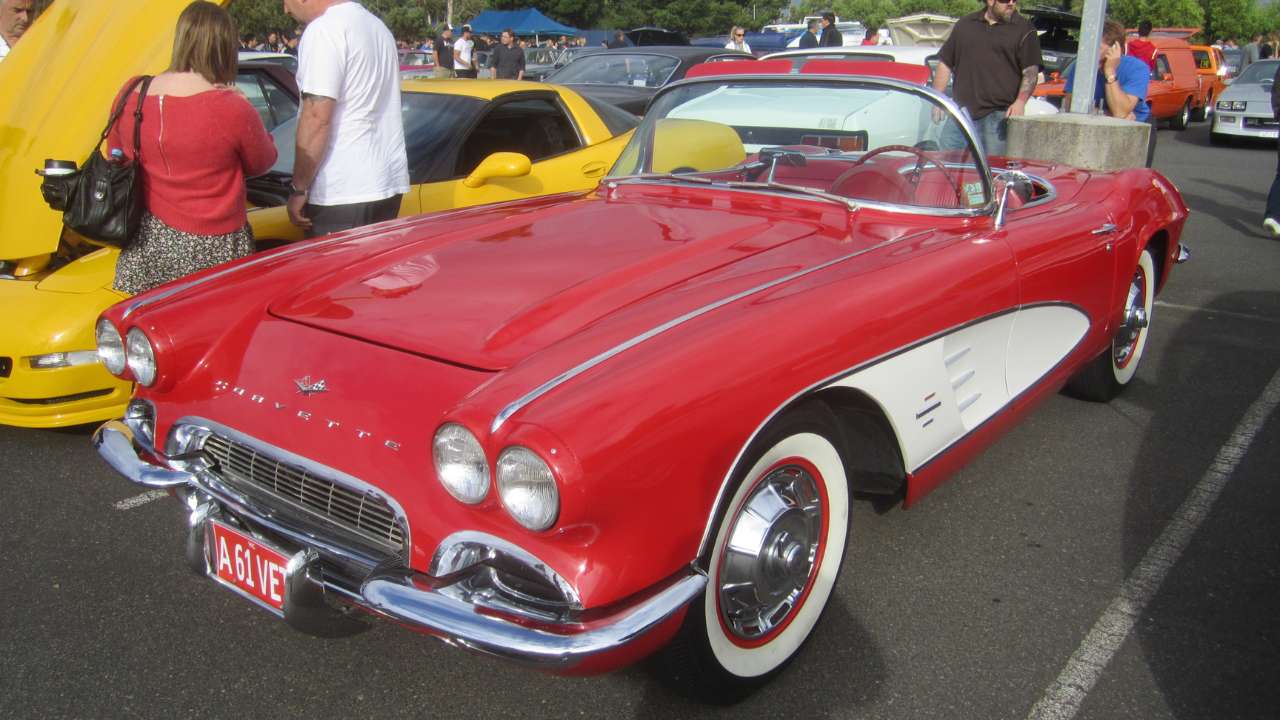
When people think of the Chevrolet Corvette today, they picture one of America’s greatest sports cars. However, its success was never guaranteed. In its earliest years, weak sales, limited performance, and changing customer expectations nearly convinced Chevrolet to end the project before the Corvette had the chance to become an automotive icon.
A Slow Start Nearly Ended the Dream
The first Chevrolet Corvette debuted in 1953 with plenty of excitement but struggled to meet buyer expectations. Its fiberglass body attracted attention, yet the six-cylinder engine and automatic transmission failed to deliver the performance many sports car enthusiasts wanted. At a time when European roadsters were becoming more exciting, the Corvette seemed stylish but underpowered.
Sales reflected those shortcomings almost immediately. Chevrolet produced only a small number of Corvettes during its first year, and many remained unsold for months. Executives questioned whether there was enough demand for an American sports car, leading some within General Motors to consider canceling the Corvette program entirely.
The disappointing reception forced Chevrolet to reevaluate its strategy. Engineers realized that appearance alone would not keep the car alive. Buyers expected speed, handling, and excitement, qualities that the original model struggled to provide.
Without significant improvements, the Corvette might have disappeared after only a few years. The project stood at a crossroads, with its future depending on whether Chevrolet could transform it into the sports car customers truly wanted.
Performance Finally Changed Everything
Chevrolet responded by introducing a powerful V8 engine in 1955, dramatically changing the Corvette’s personality. The additional horsepower made the lightweight sports car much quicker and more competitive with both domestic and European rivals. Performance became the Corvette’s defining strength rather than its greatest weakness.
Engineers also paired the V8 with a manual transmission, giving drivers greater control and a more engaging experience. These improvements appealed to enthusiasts who wanted a genuine sports car instead of a stylish cruiser. The Corvette finally began earning respect for its driving abilities.
Positive reviews and stronger customer interest gradually reversed the Corvette’s fortunes. Instead of being viewed as an expensive experiment, it started building a loyal following among performance-minded drivers who appreciated its growing capabilities.
The combination of better engineering and stronger marketing proved that the Corvette could compete on a larger stage. Chevrolet had found the formula needed to keep the car alive.
Competition Forced Chevrolet to Improve
The arrival of the Ford Thunderbird added new pressure during the mid-1950s. Chevrolet suddenly faced another American manufacturer competing for sports car buyers. While the Thunderbird leaned toward luxury, its popularity reminded Chevrolet that standing still was not an option.
Rather than abandoning the Corvette, Chevrolet invested even more heavily in its development. Engineers improved suspension tuning, increased engine output, and refined the overall driving experience. Each new generation demonstrated a stronger commitment to performance and innovation.
This competitive environment encouraged constant progress. Instead of settling for modest improvements, Chevrolet treated every update as an opportunity to prove the Corvette belonged among the world’s respected sports cars.
The rivalry ultimately benefited consumers. Continuous development transformed the Corvette from a struggling newcomer into a machine capable of challenging far more expensive performance cars.
The Corvette Became Chevrolet’s Greatest Success Story
By the early 1960s, the Corvette had completely changed its reputation. The second-generation Sting Ray introduced striking styling, improved handling, and powerful engine options that established the Corvette as a serious performance car. Sales increased, and the model became a symbol of American automotive engineering.
What nearly became a canceled experiment evolved into one of the longest-running nameplates in automotive history. Every new generation built upon lessons learned during those difficult early years, reinforcing the Corvette’s identity as Chevrolet’s flagship sports car.
Today, collectors value even the earliest Corvettes because they represent the beginning of a remarkable journey. The challenges Chevrolet faced during the 1950s ultimately shaped a stronger and more capable sports car.
The Corvette’s survival serves as a reminder that many legendary automobiles come close to failure before achieving lasting success. Chevrolet’s decision to continue investing in the project created an icon that has endured for generations.
More from Fast Lane Only
- Unboxing the WWII Jeep in a Crate
- 15 rare Chevys collectors are quietly buying
- 10 underrated V8s still worth hunting down
- Police notice this before you even roll window down
*Research for this article included AI assistance, with all final content reviewed by human editors